

Chapter 8: Building Blocks in Economics: The Problem of Choice
You cannot have everything — so how do people, firms and governments choose wisely?
Original notes — ready CBSE (NCERT, English Medium) • Class 9 • Social Science • Book: Understanding Society: India and Beyond — Part 1
Chapter 8: Building Blocks in Economics: The Problem of Choice — EG's own notes, in simple words
Book: Understanding Society: India and Beyond — Part 1 (CBSE, Class 9) | Chapter 8 | Medium: English
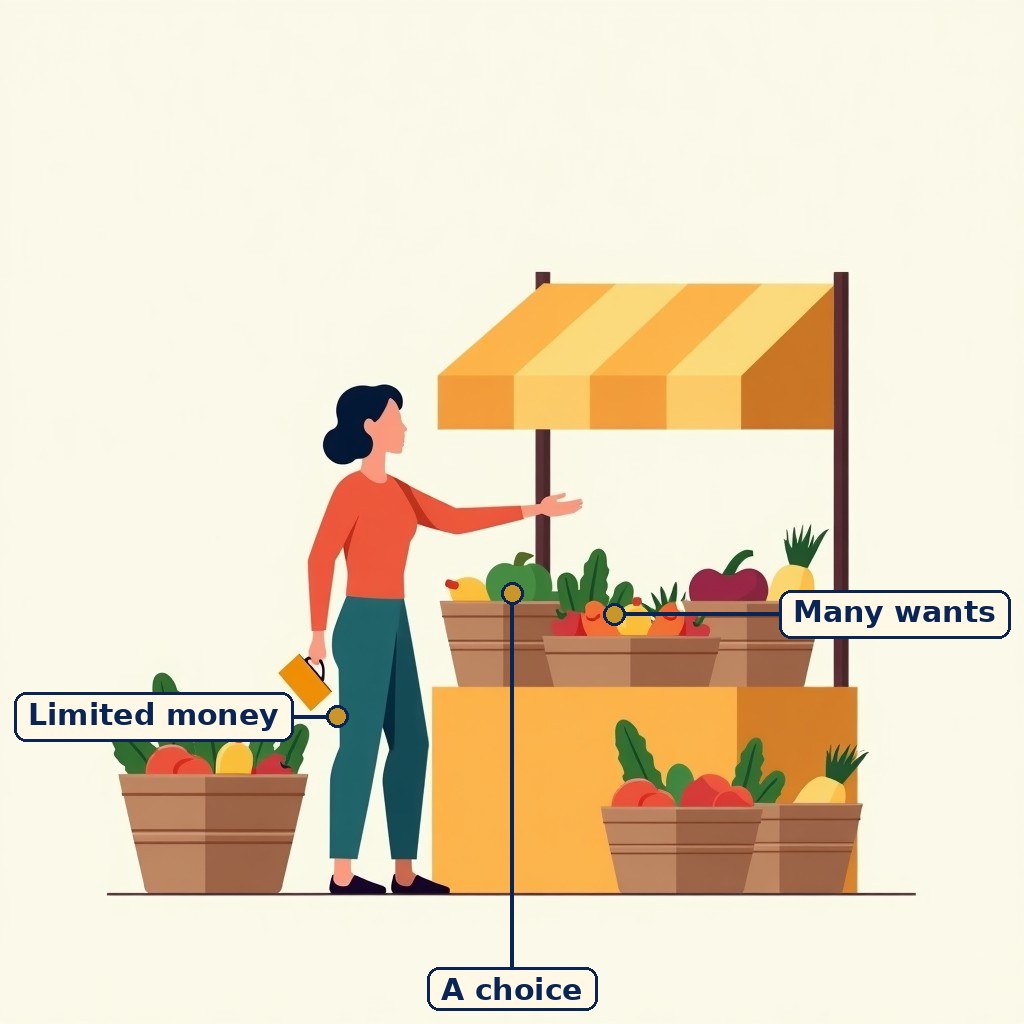
Diagram (labels are printed on the image): A shopper choosing among many wants with limited money. A general picture of choice, not a scene from the book.

A family deciding what to buy at a market stall. A general picture of household choice, not a book scene.
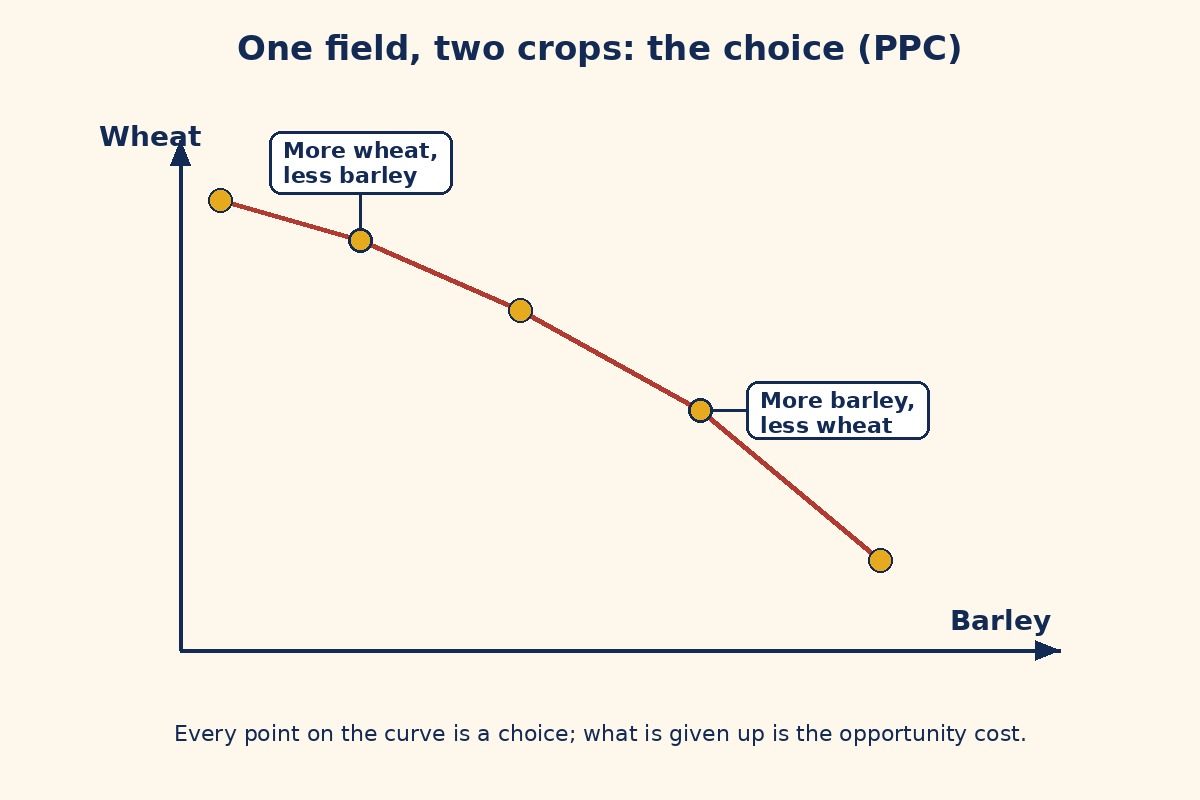
New diagram (labels are printed on the image): One field, two crops — the production possibility curve. Every point on the curve is a choice: more wheat means less barley, and vice versa. Gold dots sit on the curve's points; what is given up is the opportunity cost.
What the chapter is about
Every day, everyone chooses: pocket money on snacks or saved for shoes? Five copies of a storybook for twenty students — who gets them first, or should the school buy more? Which crop should a farmer grow, given soil, rainfall and market demand? More labour or more capital in a factory? Highways or hospitals for the government? These are economic choices, and they arise from one root problem: human wants are unlimited and keep changing (bicycle → motorbike → car), while resources are limited and have alternative uses. Economics is the discipline that studies how individuals, enterprises and governments make these choices — and how to make them well, using data and analysis rather than guesswork, and weighing short-term gains against long-term consequences.
Needs, wants and scarce resources
Needs are essentials such as food, water and shelter; wants are things like gadgets, vacations or luxury items. Wants are unlimited, and they change as incomes, fashions and technology change. Resources (factors of production) — land, labour, capital and technology — are used to produce goods and services, but they are limited in quantity and can be put to many alternative uses. The same steel can become aircraft parts or something else; the same money can buy fruit or a pair of shoes; the same land can grow barley or wheat. Because resources are scarce and wants are not, every economy must choose — and every choice means giving something up.
Opportunity cost and the production possibility curve
When one alternative is chosen, the value of what is given up is the opportunity cost. A farmer with limited land, water and labour who grows wheat gives up the barley that land could have grown; the opportunity cost of the wheat is that barley. A student with ₹100 who buys a notebook gives up saving towards a tennis racket later; the racket is the opportunity cost of the notebook. Economists picture this trade-off with the production possibility curve (PPC): all the points on the curve show the maximum combinations of two goods (say, barley and wheat) an economy can produce with its given resources and technology. Moving along the curve means producing more of one good only by producing less of the other. Points inside the curve mean resources are underused; points outside it are unattainable without more resources or better technology. The PPC is therefore a picture of scarcity and choice in one diagram.
The three central questions of every economy
Every economy — household, firm or country — must answer three questions. What to produce? Which goods and services, and in what quantities — food or phones, schools or stadiums? How to produce? With which methods and combinations — more labour or more capital and automation, depending on costs, technology and the nature of the product? For whom to produce? Who gets the output — how is income and wealth distributed, and who can afford what? How a society answers these three questions defines its economic system. Good decisions also need data: economists study alternatives, opportunity costs and outcomes using government reports such as economic surveys and financial data, so that choices rest on evidence rather than hunches.
Three economic systems — and why pure systems rarely exist
In a market economy, private individuals and enterprises own resources and decide what, how and for whom to produce, guided by prices and the profit motive, with little government intervention; competition among many producers offering similar products keeps prices in check. In a planned (command) economy, the government (for example through a planning commission) makes all major decisions, owns much of production, and directs resources through plans, permits and licences — but restricting competition and private choice. In a mixed economy, private and public sectors coexist: markets and private ownership operate with government regulation, and large public sector companies play an important role alongside private firms, while the government provides infrastructure, health, education and welfare. In reality, most economies are mixed, because pure systems have clear limits: pure markets can ignore fairness, public goods and the environment, while pure planning can stifle innovation, choice and efficiency. India illustrates the mixed path: after independence it relied heavily on planning and the public sector, but by 1991 it faced serious economic difficulties and moved towards a more market-based mixed economy, keeping an important role for government — a balance the next chapter (on markets and prices) explores further.
Choices, the future and the environment
Economic choices are not only about today. A country that spends everything now may have nothing for tomorrow; a decision to cut forests for quick income may destroy the soil, water and climate that farming needs later. Constant desire for more also pressures the environment: fulfilling unlimited wants by extracting resources without limit depletes them and damages nature. That is why the chapter insists on weighing future consequences — sustainable choices that meet present needs without harming future generations' ability to meet theirs — and on using data to compare alternatives honestly, including their opportunity costs. A choice that looks cheap today can be expensive tomorrow, and a choice that looks costly today (protecting a forest, educating a child) can be the most valuable one in the long run.
What you should learn
After this chapter you should be able to: distinguish needs from wants and explain why wants are unlimited and changing; explain scarcity and the factors of production; define opportunity cost with a personal and a farming example; draw and explain the PPC (points on, inside and outside the curve); state the three central questions; compare market, planned and mixed economies with strengths and limits; explain India's shift towards a mixed economy around 1991; and argue why decisions need data and must weigh future and environmental consequences.
Key Terms
- Needs / wants — Needs: essentials like food, water, shelter. Wants: desires like gadgets, vacations, luxury items; unlimited and changing.
- Resources (factors of production) — Land, labour, capital and technology used to produce goods and services; limited in quantity, with alternative uses.
- Scarcity — The basic economic problem: limited resources against unlimited wants, forcing choice.
- Opportunity cost — The value of the next-best alternative given up when a choice is made.
- Trade-off — Giving up one thing to get another, because resources are limited.
- Production possibility curve (PPC) — A curve showing the maximum combinations of two goods producible with given resources and technology.
- Market economy — An economy where private ownership and price signals guide what, how and for whom to produce, with little government intervention.
- Planned (command) economy — An economy where the government makes all major economic decisions and directs production.
- Mixed economy — An economy combining private markets with a significant government and public-sector role (India's system).
- Market — A place (physical or virtual, including online) where buying and selling of products and services takes place.
Remember
- Wants are unlimited and changing; resources are limited and have alternative uses — that gap is the problem of choice.
- Opportunity cost = what you give up, not what you pay.
- On the PPC, more of one good means less of the other. Inside = underused resources. Outside = unattainable (for now).
- Three questions: what, how, for whom to produce.
- Pure market or pure planned systems rarely exist; most economies, including India's, are mixed.
- Good decisions need data — and must weigh future and environmental costs, not only today's price.
Exam Tip / Common Mistake
Common mistake: defining opportunity cost as "the price paid" — it is not the money spent, but the next-best alternative given up (the tennis racket, the barley). In the ₹100 MCQ, the answer is opportunity cost, not demand or production. Another slip: drawing the PPC as a straight line or labelling its axes with prices — the axes are quantities of two goods, and the curve bows outward. Always state the trade-off in words: "producing more X means producing less Y".
Chart / Table: Three economic systems compared
| System | Who decides? | Strength | Limit |
|---|---|---|---|
| Market | Private individuals and firms, guided by prices | Choice, competition, innovation | Can ignore fairness, public goods, environment |
| Planned | Government / planning authority | Can direct resources to national goals | Less choice, competition and innovation |
| Mixed | Markets plus government and public sector | Balances efficiency with welfare | Needs constant balancing; neither side fully free |
Practice set — try it yourself
- Why can all our wants not be satisfied?
Hint: Unlimited wants meet limited resources. - Give one example of opportunity cost from your own life.
Hint: One coin, two wishes — what did you give up? - What are the three central questions every economy must answer?
Hint: What, how, for whom. - Name the three economic systems and one feature of each.
Hint: Market, plan, mix. - Why do good economic decisions need data?
Hint: Guesswork versus evidence.
Questions with Answers
- Why do people's wants keep changing, and why can they never all be satisfied?
Wants change with income, fashion, technology and advertising — today's luxury becomes tomorrow's normal, and new products create new desires. They can never all be satisfied because resources (land, labour, capital, technology) are limited and have alternative uses, while wants are unlimited. Scarcity therefore forces choice in every household, firm and country. - Explain opportunity cost with the farmer's example.
A farmer with limited land, water and labour can grow either barley or wheat on the same field. If she grows wheat, the barley she could have grown is given up; the value of that barley is the opportunity cost of the wheat. Every point on the production possibility curve embodies the same idea: more of one good costs some of the other. - What are the three central questions, and why does each matter?
What to produce decides which needs get met (food, schools, phones) and which do not. How to produce decides methods and jobs (labour-intensive or capital-intensive, given costs and technology). For whom to produce decides distribution — who earns, who can afford goods, and how fairly income is shared. Together they define an economy's priorities and its fairness. - Why do pure economic systems rarely exist in reality?
Because each pure system has limits that real societies cannot accept: pure markets may neglect the poor, public goods and the environment, while pure planning may suppress choice, competition and innovation. Real economies therefore mix both — private markets for efficiency and choice, government for infrastructure, welfare, regulation and fairness. India, after a heavily planned phase, moved from 1991 towards a market-based mixed economy for exactly this reason. - How does understanding opportunity cost improve decision-making?
It forces decision-makers to see the hidden price of every choice — not only what is gained but what is lost. A student, a farmer, a firm or a government that compares alternatives and their opportunity costs, using data, avoids choices that look free but cost dearly later, and picks options whose total benefit, present and future, is genuinely highest.
Extension Questions with Answers
- Can a resource be scarce and yet wasted? Give a local example and a fix.
Yes — scarcity and waste coexist whenever a limited resource is used carelessly. Groundwater is a classic case: it is scarce in many regions, yet it is wasted through leaking pipes, flood irrigation on unsuitable crops and over-pumping. Fixes include drip irrigation, rainwater harvesting, pricing that reflects scarcity, and community rules on pumping — managing the resource, not merely lamenting its shortage. - How does unlimited wanting pressure the environment?
Each want, when fulfilled, draws on land, water, minerals, energy and ecosystems. Constantly rising wants mean rising extraction: forests cut, rivers dammed and polluted, minerals mined, waste dumped. If extraction outruns nature's renewal, future supply falls and costs rise for everyone. Balancing wants with extraction — through efficiency, recycling, conservation and sustainable consumption — is therefore an economic necessity, not only an environmental preference. - Analyse how today's choices shape a country's long-term future.
Choices compound: investing in education, health and infrastructure raises future productivity; neglecting them lowers it. Borrowing heavily for consumption burdens future taxpayers; protecting forests and groundwater preserves future farming. That is why the chapter asks decision-makers to weigh future consequences: a nation is, in effect, the sum of its past choices, and today's choices are tomorrow's constraints or opportunities. - A student has ₹100 and must choose between a notebook now or saving for a tennis racket later. Which concept explains this, and why?
Opportunity cost. The notebook is not merely ₹100; it costs the racket-saving that is given up. The question tests whether the student sees the forgone alternative, not just the price tag — the defining move of economic thinking. - Find a news example of a production decision and explain it in economic terms.
Take any report of a company raising or cutting output of vegetables, fuel or electronics: the firm is answering "what and how much to produce" by comparing expected prices, input costs, demand and the opportunity cost of using its factories, workers and capital elsewhere. If input costs rise or demand falls, supply falls; if a rival product becomes more profitable, resources shift to it. The news story is, in miniature, the whole chapter at work.
- Problem: unlimited, changing wants vs limited resources with alternative uses.
- Opportunity cost = next-best alternative given up.
- PPC: on the curve = full use; inside = underuse; outside = unattainable.
- Three questions: what, how, for whom.
- Systems: market, planned, mixed — India is mixed (more market-based since 1991).
- Decide with data, and weigh the future and the environment.
How to use this page: Read the summary, say the Key Terms in your own words, then try the practice set without looking. Use the Questions with Answers to check yourself afterwards. Ask your teacher or parent to check your answers.