

Chapter 7: Elections
Your vote is your voice — but who makes sure millions of votes are counted fairly?
Original notes — ready CBSE (NCERT, English Medium) • Class 9 • Social Science • Book: Understanding Society: India and Beyond — Part 1
Chapter 7: Elections — EG's own notes, in simple words
Book: Understanding Society: India and Beyond — Part 1 (CBSE, Class 9) | Chapter 7 | Medium: English
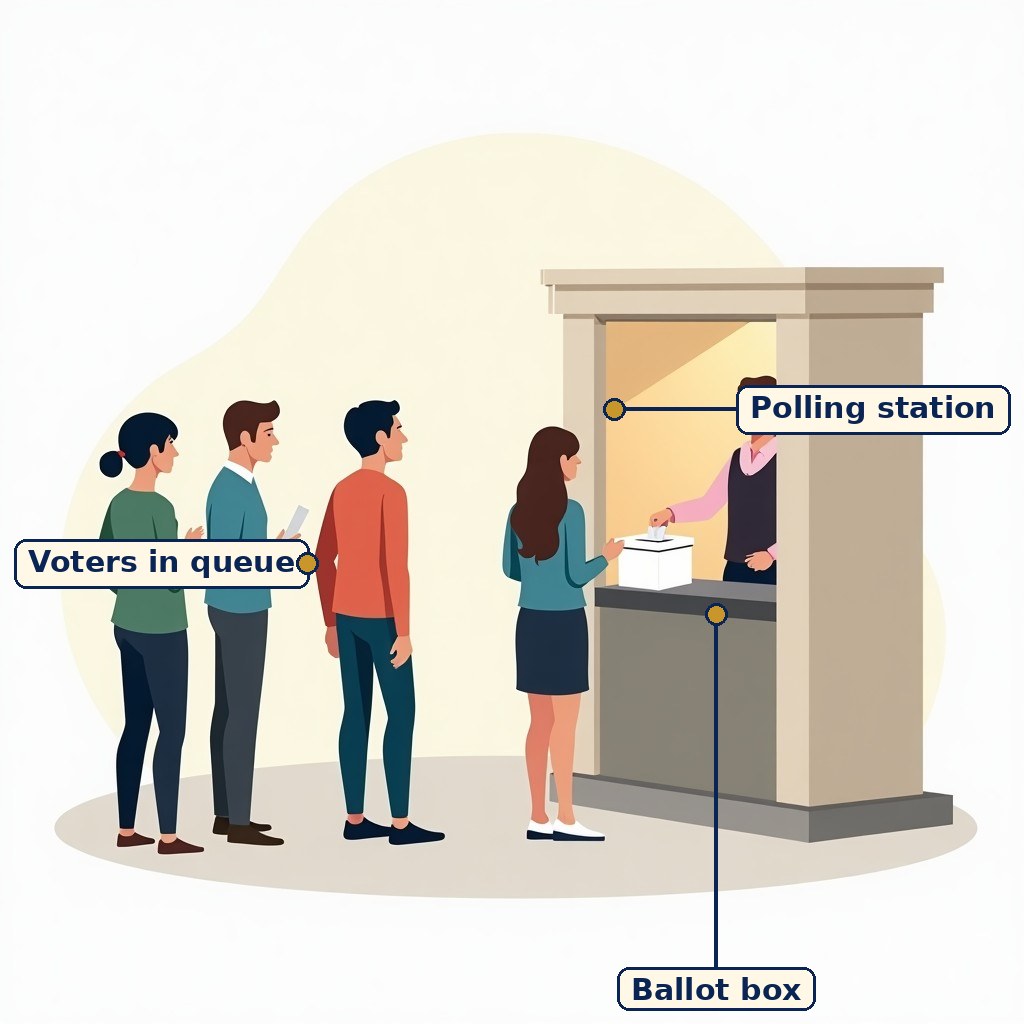
Diagram (labels are printed on the image): Voters in a queue at a polling station with a ballot box. A general picture of voting, not a scene from the book.

A voter casting a vote at a polling booth. A general picture of polling, not a book scene.
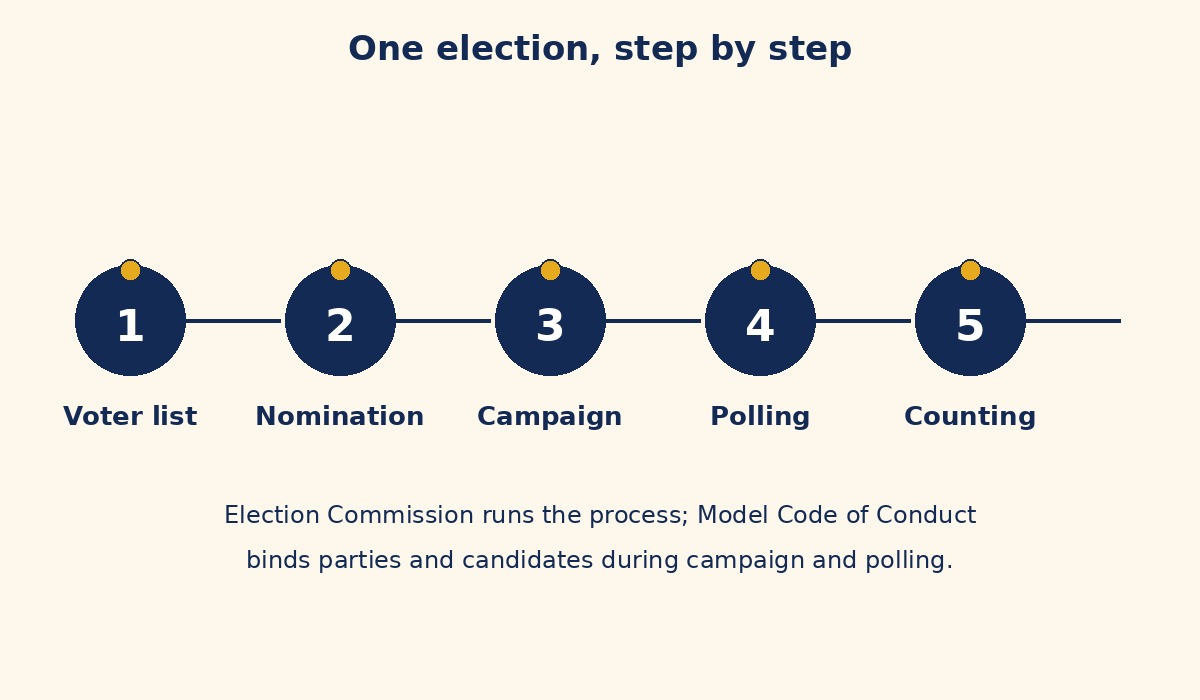
New diagram (labels are printed on the image): One election, step by step — voter list, nomination, campaign, polling, counting. Gold dots sit on each step's circle; the Election Commission runs the process under the Model Code of Conduct.
What the chapter is about
Elections are how citizens exercise democratic rights and hold representatives accountable. The vote is the principal means by which people choose who decides on their behalf — and by which they can remove non-performers. Three tests show why elections must be periodic, competitive and free: a class representative cannot simply continue into the next grade without a fresh election; a government cannot continue beyond its term without seeking a fresh mandate; and a choice is not real if only one party contests. Elections give democracy its legitimacy (governments rule with people's consent), representation (different groups get a voice), accountability (rulers answer to voters) and equality (each vote counts equally). The scientific study of elections is called psephology, from the Greek psephos (pebble) — pebbles were once used for voting.
Direct and indirect elections in India
In direct elections, citizens vote directly to choose their representatives: members of the Lok Sabha at the centre, members of the Vidhan Sabha (Legislative Assembly) at the state level, and members of local bodies such as panchayats and municipal corporations are elected directly, every five years. In indirect elections, citizens vote for representatives who then choose the leaders: the President, the Vice President and members of the Rajya Sabha are elected indirectly. This division balances direct popular choice with deliberation by elected bodies for offices that represent the whole nation or the states.
Inside India's election machinery
Running elections for a vast, diverse country needs laws, organisation at national, state and local levels, and a robust machinery. The Election Commission of India (ECI), created by the Constitution, is the central institution: it registers political parties, prepares and updates electoral rolls, lays down rules for nomination of candidates and campaigns, fixes election schedules, organises polling stations and security, supervises counting of votes and declares results. Delimitation — the drawing of constituency boundaries according to population — keeps representation fair, so one MP does not represent vastly more people than another. Electoral rolls are prepared constituency by constituency and polling-station by polling-station; only those whose names appear on the roll can vote at that station. Candidates may belong to a party or stand independently; campaigns present manifestos and promises; polling uses EVMs (Electronic Voting Machines) with VVPAT (Voter Verifiable Paper Audit Trail) slips that let voters verify their vote, including EVMs with Braille features for visually impaired voters. The Model Code of Conduct binds parties and candidates during elections — regulating campaigning, wall writing, posters, pamphlets, slogans and the use of official machinery — so competition stays fair.
Two electoral systems: FPTP and proportional representation
India uses two main systems. First-Past-The-Post (FPTP) is used for Lok Sabha and Vidhan Sabha elections: the country and states are divided into constituencies, each electing one member, and the candidate with the most votes in a constituency wins — even without an absolute majority. It is simple and gives a clear local representative, but a party can win a majority of seats with less than a majority of votes. Proportional representation (by means of the single transferable vote) is used for the President, Vice President and Rajya Sabha: seats are allocated roughly in proportion to votes or to the strength of electors, so smaller groups are less likely to be shut out entirely. Knowing which system applies where — FPTP for direct Lok Sabha/Assembly polls, proportional representation for the indirect polls — is a favourite exam distinction.
Making voting inclusive — and the challenges
The ECI works on the principle that no voter should be left behind. Reforms include facilities for persons with disabilities (wheelchairs, volunteers, accessible booths, Braille EVMs), voting arrangements for service voters (such as police and army personnel on duty, who vote through special provisions rather than at their home booth), and home voting for senior citizens aged 80 and above — the chapter's case study shows an 89-year-old grandmother voting from home, while her disabled grandson is guided by volunteers at the booth. The ECI also runs voter awareness campaigns, the Special Intensive Revision (SIR) of electoral rolls to keep them accurate and up to date, and apps for voter information and polling-station details. Challenges remain: money power (spending that distorts competition), misinformation and fake news (including paid news), criminalisation, booth capturing in the past, and low awareness among some voters. The chapter also invites debate on "One Nation, One Election" — holding Lok Sabha and Assembly elections together — weighing efficiency and cost savings against federalism, local issues and practical difficulties.
What you should learn
After this chapter you should be able to: explain why elections must be periodic, competitive and free; distinguish direct from indirect elections with Indian examples; list the ECI's functions in order (rolls, delimitation, nomination, campaign rules, polling, counting, results); distinguish FPTP from proportional representation and say where each is used; describe inclusive-voting measures (PwD facilities, service voters, 80+ home voting, VVPAT, Braille EVMs); explain the Model Code of Conduct; and discuss challenges (money power, misinformation, fake news) and the One Nation, One Election debate with arguments on both sides.
Key Terms
- Direct election — An election in which citizens vote directly to choose their representatives (Lok Sabha, Vidhan Sabha, local bodies).
- Indirect election — An election in which citizens vote for representatives who then elect the leaders (President, Vice President, Rajya Sabha).
- Election Commission of India (ECI) — The constitutional body that conducts free, fair and transparent elections in India.
- Delimitation — The drawing of constituency boundaries according to population, to keep representation fair.
- Electoral roll — The constituency-wise, polling-station-wise list of eligible voters; only listed voters can vote at that station.
- First-Past-The-Post (FPTP) — The system in which the candidate with the most votes in a constituency wins.
- Proportional representation — A system allocating seats roughly in proportion to votes or elector strength (used, via single transferable vote, for President, Vice President and Rajya Sabha).
- EVM / VVPAT — Electronic Voting Machine / Voter Verifiable Paper Audit Trail slip that lets a voter verify the vote cast.
- Model Code of Conduct — The rules binding parties and candidates during elections to keep competition fair.
- Psephology — The scientific study of elections (from Greek psephos, pebble).
Remember
- Elections must be periodic, competitive and free — otherwise choice is not real.
- Direct: Lok Sabha, Vidhan Sabha, local bodies (every five years). Indirect: President, Vice President, Rajya Sabha.
- FPTP = Lok Sabha/Assembly. Proportional representation (single transferable vote) = President/VP/Rajya Sabha.
- ECI: rolls, delimitation, nominations, campaign rules, polling, counting, results.
- VVPAT lets voters verify their vote; Braille EVMs help visually impaired voters.
- 80+ senior citizens can vote from home; service voters have special provisions.
Exam Tip / Common Mistake
Common mistake: saying the President is directly elected — he is not; the President, Vice President and Rajya Sabha members are elected indirectly, by proportional representation. Another slip: confusing the Model Code of Conduct with a law — it is a code of conduct enforced by the ECI during elections, and its violations (wall writing, posters everywhere, misuse of official machinery) are exactly what the chapter's case study asks you to spot. In the case study, also note: voting without a voter ID card is possible with another valid document, and police personnel on duty vote through service-voter provisions, not by leaving their posts.
Chart / Table: How India elects what
| Office / body | Direct or indirect? | System |
|---|---|---|
| Lok Sabha | Direct | First-Past-The-Post |
| Vidhan Sabha | Direct | First-Past-The-Post |
| Panchayat / municipality | Direct | First-Past-The-Post |
| Rajya Sabha | Indirect | Proportional representation (single transferable vote) |
| President / Vice President | Indirect | Proportional representation (single transferable vote) |
Practice set — try it yourself
- Why must elections be held regularly, even if the government is popular?
Hint: Think about the class representative in Grade 9. - Distinguish direct from indirect elections with one Indian example each.
Hint: Lok Sabha versus President. - What is the job of the Election Commission?
Hint: From voter lists to results — the whole machinery. - What is FPTP, and where is it used in India?
Hint: Most votes in one constituency wins. - What is VVPAT, and why does it matter?
Hint: A slip the voter can see.
Questions with Answers
- Why are elections essential to a democratic system?
Elections give democracy legitimacy (governments rule with consent), representation (different groups get a voice), accountability (voters can remove non-performers) and equality (each vote counts equally). Without periodic, competitive elections, representatives cannot be chosen or changed by the people, and power stops depending on public consent. - What are the functions of the Election Commission of India?
The ECI registers political parties, prepares and updates electoral rolls, carries out delimitation of constituencies, lays down rules for nominations and campaigns, enforces the Model Code of Conduct, organises polling stations, security and EVMs with VVPAT, supervises counting and declares results. Its most important function for free and fair elections is its independence and control of the whole process — from accurate rolls to honest counting — without government interference. - Distinguish FPTP from proportional representation.
In FPTP, each constituency elects one member and the candidate with the most votes wins, even without a majority; it is simple and gives a clear local representative but can give a party a seat majority on a vote minority. In proportional representation (single transferable vote), seats match votes or elector strength more closely, so smaller groups are represented; India uses it for the indirectly elected President, Vice President and Rajya Sabha. - What has the ECI done to make voting more inclusive?
For persons with disabilities: accessible booths, wheelchairs, volunteers and Braille EVMs. For service voters (police, army on duty): special voting provisions. For senior citizens 80 and above: home voting. For all voters: VVPAT verification, voter awareness campaigns, the Special Intensive Revision of rolls, and apps for voter and polling-station information. - What challenges do free and fair elections face in practice?
Money power distorts competition; misinformation and fake news (including paid news) mislead voters; criminalisation and past practices like booth capturing undermine fairness; and low awareness leaves some voters out. The ECI answers with the Model Code of Conduct, expenditure monitoring, VVPAT, voter education and roll revision — but challenges persist and need alert citizens too.
Extension Questions with Answers
- "Elections are the soul of democracy." Do you agree?
Largely yes, with a qualification. Elections are the soul in the sense that they make popular sovereignty real: without them, democracy has no mechanism for consent or removal. But a soul needs a body — rights, rule of law, free press, opposition and everyday participation — or elections become a ritual that can coexist with unfair power. The strongest answer defends elections while naming what else democracy needs. - Why should you vote? Rank the reasons and defend your order.
The chapter lists: choosing your representative, becoming a responsible person, changing a non-performing representative, and strengthening democracy. A defensible order puts "strengthens democracy" and "choose/change representatives" first, because voting is a public act whose value lies in collective self-government, while "becoming responsible" follows from exercising it. Any order works if the reasons are defended, not merely listed. - What is the Special Intensive Revision (SIR), and why is it needed?
SIR is the ECI's intensive revision of electoral rolls — a thorough, house-to-house style updating to add new eligible voters, remove the names of the deceased or shifted, and correct errors. It is needed because rolls decide who can vote: an inaccurate roll silently disenfranchises citizens or enables impersonation, so revision is as important to fairness as honest counting. - Should India adopt One Nation, One Election? Argue both sides.
For: simultaneous polls save money and administrative effort, reduce repeated Model Code periods that pause government work, and let voters decide once. Against: it may blur distinct national and state issues, strain federalism by nationalising state elections, and face huge logistical and constitutional hurdles (terms, hung assemblies, by-elections). The chapter presents it as a debate, not a settled answer — and exam answers should show both sides. - In the chapter's case study, what Model Code violations and good practices can you spot?
Violations: wall writing and campaign posters pasted everywhere the day before polling, and large campaign groups with pamphlets and slogans in a way that pressures voters. Good practices: police-guarded polling station, wheelchair and volunteers for the disabled voter, VVPAT slip shown to the voter, and home voting for the 89-year-old grandmother. Spotting both sides — not only the violations — is what the question rewards.
- Elections = legitimacy, representation, accountability, equality.
- Direct: Lok Sabha, Vidhan Sabha, local bodies. Indirect: President, VP, Rajya Sabha.
- ECI runs everything: rolls, delimitation, nominations, code, polling, counting, results.
- FPTP for direct polls; proportional representation (single transferable vote) for indirect polls.
- Inclusion: PwD facilities, service voters, 80+ home voting, VVPAT, SIR.
- Challenges: money power, misinformation, fake news — plus the One Nation, One Election debate.
How to use this page: Read the summary, say the Key Terms in your own words, then try the practice set without looking. Use the Questions with Answers to check yourself afterwards. Ask your teacher or parent to check your answers.