

Chapter 6: Democracy
Democracy is not just voting day. What makes a country truly democratic — and what threatens it?
Original notes — ready CBSE (NCERT, English Medium) • Class 9 • Social Science • Book: Understanding Society: India and Beyond — Part 1
Chapter 6: Democracy — EG's own notes, in simple words
Book: Understanding Society: India and Beyond — Part 1 (CBSE, Class 9) | Chapter 6 | Medium: English
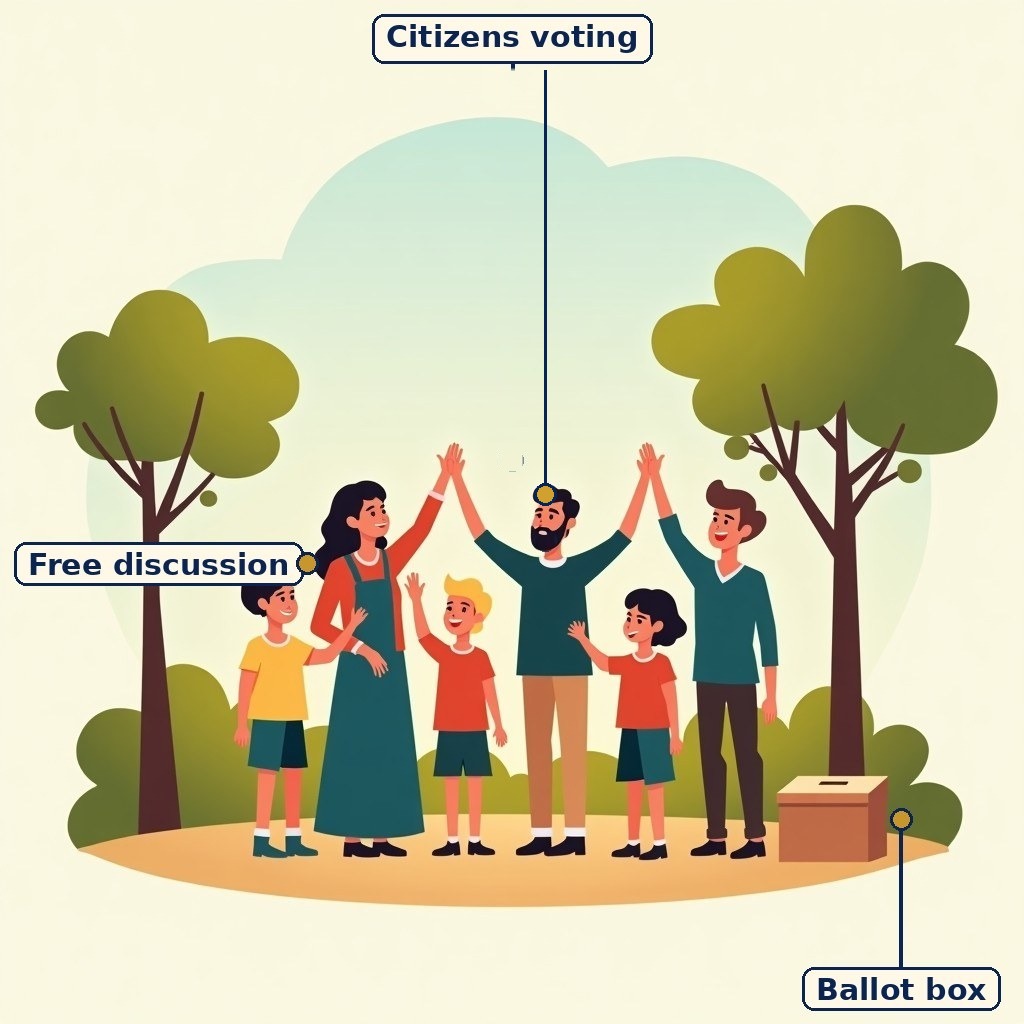
Diagram (labels are printed on the image): Citizens voting, free discussion and a ballot box. A general picture of democratic life, not a scene from the book.
People raising hands together in discussion. A general picture of participation, not a book scene.
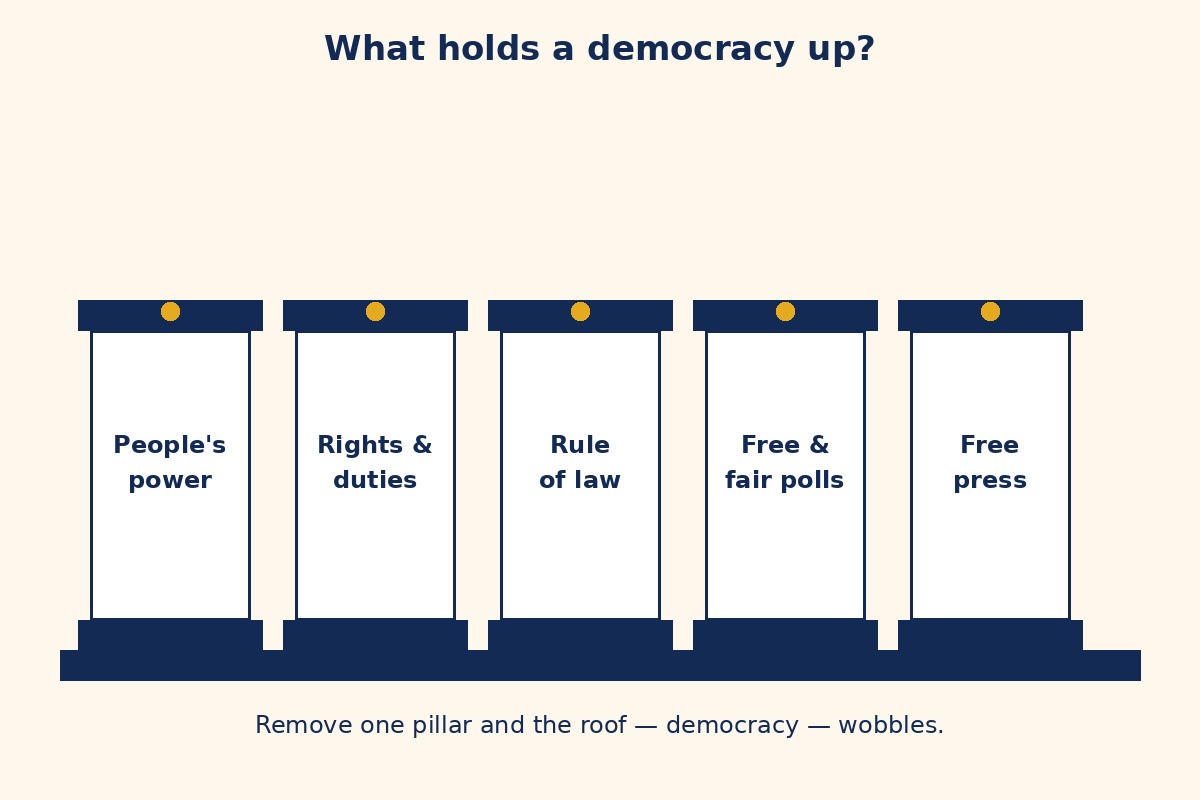
New diagram (labels are printed on the image): Five pillars holding up democracy — people's power, rights and duties, rule of law, free and fair polls, and a free press. Gold dots sit on each pillar's capital: remove one pillar and the roof wobbles.
What the chapter is about
Democracy is a form of government in which the source of power and authority lies with the citizens, who elect their representatives through free and fair elections. It rests on freedom, equality, justice, rights and duties: citizens vote, express opinions and take part in decision-making. India — Bharat — is the world's largest democracy, with a population of over 140 crore and a voter base of over 96.8 crore in 2024. But this chapter insists on a bigger point: democracy is not merely a system of government or a voting day. It is a continuous process shaped by institutions, rules, practices and everyday citizenship — and it did not emerge suddenly in India, but evolved through a long historical process.
Democratic roots in early India
From the previous chapter, we know the Vedic assemblies — Sabha, Samiti and Vidhata — involved collective decision-making, and the early republican states (ganas or sanghas) shared power rather than giving it to one ruler. The Rig Veda's Aikyamatya Suktam (10.191.3) expresses the same values: "Their counsel is one and the same; their assembly is one. Their mind is one, and their intention together is one." Consultation, shared discussion and unity of purpose are therefore ancient Indian democratic values, not imports. The king was never an independent ruler: he worked in consultation with assemblies, ministers and officers. Later developments from around the world, and India's freedom movement and Constituent Assembly, combined with these roots to produce the modern democratic system.
India's constitutional foundation
India's democracy is guided by the Constitution, adopted on 26 November 1949 and in force from 26 January 1950. It guarantees and protects the Fundamental Rights of all citizens, ensures no citizen is discriminated against on the basis of religion, race, caste, sex or place of birth, and encourages participation at national, state and local levels through elections. Its key democratic features are: popular sovereignty (the state derives its authority from the people); universal adult franchise (every adult citizen can vote without discrimination); fundamental rights and duties; the rule of law (laws apply equally to all, and courts review government actions); and separation of powers among the legislature (makes laws), executive (implements them) and judiciary (interprets them and protects rights). Democracy is guided by principles such as transparency, participation, inclusion, fairness, equality, accountability and respect for diverse opinions — and it needs a free press and a functioning opposition, so that governments can be questioned and criticised without fear.
Forms of democracy around the world
Democracies take different forms while sharing common values. In a direct democracy, citizens themselves decide — as in ancient Athens, where eligible citizens voted directly on laws (though many residents, including women and enslaved people, were excluded). In a representative democracy, citizens elect representatives who decide on their behalf — the form used by India and most large modern democracies, because direct voting by crores of people on every issue is impractical. Governments also differ: in a parliamentary system, the executive (prime minister and council of ministers) comes from and is accountable to the legislature; in a presidential system, the president is separately elected and heads the executive. States may be federal (power shared between centre and states, as in India) or unitary (power concentrated at the centre). Some democracies are also monarchies in form — parliamentary monarchies keep a king or queen as ceremonial head while elected governments actually rule. The lesson: judge a system by its democratic values and practices, not only by its label.
Democracy beyond government
Democracy extends beyond parliament into everyday institutions. In villages, the Gram Sabha — the assembly of all adult voters of a panchayat — is the primary forum where people discuss plans, budgets and problems; the chapter highlights women-friendly panchayats, such as the South Manubankul Gram Panchayat in Tripura and Jethipura Gram Panchayat in Gujarat (awarded the Nanaji Deshmukh Rashtriya Gaurav Gram Sabha Puraskar), where quorum rules, active participation and proper maintenance of proceedings made local democracy real. Panchayati Raj institutions and municipalities bring democracy to sanitation, livelihoods and local planning. The same values apply in families, schools and workplaces: discussion before decisions, respect for dissent, majority decisions that still protect minority rights, and responsibilities that match rights. Youth strengthen democracy through NCC, NSS, Bharat Scouts and Guides, by following fundamental duties, taking leadership in school and community, and becoming media literate — able to tell reliable information from misinformation.
Challenges to Indian democracy
Indian democracy faces real challenges, and the chapter names them plainly: poverty and inequality, illiteracy, gender inequality, regionalism, and caste, religion or regional discrimination, given historical disadvantages. In recent times, misinformation on social media platforms has emerged as a major concern — false news can mislead voters, damage reputations and lead to conflict. Other threats include damaging public property, spreading misinformation, violating laws, and treating powerful individuals as above the law — each a violation of the rule of law. The answer is not despair but deeper participation: informed citizens, responsible media use, community activity, respect for democratic norms, and institutions that stay accountable. As the chapter concludes, the strength of a democracy depends not only on its institutions and laws but on informed and responsible citizens who actively participate in shaping their society.
What you should learn
After this chapter you should be able to: define democracy and explain why it is more than elections; trace its Indian roots (Sabha, Samiti, Vidhata, ganas/sanghas, the Aikyamatya Suktam); list the Constitution's democratic features (popular sovereignty, universal adult franchise, rights and duties, rule of law, separation of powers); distinguish direct from representative democracy and parliamentary from presidential, federal from unitary systems; explain democracy in everyday life (Gram Sabha, Panchayati Raj, schools, families); and discuss challenges (inequality, illiteracy, misinformation, gender inequality) with reasoned responses.
Key Terms
- Democracy — A system of self-governance in which power lies with citizens, who participate in decision-making through institutions, rules and practices, including free and fair elections.
- Popular sovereignty — The principle that the state derives its authority from the people.
- Universal adult franchise — The right of every adult citizen to vote, without discrimination.
- Rule of law — The principle that laws apply equally to all, including the powerful, and that courts review government actions.
- Separation of powers — Division of government among legislature, executive and judiciary, so no one branch holds all power.
- Direct democracy — Citizens themselves vote directly on decisions (ancient Athens).
- Representative democracy — Citizens elect representatives who decide on their behalf.
- Gram Sabha — The assembly of all adult voters of a panchayat; the primary forum of village democracy.
- Panchayati Raj — The system of rural local self-government in India.
- Fundamental Rights / Duties — Rights guaranteed and protected by the Constitution, matched by citizens' duties towards the nation and community.
Remember
- Democracy = institutions + rules + practices + active citizenship — not voting alone.
- India's democratic roots include Sabha, Samiti, Vidhata and ganas/sanghas.
- Constitution: adopted 26 November 1949, in force 26 January 1950.
- India 2024: over 140 crore people, over 96.8 crore voters — the world's largest democracy by participation.
- Rule of law is violated when the powerful are treated as above the law — not when courts review government actions.
- Majority decisions must still protect minority rights; otherwise democracy becomes majoritarianism.
Exam Tip / Common Mistake
Common mistake: answering "Is voting alone enough?" with "yes" — the chapter's answer is firmly no: without rights, rule of law, free press, opposition and participation between elections, voting becomes a ritual. In case-study questions (like the school cabinet planning Republic Day), name the values shown — discussion, voting, majority decision, accountability of the elected — rather than writing vaguely about "democracy". And in MCQs, remember: a court reviewing government action strengthens the rule of law; it does not violate it.
Chart / Table: Forms of democracy compared
| Form | Who decides? | Example / note |
|---|---|---|
| Direct democracy | Citizens vote directly | Ancient Athens (with exclusions) |
| Representative democracy | Elected representatives decide | India, most large democracies |
| Parliamentary system | Executive from, and accountable to, legislature | India |
| Presidential system | Separately elected president heads executive | United States (classic example) |
| Federal / unitary | Power shared centre–states / concentrated at centre | India is federal; some states are unitary |
Practice set — try it yourself
- What is democracy, in one sentence?
Hint: Power lies with whom? - Name two ancient Indian roots of democratic values.
Hint: Assemblies and republics. - What is the rule of law?
Hint: Equal for the powerful and the powerless. - Distinguish direct from representative democracy.
Hint: Vote yourself, or vote for someone who votes for you. - Give one way a student can strengthen democracy.
Hint: Think beyond voting age — school, community, media.
Questions with Answers
- Is voting alone enough to make a country democratic? Why or why not?
No. Voting is necessary but not sufficient. A democracy also needs fundamental rights, the rule of law, separation of powers, a free press, a functioning opposition, and participation between elections — in gram sabhas, communities, schools and public debate. Without these, elections can coexist with discrimination, censorship and unaccountable power. - Which situation best reflects popular sovereignty, and why?
Citizens voting to choose their representatives. Popular sovereignty means the state derives its authority from the people; voting is the act by which people confer that authority. A law passed without public discussion, a court judgment, or a minister's independent decision does not by itself express the people's sovereignty. - Why is the rule of law essential for protecting democracy?
Because it makes laws apply equally to all, so no individual — however powerful — stands above the law, and it lets courts review government actions. That equality builds justice, accountability and trust: citizens obey laws they believe bind rulers too, and governments cannot punish critics arbitrarily. - How would democracy be affected if citizens stopped following laws and civic responsibilities?
Democracy would weaken from within: public property would be damaged, misinformation would spread unchecked, elections and institutions would lose legitimacy, and conflicts would be settled by force rather than by rules. Rights survive only when matched by duties — paying taxes, respecting others' rights, participating honestly and protecting public goods. - What role does the Constitution play in strengthening democracy in India?
It provides the framework: popular sovereignty, universal adult franchise, fundamental rights and duties, rule of law and separation of powers. It protects citizens from discrimination on grounds of religion, race, caste, sex or place of birth, and it creates institutions — Parliament, judiciary, Election Commission, panchayats — through which participation and accountability actually happen.
Extension Questions with Answers
- How can social media both strengthen and weaken democracy?
It strengthens democracy by letting people express opinions freely, organise, question governments and spread information quickly. It weakens democracy when used irresponsibly — misinformation misleads voters, rumours spark conflict, and abuse silences voices. The difference is media literacy: checking sources, refusing to forward unverified claims, and treating online speech as a civic responsibility. - Why does the chapter treat the Gram Sabha as a democratic institution, not just a meeting?
Because the Gram Sabha gives every adult voter a direct say in village plans, budgets and oversight — the closest thing to direct democracy in a large country. The chapter's examples (Tripura's South Manubankul, Gujarat's Jethipura) show that when quorum, participation and proper records are maintained, gram sabhas decide real matters like sanitation and livelihoods, and empower women and marginal groups. - What is the difference between majority rule and majoritarianism?
Majority rule decides by vote after discussion, but still protects minority rights, dissent and the rule of law. Majoritarianism uses a majority to override rights, silence minorities and treat winners as entitled to everything. Democracy requires the first and forbids the second — that is why rights and courts exist even against popular governments. - How do ancient Indian assemblies differ from modern parliaments — and what connects them?
They differ in scale, election method, written constitutions and universal franchise — Vedic assemblies were small, face-to-face bodies in kin-based societies. What connects them is the value: decisions through collective counsel, consultation and unity of purpose, expressed in the Aikyamatya Suktam. Modern democracy inherits the value and gives it new institutional form. - If you could strengthen one pillar of Indian democracy, which would you choose, and why?
Any well-defended choice works — for example, media literacy against misinformation, because false news now distorts elections before any institution can respond; or women's participation in panchayats, because half the population's voice decides whether local democracy is real. The strongest answers name the pillar, the specific weakness, and one concrete action (a school media-literacy club, a campaign for gram sabha attendance).
- Democracy = people's power through institutions, rules, practices and citizenship.
- Roots: Sabha, Samiti, Vidhata, ganas/sanghas, Rig Veda's call for one counsel.
- Constitution: 26 Nov 1949 adopted, 26 Jan 1950 in force; rights, duties, rule of law, separation of powers.
- Forms: direct vs representative; parliamentary vs presidential; federal vs unitary.
- Challenges: inequality, illiteracy, gender gaps, regionalism, misinformation — answered by participation.
How to use this page: Read the summary, say the Key Terms in your own words, then try the practice set without looking. Use the Questions with Answers to check yourself afterwards. Ask your teacher or parent to check your answers.