

Chapter 5: State and Society up to 1000 CE
From small kin groups to empires spanning a subcontinent — how did early India organise power, work and belief?
Original notes — ready CBSE (NCERT, English Medium) • Class 9 • Social Science • Book: Understanding Society: India and Beyond — Part 1
Chapter 5: State and Society up to 1000 CE — EG's own notes, in simple words
Book: Understanding Society: India and Beyond — Part 1 (CBSE, Class 9) | Chapter 5 | Medium: English
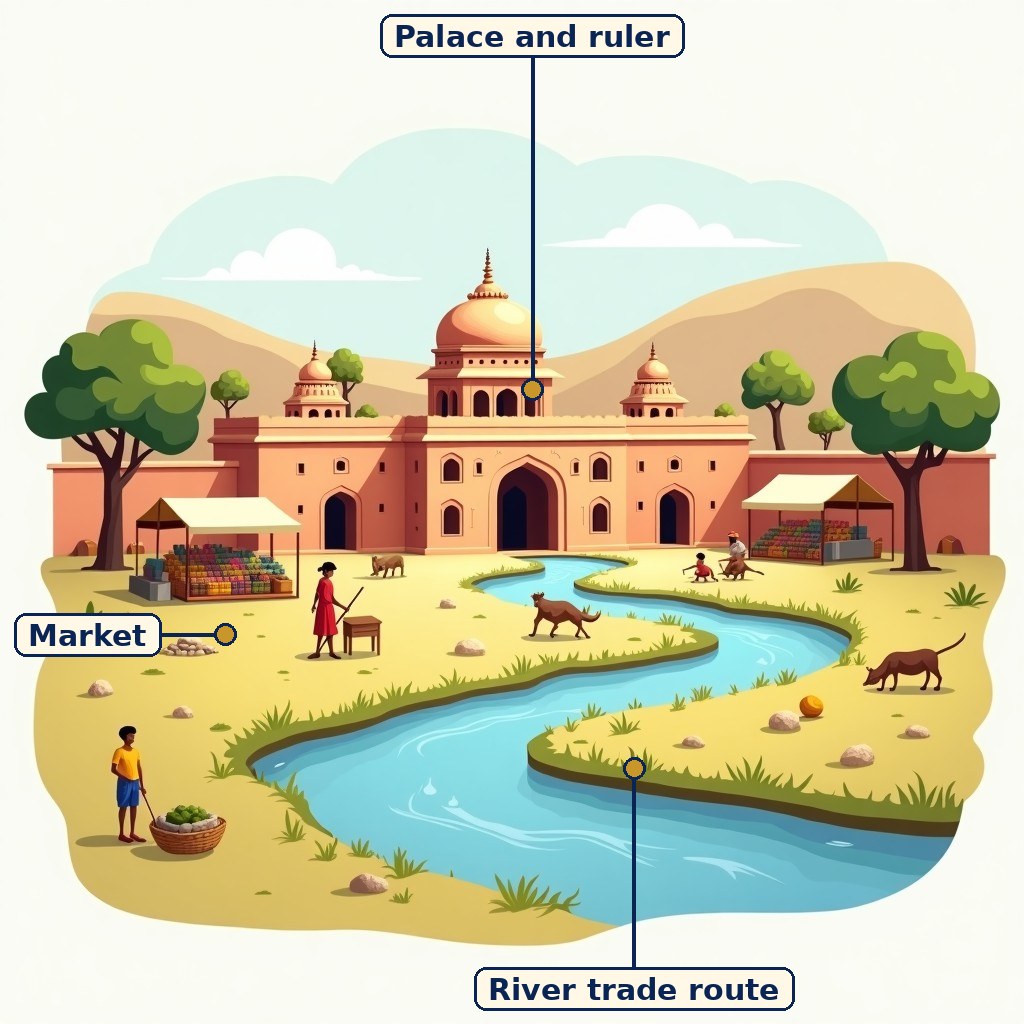
Diagram (labels are printed on the image): A palace, a market and a river trade route in an early Indian town. A general picture of state and society, not a scene from the book.

People trading and working in an early Indian town. A general picture of early economic life, not a book scene.
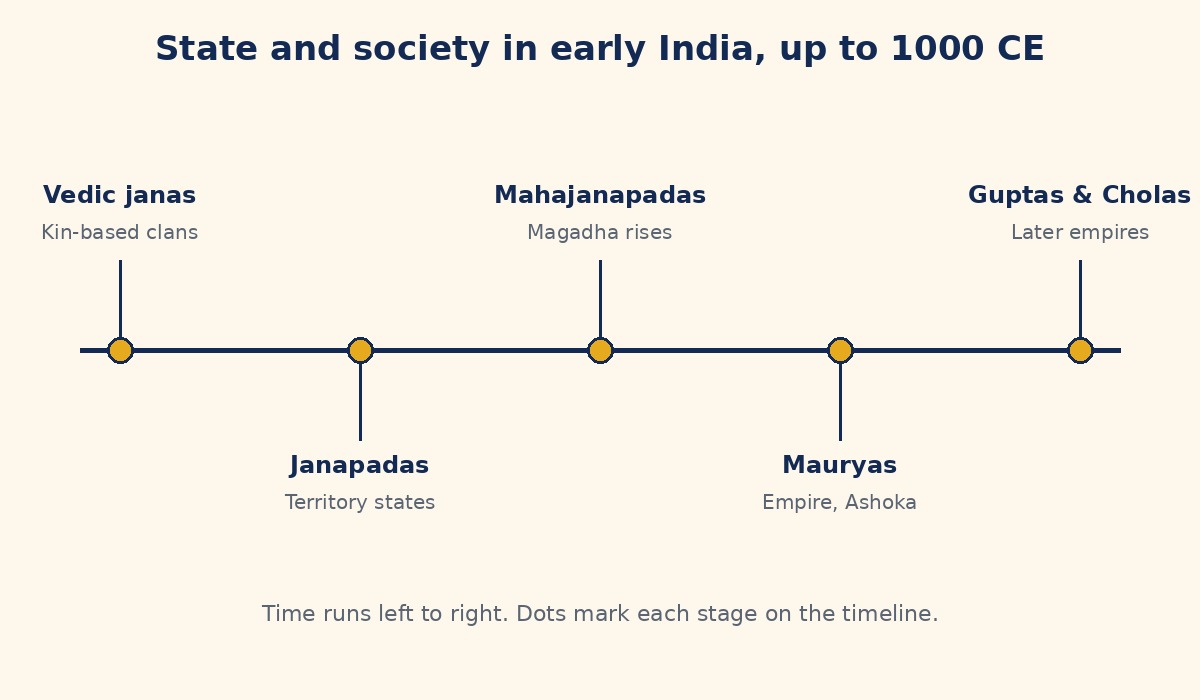
New diagram (labels are printed on the image): The political journey — Vedic janas (kin-based clans), janapadas (territory states), mahajanapadas (Magadha rises), the Mauryan empire (Ashoka), and the later Gupta and Chola empires. Gold dots mark each stage on the timeline.
What the chapter is about
After the Bronze Age, Indian history becomes richer and more detailed, because from at least the second millennium BCE, literary sources supplement archaeology. The Rig Veda, the earliest of these, opens a window on social, political, cultural and moral life. This chapter traces how political organisation grew from kin-based groups to territory-based kingdoms and then to empires, how society divided into varna and jati, how women lived and learned, how the economy ran on agriculture, irrigation, trade routes, ports and guilds, and how two ideas held the whole story together across centuries: dharma (socio-ethical duty) and the chakravarti samrat (the pan-Indian universal monarch, expressed through rituals such as the ashvamedha yajna).
From janas to janapadas to mahajanapadas
The earliest political units were janas — kin-based clans bound by kinship ties, led by a raja. The Rig Veda alone mentions about thirty janas, and the people ruled by the Bharata family were called the "jana" par excellence; groups of five peoples were collectively known as the panchajana. Power was not absolute: the raja worked with three assemblies — sabha, samiti and vidhata — which discussed, advised and limited royal power. Over time, kin groups settled into territories: a janapada literally means "where a people (jana) first set its feet". Bigger janapadas became mahajanapadas (600–300 BCE), among which Magadha (in present-day Bihar) rose to dominance through its resources, armies and strategic position. Alongside kingdoms stood republics — ganas or sanghas — where power was shared rather than held by a single hereditary king. This whole sequence — clan, territory, kingdom, republic, empire — is the backbone of the chapter.
Empires: Mauryas, Guptas and the southern kingdoms
The Mauryan empire, founded by Chandragupta Maurya, became one of the largest and most organised states of early India, with its capital at Pataliputra. Kautilya's Arthashastra describes its system: the king advised by ministers and officers (amatya), a chief tax collector, departments for different branches of administration, and the famous seven constituents of the state (Saptanga) — king, ministers, territory, fort, treasury, army and allies. Ashoka, the best-known Mauryan ruler, is remembered through his inscriptions, which speak of dharma and of the welfare of all peoples. After the Mauryas, the Guptas (320–550 CE) ruled a large northern empire noted for administration, trade and cultural achievement; later Gupta emperor Skandagupta repaired the Sudarshana Lake, showing how kings maintained irrigation works. In the south, the early kingdoms of Tamilakam — Cheras, Cholas and Pandyas (300 BCE–300 CE) — grew into the later imperial Cholas; the Chola ruler Rajendra I adopted the title Gangaikonda ("conqueror of the Ganga"), and southern kingdoms maintained ports and overseas trade. The chapter also notes the Pallavas, Chalukyas and Rashtrakutas among the powers that shaped the Deccan and south after the early empires.
Ideas that unified: dharma and chakravarti samrat
Two ideas run through the whole period. Dharma was the socio-ethical principle of duty — for rulers, it meant protecting people, ensuring justice and supporting welfare; Kautilya's dictum in the Arthashastra makes the king's happiness lie in the happiness of his subjects. The chakravarti samrat was the ideal of a universal monarch ruling the whole subcontinent: the Arthashastra defines the chakravarti kshetra as the area between the Himalayas (Himavat) and the sea, and rituals such as the ashvamedha (horse sacrifice) publicly claimed that wide authority. Together, dharma and the chakravarti ideal helped create unity in social values and governance, and promoted the idea of the Indian subcontinent as one political entity, even when it was in fact divided among many kingdoms. Indian political thought also linked politics with economics, social life, morality and defence — power was a responsibility, not merely a privilege.
Society: varna, jati, women and education
Early texts describe society organised by varna — four broad categories (Brahmanas, Kshatriyas, Vaishyas, Shudras) linked to functions such as learning, ruling and fighting, producing and trading, and service. Over time, many jatis — smaller, birth-based occupational and kin groups — took shape within and around the varna framework, shaped by occupation, region, marriage rules and local custom. Varna and jati are therefore different: varna is a broad, text-based fourfold scheme, while jati is the lived, local reality of hundreds of communities. The chapter asks what texts such as the Rig Veda, Arthashastra and Mahabharata reveal about social life, and what we can learn about varna and the role of women. Women appear in many roles — in households, in production, in religious and intellectual life — but their freedom varied by period, region and community, and the chapter invites students to examine that variation rather than assume a single story. Education combined knowledge with moral values: the gurukula system, in which students lived with a teacher, taught texts, skills and character together, and devotional traditions such as Bhakti later gave new, personal forms to religious life across regions.
Economy: fields, routes, ports and guilds
The economy rested on agriculture, supported by irrigation works — tanks, canals and lakes maintained by kings and communities. Trade ran along two great overland routes: the Uttarapatha (northern route) and the Dakshinapatha (southern route), later maintained and expanded by successive dynasties, linking inland regions with coastal ports and joining overland and maritime systems. Major ports — Muziris, Kaveripattinam (Poompuhar), Arikamedu and Masulipatnam — attracted Indian and foreign traders; by the early centuries CE, India's trade with Rome had grown greatly, by sea and by overland routes through Central Asia. Trade was organised by guilds (shrenis) — associations of people in the same profession, craft or occupation. The Jataka literature refers to eighteen types of guilds. Guilds regulated quality, often fixed prices to protect artisans and consumers, ran guild courts to enforce discipline, and acted as banks, financiers and trustees: a Nashik cave inscription (2nd century CE) of the Shaka king Nahapana's son-in-law Ushavadatta records 3,000 kahapanas deposited with weavers' guilds at Govadhana, whose interest maintained Buddhist monasteries and caves. Metallic coins, beginning with silver punch-marked coins, circulated from the mahajanapada period. Textile centres such as Mathura, Kashi and Kamarupa, and guilds of silk weavers, show how organised craft production was.
What you should learn
After this chapter you should be able to: trace political organisation from janas through janapadas and mahajanapadas to the Mauryan, Gupta and Chola empires; explain sabha, samiti and vidhata as limits on royal power; describe Mauryan administration (amatya, taxation, Saptanga); distinguish varna from jati; discuss women's roles and gurukula education; explain dharma and the chakravarti samrat ideal; and map the economy — agriculture, irrigation, Uttarapatha and Dakshinapatha, ports, guilds and punch-marked coins — with the Nashik inscription as source evidence.
Key Terms
- Jana — A kin-based clan, the earliest political unit; the Rig Veda mentions about thirty janas.
- Janapada — A territory-based state; literally, where a people (jana) first set its feet.
- Mahajanapada — A large janapada (600–300 BCE); Magadha was the most powerful.
- Gana / sangha — A republican state in which power was shared, not held by a single hereditary king.
- Sabha, samiti, vidhata — Early assemblies that advised the raja and limited royal power.
- Dharma — The socio-ethical principle of duty, binding rulers to welfare and justice.
- Chakravarti samrat — The ideal universal monarch ruling the whole subcontinent (between the Himalayas and the sea).
- Saptanga — Kautilya's seven constituents of the state: king, ministers, territory, fort, treasury, army, allies.
- Varna / jati — Varna: the broad fourfold scheme; jati: smaller, lived, birth-based occupational and kin communities.
- Shreni (guild) — An association of traders, artisans or merchants in the same profession, regulating quality and prices and acting as bankers and trustees.
Remember
- Sequence: jana (kin) → janapada (territory) → mahajanapada → empire (Maurya, Gupta, Chola).
- Assemblies limited kings: sabha, samiti, vidhata — early collective decision-making.
- Dharma + chakravarti samrat = unity of values and the idea of one subcontinent.
- Varna is the fourfold scheme; jati is the lived reality of many communities — do not merge them.
- Economy: agriculture + irrigation, Uttarapatha/Dakshinapatha routes, ports, guilds, punch-marked coins.
- Guilds were also banks: the Nashik inscription proves deposits and interest paid by weavers' guilds.
Exam Tip / Common Mistake
Common mistake: writing "varna and jati are the same" — examiners specifically test the difference. Another slip: describing Mauryan administration as "the king did everything" — name the machinery: amatya (officers), taxation, departments, and Saptanga. In source questions on the Nashik inscription, always identify donor (Ushavadatta), donees (the Sangha dwelling in the cave) and the economic point (guilds as trusted banks paying interest).
Chart / Table: Political organisation over time
| Stage | Period | Organisation | Example |
|---|---|---|---|
| Kin-based polities | Vedic period | Janas led by a raja, with sabha, samiti, vidhata | Bharatas; panchajana |
| Territory states | Later Vedic onwards | Janapadas | Settled peoples' territories |
| Great states | 600–300 BCE | Mahajanapadas; ganas/sanghas alongside | Magadha |
| Empires | From ~300 BCE | Centralised administration, taxation, armies | Mauryas, Guptas, Cholas |
Practice set — try it yourself
- What is the difference between a jana and a janapada?
Hint: Kinship versus territory — feet on the ground. - Name the three early assemblies and what they did.
Hint: They advised — and limited — the king. - What is a chakravarti samrat?
Hint: Think of the land between the mountains and the sea. - Distinguish varna from jati in one sentence each.
Hint: Fourfold scheme versus lived communities. - What was a shreni, and why was it more than a traders' club?
Hint: Think quality, prices, courts — and banks.
Questions with Answers
- How did political organisation change from the Vedic period to the Mauryas and Guptas?
It moved from kin-based janas led by a raja working with sabha, samiti and vidhata, to territory-based janapadas, then to mahajanapadas (600–300 BCE) such as Magadha, and finally to empires. Mauryan administration, described by Kautilya, had ministers and officers (amatya), a chief tax collector, departments for different functions, and the seven constituents (Saptanga); Gupta rule continued centralised administration with regional officers, and the Cholas built a southern empire with strong local and naval organisation. - How did assemblies limit the power of the raja, and what plays that role today?
Sabha, samiti and vidhata brought collective discussion and consent into decisions, so the king ruled in consultation rather than alone; republics (ganas/sanghas) went further by sharing power. Today, parliaments and legislatures, courts, free elections, a free press and local bodies like gram sabhas perform the same limiting and consulting functions in democratic form. - What do varna and jati mean, and how do they differ?
Varna is the broad, text-based fourfold division of society by function. Jati refers to the many smaller, birth-based communities defined by occupation, kinship, region and marriage custom — the lived reality of social organisation. A varna contains many jatis, and jatis changed, split and multiplied over time, while the varna scheme stayed as an ideal framework. - What do the Rig Veda, Arthashastra and Mahabharata reveal about political and social life?
The Rig Veda reveals kin-based janas, assemblies and early ideas of collective counsel. The Arthashastra reveals a detailed science of governance: taxation, administration, armies, spies, trade and the king's duty to his subjects' welfare. The Mahabharata reveals debates about dharma, kingship, duty in conflict, and social order, showing that political ideas were argued about, not simply imposed. - How did trade routes and guilds support early India's economy?
Agriculture and irrigation produced the surplus; Uttarapatha and Dakshinapatha carried goods, people and ideas across the subcontinent, and ports like Muziris, Kaveripattinam, Arikamedu and Masulipatnam linked India to Rome and Central Asia by sea and land. Guilds (shrenis) organised producers and traders, fixed quality and prices, settled disputes in guild courts, and acted as banks — the Nashik inscription shows weavers' guilds holding deposits and paying interest to maintain monasteries.
Extension Questions with Answers
- Why did Magadha, among sixteen mahajanapadas, rise above the rest?
The chapter points to the combination that made an empire possible: a strategic position in the Ganga plains, agricultural surplus, control of resources and trade routes, strong armies and capable rulers who built administration to match conquest. No single cause suffices — geography, economy, military organisation and politics reinforced each other, which is why answers that name only one factor are incomplete. - What are the limits of learning about society only from royal and scholarly texts?
Texts like the Arthashastra were written by scholars and advisors close to kings, so they present ideals and prescriptions — how things should work — more than everyday reality. They under-represent farmers, artisans, women and marginal groups, and they may exaggerate royal power. That is why historians cross-check texts with archaeology, inscriptions and coins, which record what people actually built, paid and donated. - What were the advantages and challenges of ruling a large empire without modern communication?
Advantages: control of vast resources, trade networks and armies, and the prestige of the chakravarti ideal. Challenges: messages travelled slowly, so distant officers could disobey, rebellions could grow before the capital heard, and uniform administration across languages and regions was hard. Empires answered with roads, officers, spies, inscriptions and rituals that made royal authority visible everywhere. - How did education's mix of knowledge and moral values benefit society?
The gurukula combined texts and skills with character formation, so learning produced not only literate officials and priests but citizens bound by dharma — duty to family, community and ruler. That moral frame helped hold a diverse society together, gave dispute settlement a shared language, and passed traditions across generations without a central school system. - What does the Nashik inscription prove that literary texts alone could not?
It proves, in a dated, physical record, that guilds functioned as financial institutions: Ushavadatta deposited 3,000 kahapanas with weavers' guilds at Govadhana at fixed monthly interest, and the interest funded the Sangha's cloth and living expenses. A literary mention of guilds could be an ideal; an inscription recording a real deposit, rate and purpose is evidence of practice.
- Jana → janapada → mahajanapada → empire: the political ladder.
- Sabha, samiti, vidhata limited kings; ganas/sanghas shared power.
- Dharma (duty) + chakravarti samrat (universal monarch) = unity idea.
- Varna = fourfold scheme; jati = lived communities.
- Economy: irrigation, Uttarapatha/Dakshinapatha, ports, guilds as banks, punch-marked coins.
How to use this page: Read the summary, say the Key Terms in your own words, then try the practice set without looking. Use the Questions with Answers to check yourself afterwards. Ask your teacher or parent to check your answers.