

Chapter 4: Early Humans and Beginning of Civilisation
Before writing, before kings, before cities — how did wandering tool-makers become farmers, then citizens?
Original notes — ready CBSE (NCERT, English Medium) • Class 9 • Social Science • Book: Understanding Society: India and Beyond — Part 1
Chapter 4: Early Humans and Beginning of Civilisation — EG's own notes, in simple words
Book: Understanding Society: India and Beyond — Part 1 (CBSE, Class 9) | Chapter 4 | Medium: English
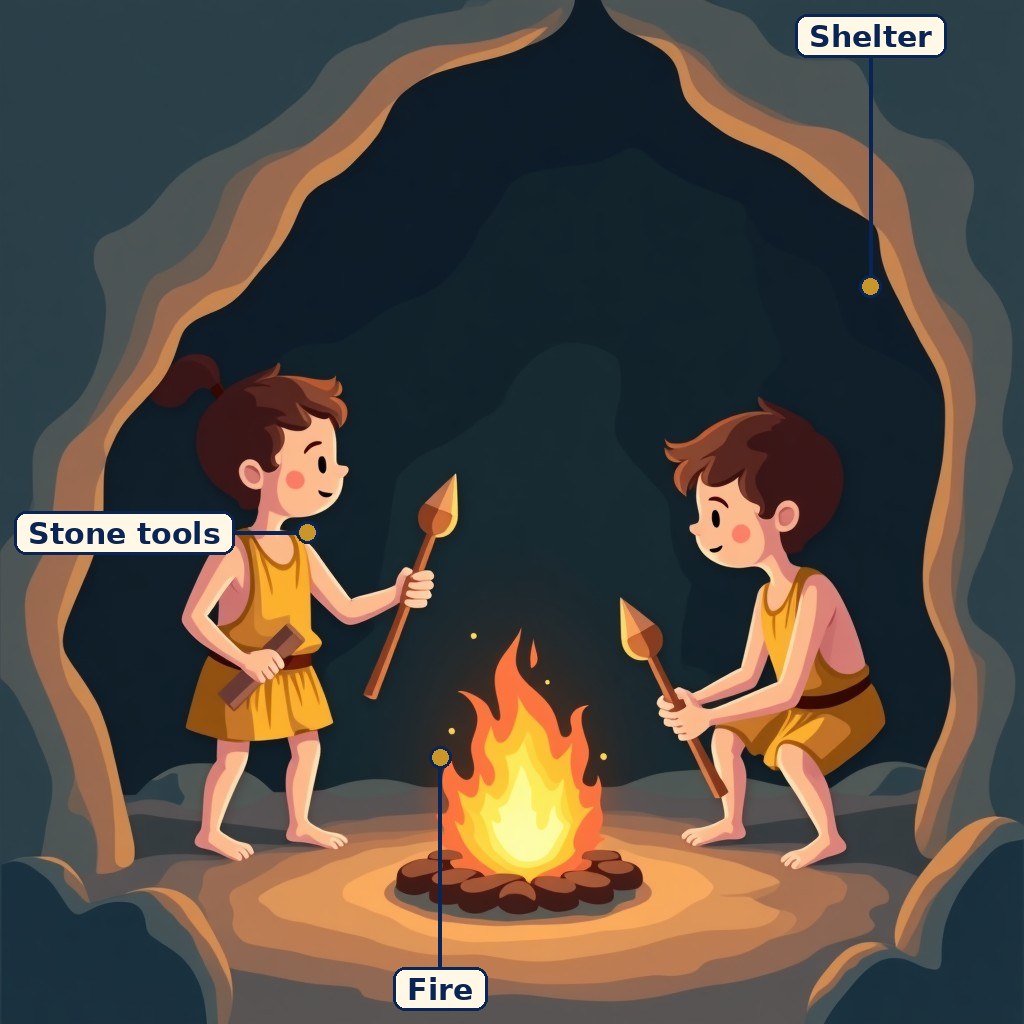
Diagram (labels are printed on the image): Early humans in a cave shelter with stone tools and fire. A general picture of hunter-gatherer life, not a scene from the book.
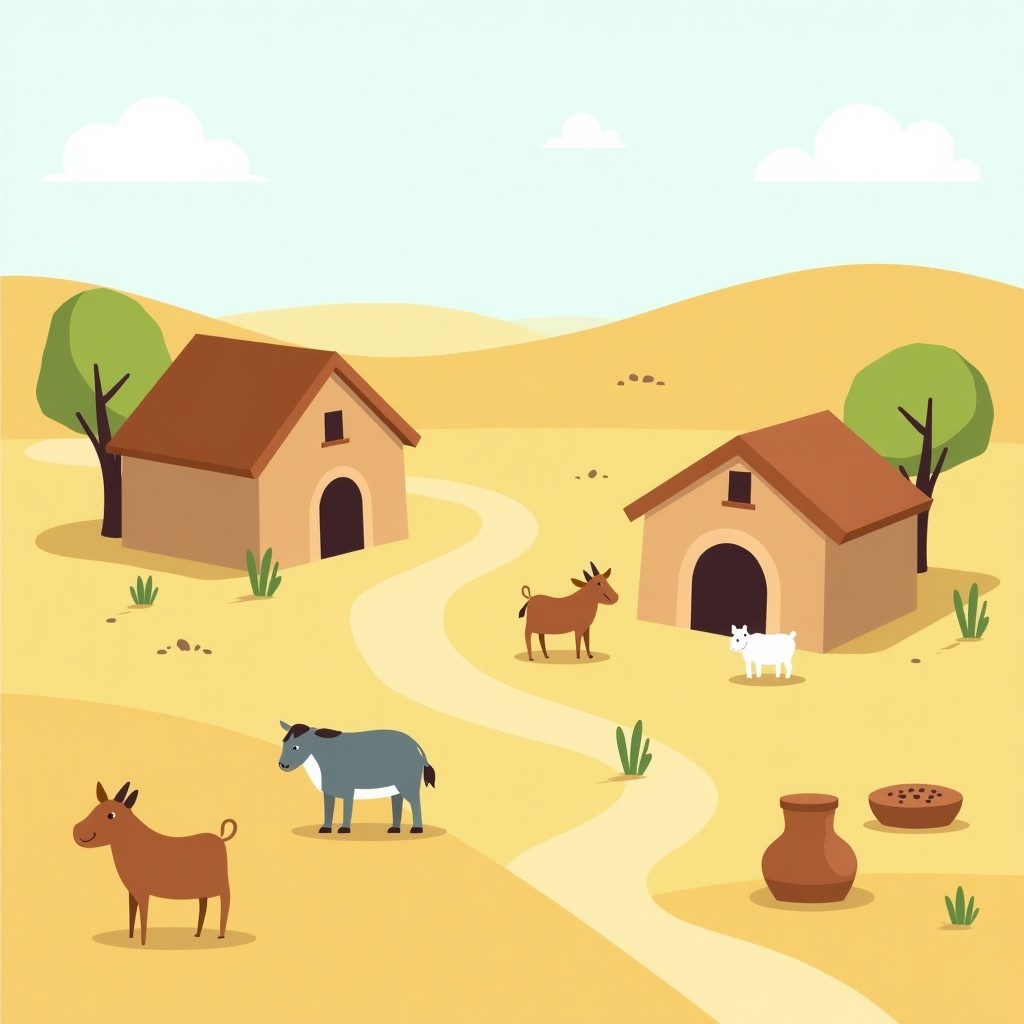
Early humans making tools and sharing food around a fire. A general picture of early life, not a book scene.
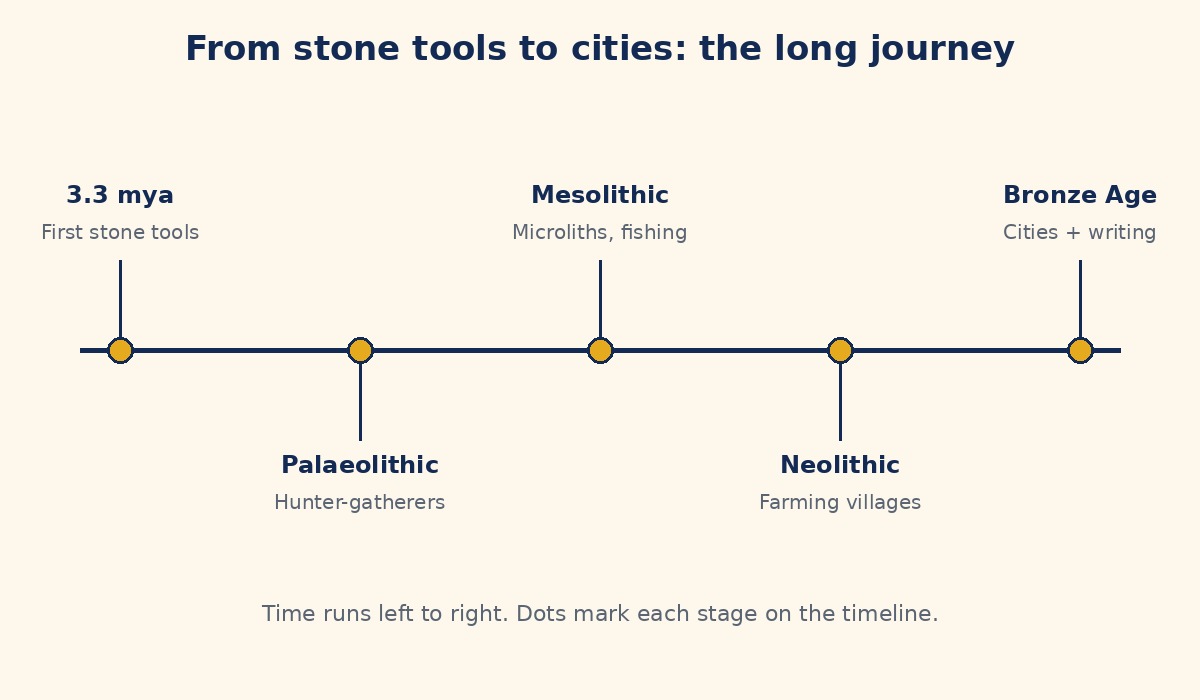
New diagram (labels are printed on the image): The long journey — first stone tools (3.3 million years ago), Palaeolithic hunter-gatherers, Mesolithic microliths and fishing, Neolithic farming villages, and Bronze Age cities with writing. Gold dots mark each stage on the timeline.
What the chapter is about
Human history goes back much further than kings and empires. The period before writing — more than 99% of human history, from about 3 million years ago to 5,000 years ago — is known mainly through archaeology: tools, fossils, bones and cave art, because written documents do not exist for it. Writing began only about 5,000 years ago, and different peoples invented it at different times. The Harappan (Sindhu-Sarasvati) script, used on seals and pottery, has still not been deciphered, while the Sumerian cuneiform script of Mesopotamia and the Egyptian hieroglyphic script have been deciphered. This chapter follows the journey from our earliest ancestors in Africa, through the Stone Ages, to farming villages and then to the four great Bronze Age civilisations — Sindhu-Sarasvati, Mesopotamia, Egypt and China — which arose independently in fertile river plains yet shared striking common features.
Who were our ancestors?
Our earliest ancestors evolved in Africa. Homo habilis ("handy man"), living in Olduvai Gorge in Tanzania and Kenya about 2–6 million years ago, made chopper stone tools. Homo erectus, the upright, bipedal ancestor of about 2 million years ago, invented handaxes and cleavers and was the first hominin to leave Africa, spreading into Asia and Europe between 2 and 0.5 million years ago. Homo neanderthalensis lived in Europe and south-west Asia until about 40,000 years ago and made Middle Palaeolithic flake tools. Homo sapiens — ourselves — evolved in Africa around 300,000 years ago; a major wave left Africa around 125,000 years ago, and between 50,000 and 12,000 years ago modern humans spread across the world, including Australia and the Americas. Humans are called hominins, or tool-makers: the earliest stone tools, made about 3.3 million years ago, mark the beginning of distinctively human behaviour, and tools acted as "extra-corporal limbs" — extensions of the body. Archaeologists also experiment by making and using similar tools to learn how early humans lived. In India, early sites include Attirampakkam in Tamil Nadu (about 1.5–1.7 million years ago) and Isampur in Karnataka (about 1.2 million years ago), where handaxes, cleavers, scrapers and choppers of quartzite and limestone were used to chop meat, dig tubers, scrape skins and crack bones for marrow.
The Stone Ages: Palaeolithic, Mesolithic, Neolithic, Chalcolithic
Palaeolithic (Old Stone Age) hunter-gatherers lived in caves or open camps, hunted and gathered, and used large tools — handaxes, cleavers, scrapers — then smaller, sharper tools: scrapers, borers and points for projectiles, and later the bow and arrow, parallel-sided blades and microblades. They painted cave walls and rock shelters, decorated their bodies with pigments, and made the first beads of stone, bone and shell. Mesolithic people (from about 12,000 years ago, as the climate warmed and forests and grasslands expanded) used tiny microlithic tools, fished in rivers and seas as a mainstay, occupied caves and rock shelters more often, and produced flourishing art — Bhimbetka in Madhya Pradesh holds hundreds of painted rock shelters. Neolithic (New Stone Age) people made the great shift to food production — the Neolithic Revolution: domesticating plants and animals, making polished stone tools for farming and food processing, inventing pottery in many shapes, and founding the first villages. Chalcolithic (Copper-Stone Age) people used copper alongside stone and developed early metallurgy. After it came the Bronze Age (copper mixed with tin to make bronze), with expanding trade, towns and civilisations, and later the Iron Age, with stronger tools and weapons and more advanced societies.
Neolithic India and the Sindhu-Sarasvati civilisation
In the Indian subcontinent, the oldest Neolithic site is Mehrgarh on the Bolan River (in present-day Pakistan), the earliest agricultural village, dating to about 7000 BCE. Its people built handmade sun-dried brick houses and granaries, buried their dead in graves, made ornaments from lapis lazuli, carnelian and shells, cultivated wheat and barley, and raised sheep, goats and zebu (humped) cattle. By about 4000 BCE they were making copper objects, entering the Chalcolithic phase. From this base, the Bronze Age Sindhu-Sarasvati civilisation grew: Early Harappan settlements (from about 3300 BCE, with some pre-Harappan phases at Bhirrana and Kunal dated 7000–5500 BCE) developed regional pottery styles, bead-making, shell work, seals and perimeter walls, and at Kalibangan, ploughed fields with crossed furrows show double cropping like today's Rabi and Kharif. The Mature Harappan phase (about 2600–1900 BCE) brought planned urban centres, water management and drainage, standard weights and measures (binary multiples for small units, multiples of ten for larger ones), inscribed seals and the still-undeciphered script, and long-distance trade — Harappan goods reached Mesopotamia through Dilmun (today's Bahrain) and Magan (today's Oman). The Late Harappan phase followed from about 1900 BCE to 1300 BCE.
Mesopotamia: the first city civilisation
Mesopotamia — Greek for "land in between" — is the land drained by the Euphrates and Tigris rivers in West Asia (today mainly Iraq and Kuwait, with parts of Turkey and south-western Iran). Farming began there about 12,000 years ago and copper tools arrived around 4500 BCE. The fertile crescent of foothills from the Mediterranean to the Persian Gulf supported the earliest city-based civilisation. The Sumerians invented cuneiform — wedge-shaped writing on clay tablets, widely used by 3000 BCE — and the wheeled cart and sailboat, and built canal irrigation and city-states. Then came the Akkadians (Akkad, a Semitic-speaking city-state), the Assyrians of Assur in the north (dominant until about 1700 BCE), and the Babylonians of central Mesopotamia (from 1900 BCE). Hammurabi, who took power in 1792 BCE, conquered neighbouring regions into a large empire and compiled the Code of Hammurabi — rules for civil and social conduct, inscribed in cuneiform beneath a relief showing him receiving the law from Shamash, god of justice — a foundational model for later legal systems. Babylonian power faded by about 1400 BCE under Hittite attacks, environmental degradation and internal problems.
Egypt and China
Egypt, along the Nile, is known for rich historical records: papyrus documents (sheets made by cutting, criss-crossing, pressing and drying the papyrus plant's inner trunk), libraries storing scrolls in labelled jars from about 2000 BCE, and stories including the oldest known form of Cinderella and tales linked to Aesop's fables. Egyptians counted days between Nile floods to build a calendar with three seasons — inundation, growing (Peret) and harvest (Shemu) — and diverted and stored flood water for fields. Pharaohs, buried after mummification, ruled a society of priests, officials, scribes, craftspeople and farmers; pyramids such as the step pyramid at Saqqara marked royal burials. The script was deciphered only in 1822, when Jean-François Champollion used the Rosetta Stone — found in 1799 by French engineer Pierre Bouchard, carrying the same text in three scripts including readable Greek. China, in the Huang He (Yellow River) basin, knew silk from the Neolithic period (4000–3000 BCE); by the Han dynasty (2nd century BCE) silk trade was so great its route became the Silk Route. Chinese civilisation developed a logographic script (characters for words or morphemes, not sounds), oracle bone inscriptions used to foretell the future, jade ritual objects, bronze ritual vessels and weapons, and — under the Zhou dynasty (1046–256 BCE) — a money economy, with paper currency and civil service examinations coming later as world firsts. The Great Wall, begun as separate walls from 680 BCE under the Zhou and others against nomadic raids, was joined and repaired until the 17th century CE. By 1500 BCE, Shang society (1600–1046 BCE) was already highly stratified, with rulers, nobles and aristocrats above farmers and labourers.
What you should learn
After this chapter you should be able to: explain why pre-writing history depends on archaeology; name the four hominins in order with their tools and dates; compare Palaeolithic, Mesolithic, Neolithic and Chalcolithic life in a table (tools, settlements, art, subsistence); describe Mehrgarh and the Harappan timeline; compare the four river-valley civilisations (rivers, writing, cities, trade, society); and explain why writing changed history — from approximate dating to exact dates, names and laws.
Key Terms
- Hominin — A member of the group including modern humans and our early human-like ancestors; tool-makers.
- Fossil — Preserved remains, traces or impressions of plants, animals or humans from the distant past, turned to stone over thousands or millions of years.
- Palaeolithic — The Old Stone Age: hunter-gatherers using large stone tools.
- Mesolithic — The middle Stone Age: microlithic tools, fishing, temporary settlements near rivers and lakes.
- Neolithic Revolution — The shift from hunting-gathering to farming: domestication of plants and animals, villages, pottery and polished tools.
- Chalcolithic — The Copper-Stone Age: copper used alongside stone tools; early metallurgy.
- Bronze Age — The age of bronze (copper + tin) metallurgy, towns, trade, writing and early civilisations.
- Cuneiform — The Sumerian wedge-shaped script written on clay tablets.
- Hieroglyphic script — The ancient Egyptian picture-based writing system.
- Logographic script — A script whose characters represent whole words or morphemes, as in Chinese.
Remember
- More than 99% of human history is pre-writing — archaeology is its main source.
- Order: habilis (choppers) → erectus (handaxes, first out of Africa) → neanderthalensis (flake tools) → sapiens (complex technology).
- Neolithic = farming + villages + pottery. Chalcolithic = copper + stone. Bronze = cities + writing + trade.
- Harappan script is NOT deciphered; cuneiform and hieroglyphs ARE.
- Four river-valley civilisations: Sindhu-Sarasvati, Mesopotamia (Euphrates–Tigris), Egypt (Nile), China (Huang He).
- Writing made dating accurate and preserved names, events, laws and literature.
Exam Tip / Common Mistake
Common mistake: saying the Harappan script has been deciphered — it has not, and that is precisely why Harappan history is harder to reconstruct than Egyptian or Mesopotamian history. Another slip: calling every stone tool "Palaeolithic" — microliths belong to the Mesolithic, polished tools to the Neolithic. In comparison questions, always organise by the same points for each civilisation (river, writing, cities, economy, society) so the comparison is genuinely comparable.
Chart / Table: Stone Ages at a glance
| Age | Tools | Settlement | Subsistence |
|---|---|---|---|
| Palaeolithic | Handaxes, cleavers, scrapers; later blades, bow and arrow | Caves, open camps | Hunting and gathering |
| Mesolithic | Microliths, bone points | Temporary camps near rivers and lakes | Hunting, fishing, gathering |
| Neolithic | Polished stone tools, pottery | Permanent villages | Farming and animal domestication |
| Chalcolithic | Copper + stone tools | Early farming communities | Farming, craft, early trade |
Practice set — try it yourself
- Why is most of early human history studied through archaeology?
Hint: Think about what is missing for 99% of our past. - Name the four hominins in order and one tool each made.
Hint: Handy, upright, European, modern. - What changed in the Neolithic Revolution?
Hint: From finding food to producing it. - Which early script is still undeciphered, and which two have been read?
Hint: Seals versus clay tablets and temple walls. - Name the four Bronze Age river-valley civilisations and their rivers.
Hint: Indus, Euphrates–Tigris, Nile, Huang He.
Questions with Answers
- How does archaeology help us understand our past before writing?
Before writing (over 99% of human history), there are no documents, so archaeologists reconstruct life from material remains: stone tools, fossils, bones, cave art, pottery, seals and settlement remains. They also experiment by making and using similar tools. Together these clues reveal what people ate, how they hunted, farmed, built and traded. - Why is the Neolithic shift called a revolution?
Because it changed everything at once: from hunting and gathering to producing food by domesticating plants and animals; from wandering camps to permanent villages; from tools for procuring food to tools for producing and processing it; and from no pottery to varied earthenware. Surplus food then supported crafts, trade and, eventually, cities and civilisation. - Compare the Harappan, Mesopotamian, Egyptian and Chinese civilisations.
All four arose independently in fertile river plains and shared cities, agriculture, craft, trade, administration, social hierarchy and writing. They differed in writing (Harappan undeciphered; cuneiform in Mesopotamia; hieroglyphs in Egypt; logographic characters in China), in political forms (Mesopotamian city-states and empires; Egyptian pharaohs; Chinese dynasties) and in contacts — Mesopotamia traded directly with the Harappans via Dilmun and Magan, while Egypt and China show little direct contact with the Sindhu-Sarasvati world. - Why was writing such a turning point?
Writing changed the sources of history: before it, only artefacts survive and dating is approximate, and people's thoughts are hard to recover. After it, written documents give names, events, laws (like Hammurabi's Code), economic transactions and literature, and dating becomes relatively accurate because documents mention specific dates of coronations, wars and reigns. - What made Mehrgarh important?
Mehrgarh (about 7000 BCE, on the Bolan River) is the Indian subcontinent's oldest Neolithic site and earliest agricultural village. Its people built sun-dried brick houses and granaries, buried their dead, made ornaments from semi-precious stones and shells, grew wheat and barley, raised sheep, goats and zebu cattle, and by about 4000 BCE made copper objects — laying the basis for the Bronze Age Sindhu-Sarasvati civilisation.
Extension Questions with Answers
- Did life become easier or harder after farming began?
Both. Farming gave steadier, storable food and supported larger, settled populations, crafts and villages. But it also brought harder, more repetitive work, dependence on a few crops and on rainfall, new diseases from crowded living and animals, and social inequality as surplus, land and stores had to be managed and guarded. The chapter's question invites two reasons either way — the honest answer is that "easier" and "harder" both apply, to different parts of life. - If the Harappan script were deciphered tomorrow, what might historians learn?
Names of rulers and officials, laws and administrative orders, trade records and prices, religious beliefs in the Harappans' own words, and the language family of the script — the very things that written sources give for Egypt and Mesopotamia but that Harappan history currently lacks. It could also settle debates about Harappan political organisation, which today must be inferred from artefacts alone. - Why do historians divide early history into Stone, Bronze and Iron Ages?
Because the main material of tools marks real leaps in capability: stone tools for hunting and farming, bronze for stronger tools, weapons and urban craft economies, iron for still stronger and cheaper tools and more advanced societies. The division tracks technological progress, settlement change and social complexity — but it is a rough guide, since different regions entered each age at different times. - How did rivers both help and hurt early civilisations?
Rivers gave fertile silt, water for crops, transport and trade routes, and food from fishing — the foundation of surplus and cities. But they also flooded unpredictably, changed course, bred disease in standing water, and needed constant labour on canals, embankments and drainage. Civilisations that managed rivers (Egypt's flood calendar, Mesopotamian canals, Harappan drainage) thrived; those that failed paid in famine or flood. - Choose one innovation from early civilisations that changed the world permanently — and defend it.
Writing is the strongest choice: it preserved laws, accounts, science and literature across generations, made large administration and empires possible, and turned history from guesswork into record. Other defensible choices include bronze metallurgy, the wheel, irrigation or the plough — but writing alone changed how knowledge itself survives, which is why the chapter treats it as the boundary between prehistory and history.
- Pre-writing history = archaeology: tools, fossils, cave art.
- Hominins: habilis → erectus → neanderthalensis → sapiens (Africa origin).
- Stone Ages: Palaeolithic hunt → Mesolithic microliths → Neolithic farming → Chalcolithic copper.
- Mehrgarh (~7000 BCE) → Early Harappan → Mature Harappan (~2600 BCE) → Late Harappan.
- Four civilisations, four rivers, three deciphered scripts — and one (Harappan) still unread.
How to use this page: Read the summary, say the Key Terms in your own words, then try the practice set without looking. Use the Questions with Answers to check yourself afterwards. Ask your teacher or parent to check your answers.