

Chapter 3: Atmosphere and Climate
The invisible blanket above you decides your weather, your seasons — and your future. How does it work?
Original notes — ready CBSE (NCERT, English Medium) • Class 9 • Social Science • Book: Understanding Society: India and Beyond — Part 1
Chapter 3: Atmosphere and Climate — EG's own notes, in simple words
Book: Understanding Society: India and Beyond — Part 1 (CBSE, Class 9) | Chapter 3 | Medium: English
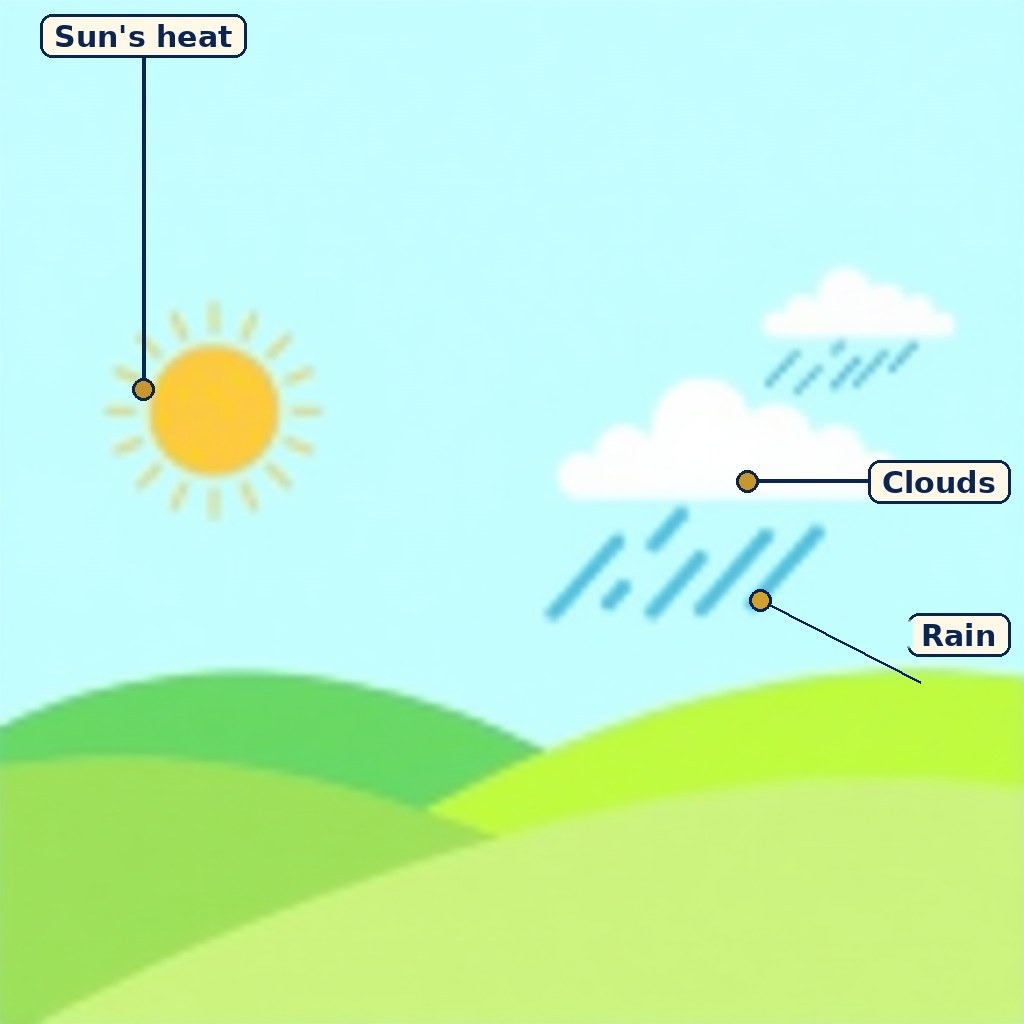
Diagram (labels are printed on the image): The Sun's heat, clouds and rain over green hills. A general picture of weather, not a figure from the book.

Rain falling over fields under a cloudy sky. A general picture of the monsoon, not a book scene.
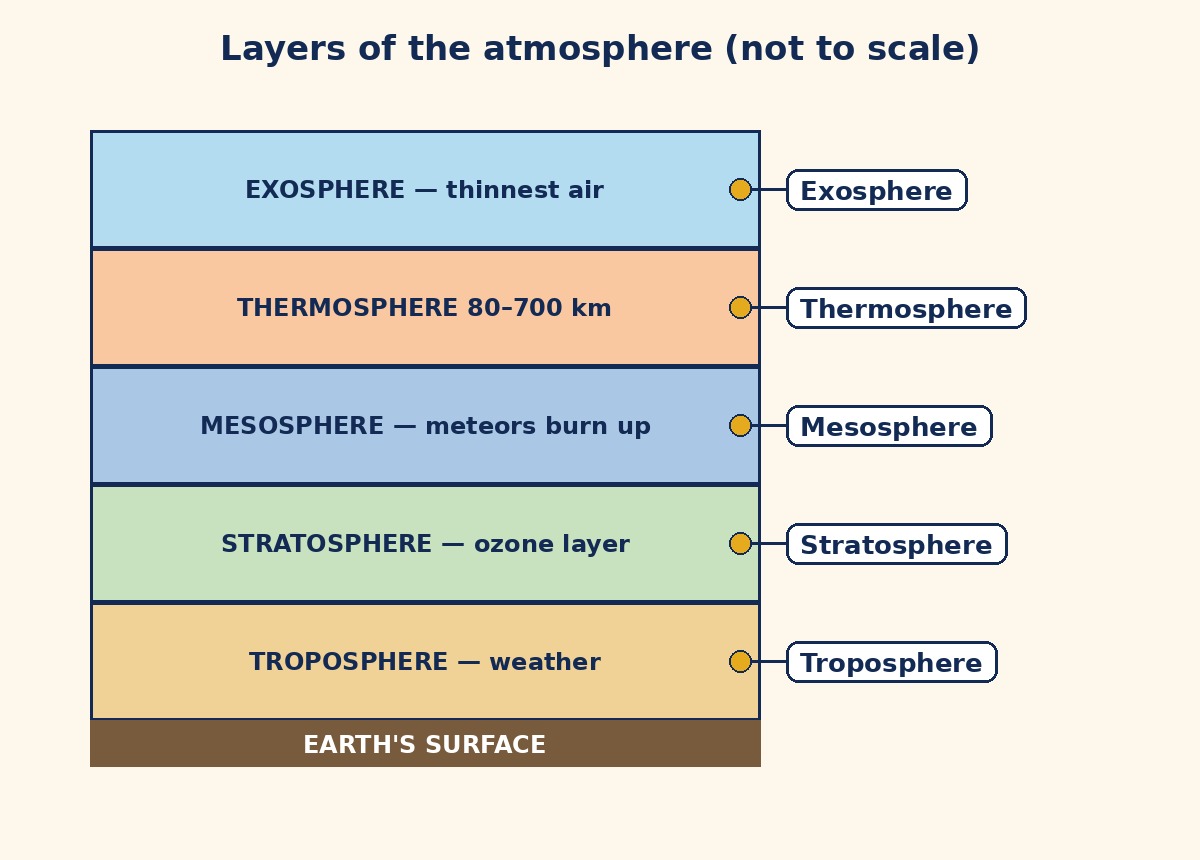
New diagram (labels are printed on the image): The five layers from the Earth's surface upward — troposphere, stratosphere, mesosphere, thermosphere, exosphere. Gold dots sit on each layer's band (not to scale).
What the chapter is about
The atmosphere is the blanket of air surrounding the Earth, held down by gravity. It is a mixture of gases vital for life: it shields us from harmful solar radiation including ultraviolet rays, regulates temperature by trapping some of the Sun's energy, and drives weather and climate through temperature, humidity and air pressure. Without it, there would be no clouds, no rain, no breathable air — and no protection from space. This chapter explains what the atmosphere is made of, how its layers work, what weather and climate mean, how India's seasons and monsoon work, and what climate change and our carbon footprint have to do with floods like the Punjab floods of 2025.
Composition and layers
By volume, the atmosphere is about 78% nitrogen, 21% oxygen, 0.93% argon, 0.04% carbon dioxide and 0.03% other gases (helium, neon, krypton, xenon, ozone, hydrogen), plus water vapour (generally 0.1% to 0.4%, varying with place and time) and tiny dust particles. Water vapour matters far beyond its small share: it forms clouds and brings precipitation. Air density is highest near the surface and decreases with altitude, and the layers are defined by how temperature changes with height. The troposphere (average height about 12 km) holds the air we breathe, most water vapour and clouds, and nearly all weather — rainfall, fog, hail; temperature falls with height here. Above the tropopause lies the stratosphere (up to 50 km), free of clouds and weather disturbances, which is why aeroplanes fly there; it contains the ozone layer that filters ultraviolet radiation. The mesosphere (up to 80 km) also cools with height, and most meteors burn up in it. The thermosphere (80 to 700 km) heats up rapidly as its gases absorb X-rays and short-wave ultraviolet radiation; it reflects radio waves back to Earth, contains the ionosphere, and hosts the auroras — Aurora Borealis in the north, Aurora Australis in the south — as solar wind particles interact with atmospheric gases near the magnetic poles. The exosphere is the uppermost, thinnest layer, where light gases like helium and hydrogen drift into space.
Weather, climate and their elements
Weather is the hour-to-hour and day-to-day condition of the atmosphere; climate is the average weather of a place over a long period, usually thirty years or more, summed over a large area. Five elements shape both. Temperature depends largely on insolation — incoming solar energy — which decreases from the equator towards the poles, so temperature also falls poleward; this gives the Torrid, Temperate and Frigid zones. Humidity is the water vapour present in the air; warmer air can hold more vapour, which is why humid days feel uncomfortable and clothes dry slowly. Precipitation happens when air becomes saturated, vapour condenses and falls by gravity as drizzle, rain, snow, sleet or hail; it is influenced by prevailing winds, mountains and seasons, and most groundwater comes from rain. Atmospheric pressure is the weight of air on the surface: highest at sea level, falling rapidly with height; warm air rises and creates low pressure (cloudy, wet weather), cold air sinks and creates high pressure (clear, sunny skies). Wind is air moving from high pressure to low pressure; winds are named after the direction they blow from — a wind from the west is a westerly. You do not feel atmospheric pressure because air presses on you from all sides and your body exerts an equal counter-pressure.
Seasons of India
India has a tropical monsoon climate. The India Meteorological Department (IMD) recognises four main seasons. Winter (December to early April; coldest in December–January, about 10–15°C in the north-west, rising to about 20–25°C in the mainland south-east). Summer or pre-monsoon (April to June, up to July in the north-west; hottest month April in the west and south, May in the north; most inland temperatures 32–40°C). Monsoon or rainy season (June to September, the advancing south-west monsoon). Post-monsoon or retreating monsoon (October to December; October–November usually cloudless in the north-west). The Himalayan states add two more seasons, autumn and spring. Traditionally, India also counts six seasons of about two months each — Vasanta (spring), Grishma (summer), Varsha (monsoon), Sharad (early autumn), Hemanta (late autumn) and Shishira (winter) — arranged through the Indian calendar months.
The monsoon mechanism
"Monsoon" comes from the Arabic word mausim, meaning season: it is the seasonal reversal of wind direction, noticed first by ancient sailors and Arab traders who sailed with it. The south-west (summer) monsoon (June to September) is caused by unequal heating of land and sea: in summer the Indian landmass heats faster than the oceans, creating low pressure over land and relatively high pressure over the Indian Ocean, so moist winds blow from sea to land, bringing most of India's annual rainfall. It normally advances across the country from late May into June and July, and begins to retreat from north India at the start of October. The north-east (winter) monsoon (October to February) reverses the pattern: land cools faster than sea, high pressure sits over land, and cold, dry winds blow from land to sea, bringing little rain to most of India — except that, crossing the Bay of Bengal, they pick up moisture and rain the eastern coast, especially Tamil Nadu, Andhra Pradesh and parts of Karnataka. Monsoon decides agriculture, food production, water in rivers, reservoirs and wells, and much of daily life, transport, festivals and rural employment; too much rain brings floods, too little brings drought. Ancient India also tried to predict rain: the Krishiparashara used positions of the Moon and Sun, and Varahamihira's Brihatsamhita used lunar mansions (nakshatras). Today the National Monsoon Mission and Mission Mausam work to improve weather and climate prediction for agriculture, disaster management and rural development.
Climate change, carbon footprint and floods
Climate change is the long-term change in weather patterns — temperature, rainfall, wind — caused mainly by human activities: burning fossil fuels, deforestation and industrial pollution, which raise greenhouse gases (carbon dioxide, methane, nitrous oxide, water vapour) that trap heat and warm the planet. Results include more frequent floods and droughts, melting glaciers, rising sea levels and biodiversity loss, hitting health, agriculture and livelihoods, including women and children. A carbon footprint is the total greenhouse gases released by human activities such as energy use, transport and production of goods and services. The chapter's self-check scores daily habits — transport, electricity, water and waste/plastics — from low to very high impact, and asks for a climate action pledge of two simple changes. The Punjab floods of 2025 show why this matters: very heavy monsoon rain, intensified by western disturbances, fell on Punjab, Himachal Pradesh and Jammu & Kashmir while the Satluj, Beas, Ravi and Ghaggar were already flowing high; weak, old embankments (dhusi bandh), houses and farms built too close to rivers, silted rivers and dams, and late or unclear warnings made the damage worse — lives lost, thousands in relief camps, paddy destroyed, poultry and dairy farms ruined, roads, bridges and border fences damaged, and waterborne disease spreading in standing water. The lesson is flood management and preparedness, not only rescue.
What you should learn
After this chapter you should be able to: state the atmosphere's composition with percentages; name the five layers in order with one feature each; distinguish weather from climate; explain the five elements (temperature, humidity, precipitation, pressure, wind) and why we do not feel air pressure; name India's four IMD seasons and the six traditional seasons; explain the south-west and north-east monsoons by land–sea heating and pressure; define carbon footprint and suggest ways to reduce it; and analyse the Punjab 2025 floods into natural and human-made causes.
Key Terms
- Atmosphere — The blanket of air surrounding the Earth, held by gravity, shielding life and driving weather and climate.
- Insolation — The incoming solar energy intercepted by the Earth.
- Troposphere / stratosphere / mesosphere / thermosphere / exosphere — The five layers of the atmosphere from the surface upward.
- Ozone layer — The layer of ozone gas in the stratosphere that filters harmful ultraviolet radiation.
- Weather — Hour-to-hour and day-to-day atmospheric conditions.
- Climate — Average weather conditions of a place over a long period, usually thirty years or more.
- Humidity — The presence of water vapour in the air.
- Precipitation — Water falling from the atmosphere by gravity: rain, drizzle, snow, sleet or hail.
- Monsoon — The seasonal reversal of wind direction during a year (from Arabic mausim, season).
- Carbon footprint — The total greenhouse gases released into the atmosphere as a result of human activities.
Remember
- Composition: nitrogen 78%, oxygen 21%, argon 0.93%, carbon dioxide 0.04%, others 0.03%, plus water vapour and dust.
- Temperature falls with height only in the troposphere and mesosphere.
- Aeroplanes fly in the stratosphere because it is free of clouds and weather disturbances.
- Wind always blows from high pressure to low pressure, and is named after where it comes from.
- South-west monsoon = sea to land, June–September, most of India's rain. North-east monsoon = land to sea, October–February, rain mainly on the south-eastern coast.
- Climate change is long-term; weather is short-term. Do not confuse the two.
Exam Tip / Common Mistake
Common mistake: saying "the monsoon brings rain" without saying which monsoon or why. Always give the mechanism: summer land heats faster → low pressure over land → moist sea winds blow in (south-west); winter reverses it (north-east). Another slip: placing the ozone layer in the troposphere — it belongs to the stratosphere. And in the layers question, always write the order from the ground up: troposphere, stratosphere, mesosphere, thermosphere, exosphere.
Chart / Table: Layers of the atmosphere
| Layer (from ground up) | Up to | Key feature |
|---|---|---|
| Troposphere | ~12 km | Weather, clouds, air we breathe; temperature falls with height |
| Stratosphere | 50 km | Ozone layer; aeroplanes fly here (no weather disturbances) |
| Mesosphere | 80 km | Meteors burn up; temperature falls with height |
| Thermosphere | 80–700 km | Auroras, ionosphere, reflects radio waves; temperature rises rapidly |
| Exosphere | Uppermost | Thinnest air; light gases escape into space |
Practice set — try it yourself
- What gases make up most of the atmosphere, and in what shares?
Hint: Two gases do almost all the work — roughly four-fifths and one-fifth. - Name the five layers of the atmosphere in order from the ground up.
Hint: Weather layer first, space-escaping layer last. - Why do aeroplanes fly in the stratosphere?
Hint: Think about what is missing there. - What is the difference between weather and climate?
Hint: Hours and days versus thirty years. - Why does Tamil Nadu get rain in winter when most of India stays dry?
Hint: Follow the north-east winds across a bay.
Questions with Answers
- What is the atmosphere, and what does it do for us?
The atmosphere is the blanket of air around the Earth, held by gravity. It shields us from harmful solar radiation including ultraviolet rays, regulates temperature by trapping some of the Sun's energy, and controls weather and climate through temperature, humidity and pressure. Without it there would be no rain, no breathable air and no protection from space. - Explain the composition of the atmosphere with a pie diagram in words.
About 78% nitrogen, 21% oxygen, 0.93% argon, 0.04% carbon dioxide and 0.03% other gases (helium, neon, krypton, xenon, ozone, hydrogen), plus water vapour (0.1–0.4%) and dust particles. A pie diagram would show nitrogen as more than three-quarters, oxygen about one-fifth, and all other gases as thin slices — yet the small shares of carbon dioxide and water vapour matter greatly for temperature and rainfall. - Why do we not feel the pressure of the atmosphere?
Air presses on our bodies from all sides at once, and our bodies exert an equal counter-pressure from inside. The two pressures cancel, so we feel nothing — just as a balloon does not collapse under the air pressing on it from outside. - Distinguish the troposphere from the stratosphere.
The troposphere (about 12 km) holds the air we breathe, most water vapour and clouds, and nearly all weather; temperature falls with height. The stratosphere (up to 50 km) is free of clouds and weather disturbances, so aeroplanes fly there; it contains the ozone layer that filters ultraviolet radiation, and temperature does not fall with height in the same way. - How does the south-west monsoon mechanism work?
In summer the Indian landmass heats faster than the surrounding oceans, creating low pressure over land and higher pressure over the Indian Ocean. Air moves from high to low pressure, so moist winds blow from the Arabian Sea and Bay of Bengal towards the land, bringing most of India's rainfall between June and September.
Extension Questions with Answers
- Why is the book's station table a trap for careless answers?
The chapter states clearly that its temperature and rainfall figures for ten stations are representational — they illustrate patterns, not official records. So answers should compare patterns (for example, that high-altitude Leh is cold and dry while Shillong is very wet) rather than quoting monthly figures as exact facts. Always check whether a table in a question is labelled representational before citing numbers. - How can one country have both a four-season and a six-season calendar?
The IMD's four seasons (winter, summer, monsoon, post-monsoon) divide the year by generalised monthly weather patterns for forecasting and administration. The traditional six seasons (Vasanta, Grishma, Varsha, Sharad, Hemanta, Shishira) divide the twelve months astronomically into roughly two-month parts and live on in the Indian calendar and culture. They describe the same year at different resolutions, for different purposes. - Was the Punjab flood of 2025 purely natural?
No. Natural causes — very heavy monsoon rain intensified by western disturbances, and rivers already flowing high — combined with human-made causes: weak old embankments, construction too close to rivers, silt reducing river and dam capacity, and late or unclear warnings. The case study's point is that better planning, embankment care, floodplains left open and timely warnings could have reduced the damage. - How does a carbon footprint connect your daily habits to global climate?
Every choice — walking or taking a private car, switching off appliances or leaving them on, wasting water, using single-use plastic — releases greenhouse gases or avoids releasing them. Added across millions of people, these choices raise atmospheric greenhouse gases, trap heat and shift rainfall and temperature patterns. The chapter's scoring activity makes the link personal: two small changes per person, multiplied, become climate action. - Why do the same monsoon winds give Chennai rain after the rest of India dries up?
Because the retreating north-east monsoon winds blow from land to sea and are dry over most of India, but they cross the Bay of Bengal before reaching the south-eastern coast. Over the bay they pick up moisture, then drop it as rain on Tamil Nadu, Andhra Pradesh and parts of Karnataka. The same wind system is dry on one side of its journey and wet on the other.
- Atmosphere: 78% nitrogen, 21% oxygen, rest small — but water vapour and carbon dioxide punch above their share.
- Layers (ground up): troposphere, stratosphere, mesosphere, thermosphere, exosphere.
- Weather = short-term; climate = average over 30+ years.
- Monsoon = seasonal wind reversal; south-west brings most rain, north-east waters the south-east coast.
- Climate change = long-term shifts from greenhouse gases; carbon footprint = your share of them.
How to use this page: Read the summary, say the Key Terms in your own words, then try the practice set without looking. Use the Questions with Answers to check yourself afterwards. Ask your teacher or parent to check your answers.