

Chapter 9: Personal and Lifestyle Services
Good service is not words — it is the user at the centre, fair decisions, teamwork and a welcoming space.
Original notes — ready CBSE (NCERT, English Medium) • Class 9 • Skill Education • Book: Kaushal Vikas
Chapter 9: Personal and Lifestyle Services — EG’s own notes, in simple words
Book: Kaushal Vikas (CBSE, Class 9) | Chapter 9 | Unit: Unit III: Work in Human Services | Medium: English
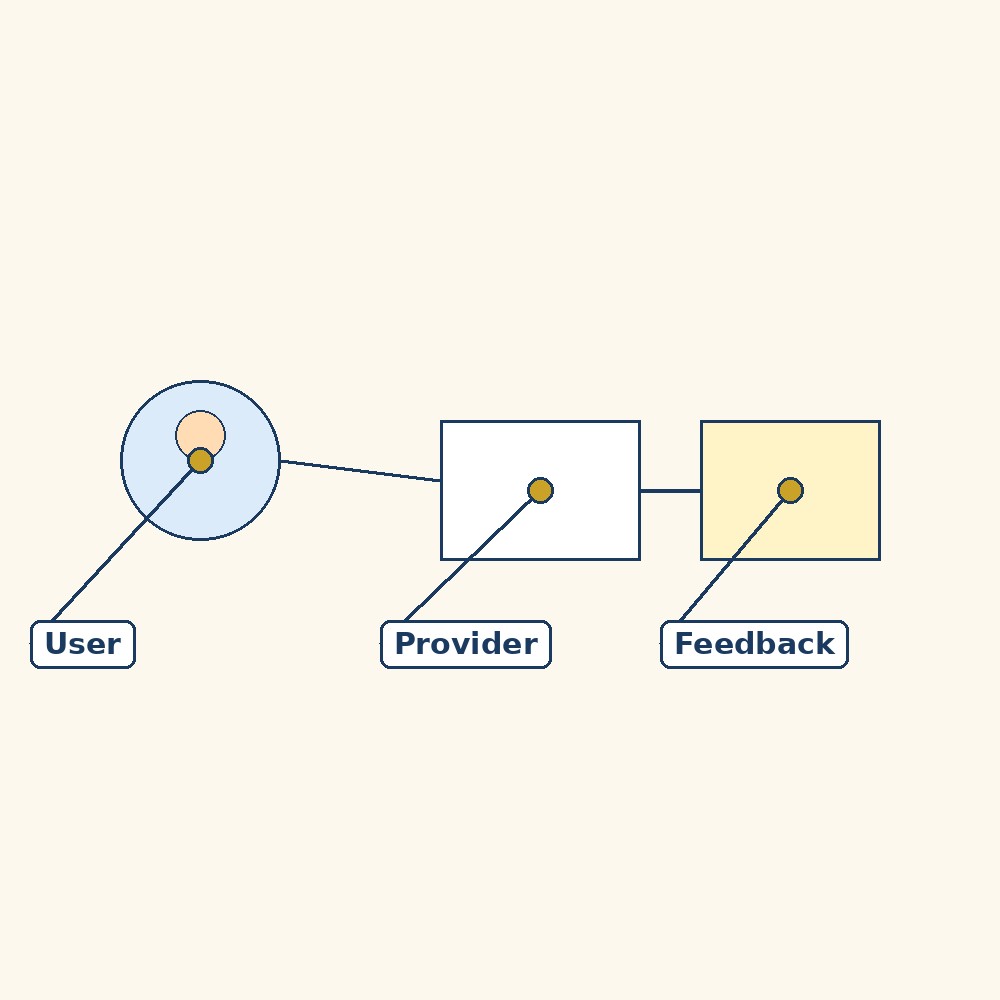
Diagram (labels are printed on the image): The chain of service: the user, the provider, and the feedback that improves the next service.

Helping visitors in a service space. A general picture about personal services; it is not a scene from the book.
What the chapter is about
Services provided on an everyday basis in the home or community are informal, while services organised so that large numbers of people can benefit from them are either voluntary or professional. Note carefully: the word “professional” refers only to how the work is organised; it does not mean greater dignity or value belongs to some kinds of work. Dignity is the inherent respect and honour that every person deserves, regardless of job title. Whether someone is a trained professional or an untrained worker, their work is equally worthy of respect, because it fulfils a human need.
Professional services are offered by trained people like nurses, drivers, counsellors, cooks, clerks or technicians, who combine skill and commitment and act to support others. Yet all forms of service — informal, voluntary and professional — share the same foundation, which this chapter teaches: service orientation, service environment, consent and service quality criteria. Healthcare and tourism (Chapters 10 and 11) then apply this foundation, and Chapter 12 gives guidelines for hospitality, event management, data-based services, interior design and public information services.
Developing service orientation: four qualities
We are both givers and receivers of service. Just as we expect good service when we receive it, we too must offer thoughtful service when it is our turn. The ability to empathise with others helps us understand how to interact with them and how to identify and respond to their needs. This way of thinking — valuing people’s needs, acting with care and finding satisfaction in serving others — is called service orientation. For example, if we visit a shop and the salesperson listens patiently, explains where things are kept and guides us without irritation, we feel at ease and happy, and we are likely to return because of the service.
Service orientation comprises four key qualities:
1. Being centred on the user. Every service exists to meet someone’s need, so before starting, ask: Who am I serving? What do they really need? Think about how to make sure users receive the service as intended. The chapter’s flood relief camp shows this: a school houses the camp with limited toilets, so portable toilets are organised; people may be hurt or fall ill from exposure, so a first aid centre is set up; and although the space is mostly makeshift, it is planned with the user in mind — clothes, bedding, medicine, clean water and food for people abruptly displaced from their homes.
2. Making fair and ethical decisions. Fair and ethical decision-making means reflecting on a situation from all angles and choosing what is correct. When users know they will be treated fairly and ethically, they feel respected and service quality improves. In practice this means actions that are fair, safe, trustworthy and inclusive for everyone, irrespective of background: following agreed processes, like maintaining a queue and serving persons as per their turn, while making exceptions for a few — seats earmarked for the elderly in public transport, for example; making sure everyone is treated with dignity and their privacy maintained, for example keeping the door closed while treating a patient in a clinic; and making decisions that consider everyone’s needs, not just the loudest voice.
3. Contribution to society. Every act of service — big or small — helps improve society. When we try to understand what others need and respond with patience, service does not feel like a burden. Simple actions — helping an older neighbour read a message on their phone, showing a new student the right classroom, helping keep a shared space clean — slowly build a kinder, more responsible community. In professional spaces (an elder care worker, a school administrator, a sanitation worker) these actions become part of professional services, and professionals often go beyond the call of duty and contribute to society and the nation, as seen during the COVID-19 pandemic, declared a global threat by the World Health Organisation (WHO) from March 2020 to May 2023.
4. Organisation and teamwork. In a service environment, teamwork and organisation are extremely important for ensuring every professional works towards the same goal. Many services — retail, hospitality, healthcare — depend on a “chain of service” where one person’s work directly affects the next person’s. In a restaurant, if the waiter (front-end) does not communicate well with the kitchen staff (back-end), the customer receives the wrong order. When nurses change shifts, they ensure the next person knows the patient’s requirements, so there is no change in the service the patient receives. Organisation means detailed planning, ensuring all tools and materials are available, scheduling work as per time available and deadlines, and assigning responsibilities.
Service environment, consent and quality criteria
Creating service environments. A service environment comprises the physical and the social environment, including safety considerations. The physical environment should be clean, well-organised and safe: is the place clean with well-placed furniture? Is it well-ventilated, without any bad odour? Does it have basic amenities — clean bathrooms, a water dispenser and a first-aid kit? The social environment matters just as much: imagine a dental clinic that is neat and well-furnished with the best amenities, but where the assistant answers coldly or cancels your appointment without prior notice. You would not be happy — behaviour is part of the environment, not an extra.
Consent. In human services, a consent form is an agreement between the service provider and the person being helped. It tells the person exactly the service they will receive and what is expected of them in return. Consent acknowledges the right of the service user to make decisions regarding their comfort and safety, and helps build a safe and trusting relationship. It is rooted in respect for every person’s right to control what happens to their body and lives: service users must have a complete understanding of what is offered and willingly give their permission before an action is taken, and they must be aware of potential risks, however minor.
Service quality criteria. Working in services involves step-by-step practices “before”, “during” and “after” the service, leading to the satisfaction of those receiving it. Each step falls into input (before), process (during) or output (after) the service. At the input stage, quality means: needs of service users identified; space clean and hygienic; tools and materials procured before starting; a task checklist prepared; consent received; and the service environment oriented towards efficient processes. During the service, the plan and checklist are followed with clear communication and hygiene; after it, feedback is collected, the service is reviewed, and improvements are made next time.
Chart / Table: Service quality at three stages
| Stage | Key focus | Quality means |
|---|---|---|
| Input (before) | Resources, materials, preparation | Needs identified; clean space; tools ready; checklist made; consent received |
| Process (during) | Delivery as planned | Clear communication; hygiene maintained; fair order; safety followed |
| Output (after) | Review and improvement | Feedback collected; what worked noted; changes made next time |
Choosing a vocation, and delivering well
This unit contains details of healthcare and tourism, as well as guidelines for hospitality, event management, data-based services, interior design and public information services. To choose your vocation, explore the human-service work you observe around you — what it involves, its inputs, key processes and outcomes — and map your resources: do you think you can do this work in school, and why or why not?
While delivering human services: before you begin, ensure the service environment is clean, hygienic, welcoming and attractive, whether you are serving water at a community event or helping at a school desk. Human service is all about interaction: always let the other person finish speaking before you respond, listen carefully so the service actually addresses their needs, and remember that your attire and demeanour also matter. Following a set schedule and fixed rules (protocols) ensures the service is fair for everyone, with no one waiting unnecessarily. And always ask for permission before you start — whether helping an elderly person cross the road or collecting data for a school project, always seek consent.
Key Terms
- Service orientation — Valuing people’s needs, acting with care, and finding satisfaction in serving others.
- Dignity — The inherent respect and honour every person deserves, regardless of job title.
- Informal / voluntary / professional services — Everyday home or community help; organised unpaid help; organised trained help.
- Chain of service — The sequence where one person’s work directly affects the next person’s service.
- Service environment — The physical, social and safety conditions of the place where service happens.
- Consent — The service user’s informed, willing permission, given before any action, with risks understood.
- Consent form — A written agreement stating what service will be given and what is expected in return.
- Quality criteria — Standards checked at input (before), process (during) and output (after) stages of a service.
- Empathy — Understanding others’ feelings and needs in order to respond to them well.
Remember
- Professional = organised, not superior: dignity belongs to every worker equally.
- Service orientation has four qualities: user at centre, fair and ethical decisions, contribution to society, organisation and teamwork.
- Ask first: Who am I serving? What do they really need?
- Environment is physical + social + safety: clean rooms need kind behaviour too.
- Consent means complete understanding plus willing permission, before action, with risks known.
- Quality is checked before (input), during (process) and after (output) — and after means feedback and improvement.
Exam Tip / Common Mistake
Common mistake: describing service orientation with words (“polite”, “kind”) instead of actions. Examiners ask which actions showed it: listening without interrupting, guiding without irritation, serving by turn, handing over properly. Always answer with an action, not an adjective.
- Services are informal, voluntary or professional — and “professional” never means more worthy.
- Service orientation = user at centre, fair and ethical decisions, contribution to society, organisation and teamwork.
- The chain of service means one broken handover breaks the next person’s service.
- Environment is physical, social and safety together; consent is informed permission before action.
- Quality runs before, during and after — ending in feedback and improvement, not applause.
Practice set — try it yourself
- What does “professional” mean in this chapter, and what does it not mean?
Hint: Organisation — not dignity or value. - Name the four qualities of service orientation.
Hint: User, fairness, contribution, teamwork. - What two questions must you ask before starting any service?
Hint: Who, and what do they really need? - What is a consent form, in one sentence?
Hint: An agreement stating service given and expected in return. - Name one physical and one social feature of a good service environment.
Hint: Clean bathrooms — and a warm, honest welcome.
Questions with Answers
- What are informal, voluntary and professional services, and what is dignity?
Informal services are everyday home or community help; voluntary services are organised so large numbers benefit without professional organisation; professional services are organised trained work (nurses, drivers, counsellors, cooks, clerks, technicians). “Professional” describes organisation only. Dignity is the inherent respect every person deserves regardless of job — trained or untrained work is equally worthy because it fulfils a human need. - What is service orientation, and what are its four qualities?
Valuing people’s needs, acting with care and finding satisfaction in serving others, built on empathy. Its four qualities: keeping the person receiving the service at the centre; fair and ethical decision-making; contribution to society; and organisation and teamwork. - Explain the chain of service with an example.
In services like retail, hospitality and healthcare, one person’s work directly affects the next person’s. In a restaurant, if the waiter (front-end) does not communicate well with the kitchen staff (back-end), the customer receives the wrong order. When nurses change shifts, they hand over the patient’s requirements so the service the patient receives does not change. - What makes a good service environment?
Physical: clean, well-organised, safe, well-ventilated, without bad odour, with basic amenities like clean bathrooms, a water dispenser and a first-aid kit. Social: warm, honest behaviour — a neat clinic with a cold, unexplained cancellation still fails, because tone and communication are part of the environment. Safety considerations run through both. - What is consent, and why does it matter?
Consent is the service user’s informed, willing permission before any action, recorded in a consent form stating exactly what service will be given and what is expected in return. It matters because it respects every person’s right to control what happens to their body and life, ensures complete understanding including risks, and builds a safe, trusting relationship.
Extension Questions with Answers
- Which actions — not words — show strong service orientation? Name three from the chapter’s examples and one you would practise.
Listening patiently in a shop and guiding without irritation; planning a relief camp around users’ real needs (portable toilets, first aid); handing over patient requirements fully at a shift change. Any of these, practised consistently, counts more than any polite slogan — and a good answer names the action and the need it met. - Compare a clean, organised, welcoming service space with a messy, confusing one. How does the environment change users’ feelings and behaviour?
The welcoming space makes users feel respected, calm and willing to cooperate: they find what they need, trust the provider and follow instructions. The messy space creates confusion, anxiety and complaints, and users may leave or argue — even when the underlying service is identical — because environment shapes expectation before service begins. - What adds value to service in a shop — range, arrangements, décor, interaction, labelling? Which actions make the biggest difference?
All add value, but interaction and clarity matter most: a salesperson who listens, explains where things are kept and guides without irritation, plus clear labelling and instructions, changes the user’s experience more than décor alone. Range and arrangement help only when users can find and understand them. - During a crowded event, some guests demand to be served first. How would you respond, and what preparation could have prevented it?
Respond calmly and fairly: acknowledge them, explain the queue and the agreed order, and offer exceptions only for genuine need (elderly, disabled, ill), as fair decision-making requires. Prevention belongs in preparation: visible queues, clear signage, announced order of service, and volunteers assigned to manage crowds before the rush begins. - Plan a cloth donation drive: a big hall, four volunteers, 60 donors in two hours. How do you arrange space, roles and fairness?
Arrange the hall in flow order — entry and registration, collection, sorting, packaging, exit — with clear signs and separate queues so donors never cross. Assign roles: one greeter and registrar, one collector, one sorter, one packer and record-keeper (rotating to avoid fatigue). Keep it fast, fair and safe by serving strictly by turn with need-based exceptions, keeping paths clear, and recording every donation for transparency.
How to use this page: Read the summary, say the Key Terms in your own words, then try the practice set without looking. Use the Questions with Answers to check yourself afterwards. Ask your teacher or parent to check your answers.