

Chapter 10: Healthcare
A health camp helps, never treats: check with care, explain everything, and always send people to a doctor when needed.
Original notes — ready CBSE (NCERT, English Medium) • Class 9 • Skill Education • Book: Kaushal Vikas
Chapter 10: Healthcare — EG’s own notes, in simple words
Book: Kaushal Vikas (CBSE, Class 9) | Chapter 10 | Unit: Unit III: Work in Human Services | Medium: English
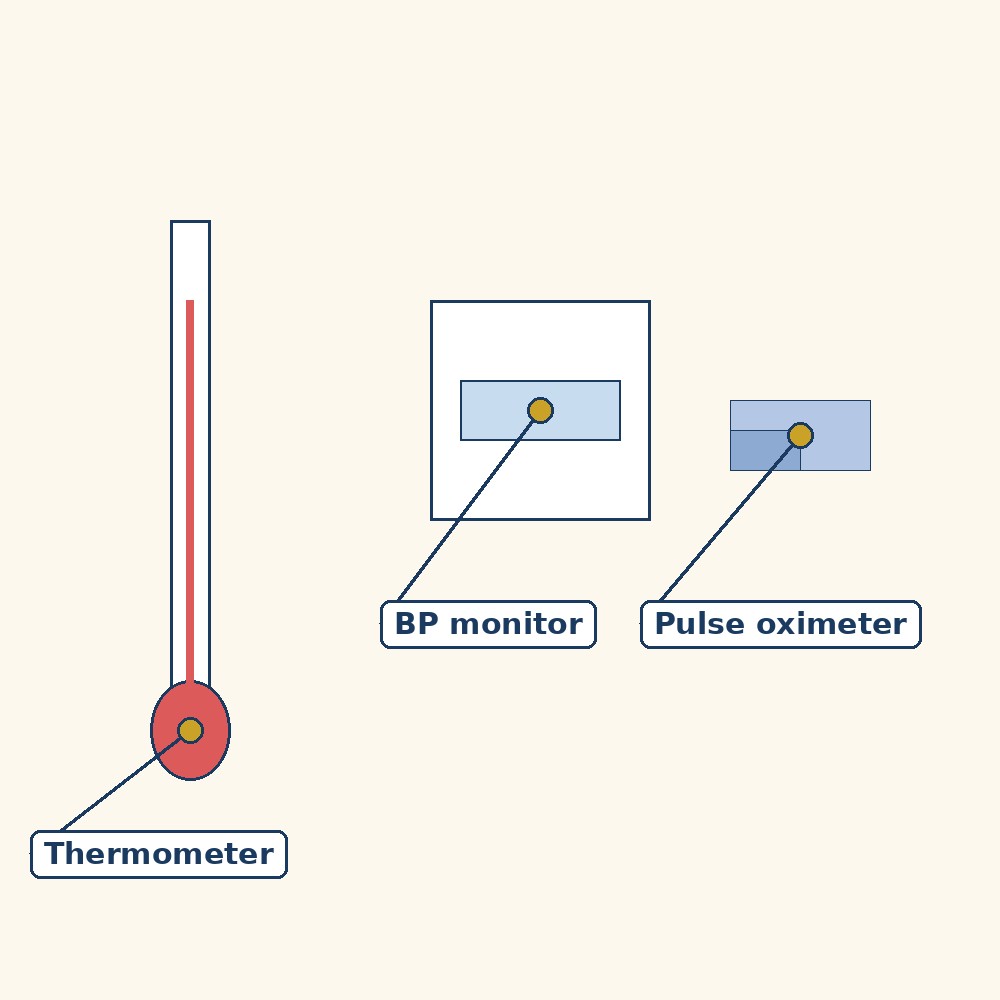
Diagram (labels are printed on the image): Health-camp tools: thermometer, BP monitor and pulse oximeter — for observation and awareness only.

Checking health at a camp. A general picture about healthcare; it is not a scene from the book.
What the chapter is about
Health is the foundation of life: we learn, work and enjoy life more fully when we are healthy. Health is shaped daily by clean surroundings, safe water, nutritious food, physical activity, mental well-being, timely care and support. Healthcare brings services closer to where people live. In India, healthcare has always had two faces: preventive measures (protecting health before illness) and curative care (treating illness). Auxiliary Nurse Midwives (ANMs) and Accredited Social Health Activists (ASHAs) play a vital role in rural areas by connecting communities with formal healthcare facilities. This chapter applies Chapter 9’s service foundation — orientation, environment, consent, quality — to a school health camp.
The one rule that governs everything: students must focus on support, awareness and assistance — and must NOT provide medical diagnoses or treatments. A camp checks, explains and refers; it never decides what is wrong or what medicine to take.
Scoping, process chart and site visit
What kind of service? Think through what you can offer: a health awareness camp, hygiene and sanitation activities, nutrition and fitness materials, or basic first aid awareness. Do not promise treatment. Resources range from stationery for posters to devices for checking parameters, and you must work with support from a nurse, doctor, local health worker or expert.
Process chart. The chapter’s caselet camp covers three task families: (1) monitoring vital signs — temperature, blood pressure, blood sugar, oxygen saturation, weight, height and Body Mass Index (BMI); (2) demonstrating homemade remedies; and (3) building awareness of occupational hazards. The chart runs from scoping, through site visit, materials and tools, bill of materials (BoM), consent and preparation, to delivery and review.
Site visit. Visit a healthcare site with your teacher and interact with a doctor, a nurse, an ASHA or ANM, a pharmacist and a laboratory technician. Observe their tools and materials, procedures and safety practices, and ask what practitioners value most and what challenges they face — their answers shape a realistic camp.
Materials, tools and bill of materials
Materials. Personal Protective Equipment (PPE) — gloves and masks, a new pair for every person, disposed of in a covered biomedical waste bin. Separate waste bins for regular waste and biomedical waste, kept closed with lids. A measuring tape and weighing scale for height and weight, and yoga mats that are clean, dry and laid straight.
Tools (observation and awareness only). A thermometer for body temperature — sanitise the tip before and after use and handle it gently. A pulse oximeter or smartwatch for oxygen saturation and pulse — clean the sensor and keep the finger dry. A stopwatch for pulse, breathing and exercise duration — keep hands dry and do not reset it accidentally. A blood pressure monitor (sphygmomanometer) for blood pressure — fit the cuff properly, clean it after use and do not overinflate. A glucometer for blood sugar — again, observation only.
BoM (caselet). Gloves, 50 pairs, ₹250 (single use); sanitiser, 2 bottles of 500 ml, ₹300 (refillable); masks, 50, ₹200 (single use); first-aid kit, 1, borrowed from the Primary Health Centre (PHC) or school; stationery, 1 set each, ₹400 (posters); BP monitor, oximeter and thermometer, 1 each, borrowed from the PHC. Labour cost is included in the total.
Consent, preparation: vital signs, remedies, hazards, first aid
Consent. As in Chapter 9, a consent form is an agreement stating the services offered and safety expectations; it is not a legal document. For a health camp it must also clarify that the camp is NOT a substitute for medical treatment, and take consent for health data and photographs. Visitors fill and sign the form during registration.
Vital signs (Table 10.7). Practise measuring under supervision: temperature with a thermometer; blood pressure with a BP monitor; weight and height, from which BMI is calculated; oxygen saturation and pulse with an oximeter; blood sugar with a glucometer (observation only).
| Parameter | Tool | Normal range (chapter) | When to act |
|---|---|---|---|
| Temperature | Thermometer | 97–99°F, average 98.6°F | Above 99°F = fever; above 103°F = medical emergency |
| Blood pressure | BP monitor (sphygmomanometer) | Below 120/80 mmHg | Above 140/90 mmHg needs medical attention |
| Height, weight, BMI | Tape + scale | Recorded for awareness | Refer unusual results to a doctor |
| Oxygen saturation, pulse | Pulse oximeter / smartwatch | Recorded for awareness | Refer unusual results to a doctor |
| Blood sugar | Glucometer | Recorded for awareness | Refer unusual results to a doctor |
Homemade remedies. Traditional remedies for minor everyday complaints use natural ingredients — herbs, spices and household items. They can prevent illness and give quick relief until medical help is available, but they do NOT replace a doctor. Examples: herbal teas, turmeric milk, and aloe vera gel, from a family tradition. AYUSH covers Ayurveda, Yoga and Naturopathy, Unani, Siddha and Homeopathy. The chapter’s task: ask parents, grandparents or elders for one or two safe, easy remedies and practise them.
Occupational hazards and prevention. Long hours, repeated movements, heat, noise, pollution and uncomfortable postures cause work-related problems: a rickshaw driver’s back pain, a tailor’s eye strain, a cook’s exposure to heat and smoke, a computer user’s neck and shoulder pain and eye strain. Prevention: correct posture (straight back, feet flat on the floor, screen at eye level, back supports like a rolled towel or lumbar roll; avoid slouching and twisting); stretching for 2–3 minutes each (knee-to-chest, standing forward-bend, side-lunge, kneeling, upper-arm and arm-bent-over stretches); breathing exercises (deep breathing for 5 slow cycles, diaphragmatic breathing, Anuloma-Viloma alternate-nostril breathing); and yogasanas (Bhujangasana, Tadasana, Vajrasana). Survey your community, add its hazards to the list, and plan awareness around them.
Basic emergency response — limits first. From Grade 7 first aid: cleaning small wounds, cooling burns, and giving Oral Rehydration Solution (ORS). At a camp, demonstrate safe steps for fever, heat cramps, nose bleeds, small cuts and scrapes, and snakebites: symptoms, response, and what NOT to do — and respond calmly until a trained adult arrives. The limits are strict: first aid is only the first response, not medical care; always call an adult first; do NOT give medicines or home remedies to an injured person; do NOT attempt advanced procedures like Cardio-Pulmonary Resuscitation (CPR) — only trained adults may do that.
Promoting the camp. Posters with date, time, place and services; announcements in school assemblies and community meetings; community walks informing parents and neighbours; notices at schools, community centres, anganwadis and local shops; school notice boards and social media, with due permission.
Providing the service, and while delivering
Delivery. Apply the Grade 6–8 Kaushal Mela planning pattern: planning, setting up the space, delivering, then post-event documentation and cleanup, coordinating with health professionals through your teacher and experts. The event checklist covers processes for the final day and who is responsible for each. The caselet checklist: screening (temperature, pulse, BP, oxygen saturation, BMI), demonstrations (first aid, yogasana, home remedies), and a meeting with the doctor and nurse. Physically, choose indoor versus outdoor space by expected visitors, lay out the space to avoid crowding, and put signboards from entrance to stalls to exit. Socially, keep a helpful, respectful service orientation and follow safety protocols for every process. Afterward, collect feedback through a short form or verbal questions, recording only general comments — never names or personal details — analyse it, note improvements, then clean the area and sort, store or dispose of materials safely.
While delivering: use tools and materials only as taught, and only for awareness; do not interpret results or give medical advice; use and store everything safely and hygienically; keep consent, privacy and respectful communication at the centre — explain the procedure before starting, protect privacy during checks, and communicate results politely without causing fear or confusion; emphasise healthy habits, exercise, hygiene, nutrition and safe work practices; and clean the area and dispose of waste as per protocol.
Key Terms
- Preventive / curative care — Protecting health before illness / treating illness after it occurs.
- ANM / ASHA — Auxiliary Nurse Midwife / Accredited Social Health Activist; the rural link between community and formal facilities.
- Vital signs — Temperature, blood pressure, blood sugar, oxygen saturation, weight, height and BMI.
- BMI — Body Mass Index, calculated from height and weight.
- PPE — Personal Protective Equipment: gloves and masks, new for every person.
- Biomedical waste — Used gloves, masks and similar material, disposed of in a separate covered bin.
- Sphygmomanometer — The instrument (BP monitor) that measures blood pressure.
- AYUSH — Ayurveda, Yoga and Naturopathy, Unani, Siddha and Homeopathy.
- ORS — Oral Rehydration Solution, for fluid loss.
- Occupational hazard — A health risk arising from work conditions: posture, heat, noise, repetition, pollution.
- CPR — Cardio-Pulmonary Resuscitation, an advanced procedure only trained adults may attempt.
Remember
- Camp rule: support, awareness and assistance only — never diagnosis or treatment.
- Temperature: 97–99°F normal (average 98.6°F); fever above 99°F; emergency above 103°F.
- BP: below 120/80 normal; above 140/90 needs medical attention.
- Gloves and masks are single use; biomedical waste goes in a separate covered bin.
- Home remedies do not replace a doctor; AYUSH = Ayurveda, Yoga and Naturopathy, Unani, Siddha, Homeopathy.
- First aid = first response only: call an adult first; no medicines, no home remedies, no CPR by untrained persons.
- Feedback records general comments only — never names or personal details.
Exam Tip / Common Mistake
Common mistake: writing that a health camp “treats” visitors or “prescribes” remedies. The chapter’s limit is absolute — students observe, demonstrate awareness and refer. Any answer that crosses into diagnosis or treatment loses marks, even if it sounds helpful.
- Health is daily: surroundings, water, food, activity, well-being, timely care and support.
- A school camp checks vital signs, demonstrates remedies and raises hazard awareness — never treats.
- Know the numbers: 97–99°F (98.6°F average); BP below 120/80; above 140/90 needs attention.
- Consent, privacy, hygiene and single-use PPE protect visitors and volunteers alike.
- First aid is first response only: adult first, no medicines, no CPR by the untrained.
Practice set — try it yourself
- What is the one rule that governs a school health camp?
Hint: Awareness, never diagnosis or treatment. - What is the normal temperature range, and when is it an emergency?
Hint: 97–99°F; above 103°F. - What does AYUSH stand for?
Hint: Ayurveda, Yoga and Naturopathy, Unani, Siddha, Homeopathy. - What are ANM and ASHA, and why do they matter in rural areas?
Hint: They link communities with formal facilities. - What must never be recorded in camp feedback?
Hint: Names or personal details.
Questions with Answers
- What is healthcare, and what shapes health daily?
Healthcare brings services closer to where people live, in two forms: preventive measures (protecting health before illness) and curative care (treating illness). Health is shaped daily by clean surroundings, safe water, nutritious food, physical activity, mental well-being, timely care and support. In rural areas, ANMs (Auxiliary Nurse Midwives) and ASHAs (Accredited Social Health Activists) connect communities with formal healthcare facilities. - What can a school health camp offer, and what must it never do?
It can offer a health awareness camp, hygiene and sanitation activities, nutrition and fitness materials, and basic first aid awareness — in the chapter’s caselet, monitoring vital signs, demonstrating homemade remedies, and building awareness of occupational hazards. It must never provide medical diagnoses or treatments; students observe, explain and refer to doctors. - Describe the camp’s tools and their safety rules.
Thermometer (temperature; sanitise the tip before and after, handle gently); pulse oximeter or smartwatch (oxygen saturation and pulse; clean the sensor, finger dry); stopwatch (pulse, breathing, exercise duration; dry hands, do not reset accidentally); BP monitor or sphygmomanometer (blood pressure; cuff properly fitted, cleaned after use, never overinflated); glucometer (blood sugar; observation only). Gloves and masks are single use, and biomedical waste goes in a separate covered bin. - What are the vital-sign numbers a student must know?
Temperature: 97–99°F, average 98.6°F; above 99°F is fever, above 103°F is a medical emergency. Blood pressure: below 120/80 mmHg is normal; above 140/90 mmHg needs medical attention. Height, weight and BMI, oxygen saturation, pulse and blood sugar are recorded for awareness, and unusual results are referred to a doctor, never interpreted by students. - What is the consent rule for a health camp?
A consent form is an agreement stating the services offered and safety expectations; it is not a legal document. For health camps it must also clarify that the camp is not a substitute for medical treatment, and take consent for health data and photographs. Visitors fill and sign it during registration.
Extension Questions with Answers
- Compare two community healthcare needs and prioritise one for a school service. How would you decide?
Compare by urgency, number of people affected, and what students can safely do. For example, widespread ignorance of safe drinking water and hand hygiene affects everyone daily and suits awareness work, while a need for medicines or treatment cannot be met by students at all. Prioritise the awareness need students can meet safely, and refer the treatment need to the PHC — need alone never justifies crossing the camp’s limit. - Write a safety checklist for the camp. What must be on it, and why?
New gloves and masks for every person; separate covered biomedical waste bins; sanitised thermometer tips and cleaned sensors and cuffs; consent forms signed before any check; privacy during checks; an adult and a health professional present; waste disposed as per protocol; and an emergency contact ready. Each item protects either the visitor’s health, their privacy, or the volunteers’ safety — missing one turns help into risk. - Which elements of service orientation and service environment matter most in healthcare, and why? Give examples.
Service orientation: listening fully before responding, explaining every procedure before starting, and communicating results politely without fear or confusion. Environment: a clean, uncrowded layout with signboards from entrance to stalls to exit, plus privacy during checks. In healthcare these matter most because visitors are often anxious and sharing personal information; trust is the service. - Why must the patient or visitor be at the centre of healthcare service? Give an example.
Because health service exists for their need, not the provider’s convenience: their comfort, privacy and understanding decide whether the service helps. Example: a visitor who is told what a BP check involves, checked in private, and given results calmly with advice to see a doctor leaves informed and reassured; the same check done hurriedly, publicly and unexplained leaves them anxious and less likely to seek care. - A health camp went wrong: visitors were rushed, not greeted, given no explanations, tools were unexplained, cleaning and waste rules were ignored, answers were brief, and visitors were left confused. What went wrong, and how would you fix it?
Service orientation failed (no greeting, no listening, rushed answers), the social environment failed (no welcome, no explanation), and safety failed (un cleaned tools, ignored waste disposal, no privacy). Fix it by staffing to the schedule, greeting and explaining every step, sanitising tools between visitors, using separate covered biomedical bins, protecting privacy, answering fully, and collecting proper feedback — then reviewing what went wrong before the next camp.
How to use this page: Read the summary, say the Key Terms in your own words, then try the practice set without looking. Use the Questions with Answers to check yourself afterwards. Ask your teacher or parent to check your answers.