

Chapter 3: Precision Farming
Give every plant exactly what it needs — the right water, food and care, at the right time, measured by data.
Original notes — ready CBSE (NCERT, English Medium) • Class 9 • Skill Education • Book: Kaushal Vikas
Chapter 3: Precision Farming — EG’s own notes, in simple words
Book: Kaushal Vikas (CBSE, Class 9) | Chapter 3 | Unit: Unit I: Work with Life Forms | Medium: English
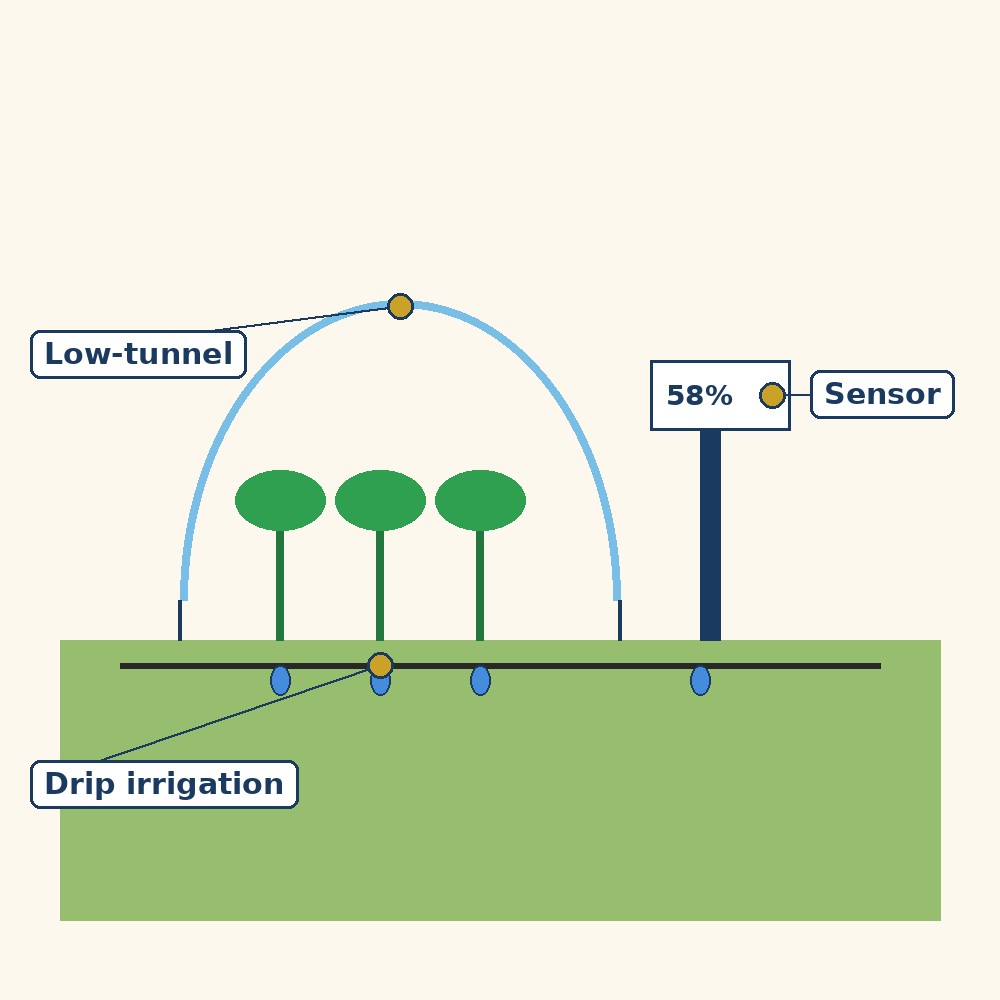
Diagram (labels are printed on the image): A precision farming unit: drip irrigation at the roots, a soil-moisture sensor, and a low-tunnel protecting the crop.

Using sensors and drip lines in a small farming unit. A general picture about precision farming; it is not a scene from the book.
What the chapter is about
Precision farming uses science and technology to improve agricultural yield while caring for the environment. The word “precision” means exactly as required and consistent — the same every time. So precision farming gives plants exactly what they need: the right amount of water, nutrients and care, at the right time and in the right amount.
It is especially useful in small nurseries, where space and resources are limited. By using drip irrigation and sensors and making data-based decisions, you can save water and avoid wastage, reduce excess use of fertilisers and pesticides, and grow healthier plants. Greenhouses and shade-nets are examples of precision farming, because plants there get essential conditions for growth as per need, not by guesswork.
This chapter is a project like Chapter 2: you scope the work, visit a precision farming unit, set up a unit in school, prepare biofertiliser, manage pests with data, and harvest, package and store the produce — with QR-code labelling.
Planning: scoping, process chart and site visit
Scoping. You may work with farmers already using precision techniques (in small groups of 5–10), establish a precision farming unit in your school including a small plant nursery, or convert your school garden into a precision unit by using technology-based inputs for decisions. Choose plants with a 2–3 month life cycle, using Chapter 1’s agro-climate discussion, and decide what will be useful for the school or community.
Process chart. List tasks with dates and responsibility: site selection and layout; deciding the crop protection method from agro-climatic data; testing for organic carbon and adding required compost; setting up a humidity chamber for raising seedlings; building a low-tunnel or shade-net; installing a drip irrigation system; preparing biofertiliser; identifying and managing pests using apps; harvesting; and packaging and transport with QR-code labelling.
Site visit. Interact with farmers, agricultural scientists or urban gardeners at a Krishi Vigyan Kendra (KVK), an agricultural university or a community greenhouse, with your teacher. Observe tools and materials and their storage, key processes, safety protocols, schedules, quality criteria and the digital tools and apps used — and ask the expert what they value most about their work.
Setting up the unit: weather data, layout and protection
Collecting weather data. In precision farming you can modify climatic conditions for better growth — providing shade, increasing humidity, protecting plants from rain and wind. Collect data from the school meteorological observatory (Chapter 1), the IMD website, the local KVK or an agricultural university, then choose the crop protection method from the chapter’s table.
Chart / Table: Crop protection methods
| Method | What it does |
|---|---|
| Greenhouse | Lowers temperature; protects from rainfall and frost |
| Low-tunnel | Increases temperature; traps solar heat; extends the growing season |
| Shade-net | Cuts excess sunlight and heat; protects from harsh sun |
| Humidity chamber | Gives seedlings very high, precise moisture and temperature for germination |
Layout. A small unit includes raised beds, a low-tunnel and an area for pots, plus a humidity chamber for seedlings, marked areas for beds or pots, and space for the water tank, pump, raw-material storage, pathways and composting. Build a small greenhouse, low-tunnel or shade-net on the basis of weather data and the chosen protection mode.
Humidity chamber and low-tunnel. A humidity chamber is a small, specialised structure giving extremely high, precise moisture and temperature — ideal for rapid germination of cuttings and seeds. Three simple ways to make one: place a clear polythene bag over a pot, over a tray, or place a pot inside a clear bottle whose bottom has been cut off. A low-tunnel is larger and less controlled: build a frame from bamboo, wood or metal rods, cover it with transparent polyethylene sheets to trap heat and moisture, spread sand and compost (1:1) at the base, and provide small openings or roll-up sides for airflow so it never overheats.
Materials, tools and Bill of Materials
Materials. Seeds and saplings (healthy, disease-free, handled gently, stored dry and cool); growing media (soil, cocopeat, vermicompost, sand, pot mix — wear gloves to prevent skin irritation and wash hands after handling organic media); bamboo poles or metal frames for low-tunnels, humidity chambers and shade-nets (securely fixed, free of sharp edges).
Tools. Hand trowel, measuring tape (flexible tape avoids sharp metal edges), hygrometer or humidity meter for the humidity chamber (handle carefully — the cover can break; do not expose to excess water), pruning scissors (blades closed when not in use), watering can or spray bottle, and drip irrigation parts. In the chapter’s caselet, students planned a 30 square metre unit with four plant beds — two under low-tunnels and two in open farming — plus a humidity chamber, water tank and material storage, and costed tools, materials, technologies and activity duration in their Bill of Materials.
Soil, biofertiliser, pests and harvest
Soil nutrients, measured — not guessed. You already know the mason-jar texture test and the soil pH test from Chapter 1. In precision farming, nutrient supply is precise: a soil-sensor-based “fertigation” system supplies fertiliser through drip irrigation. A simple classroom estimate of Soil Organic Carbon (SOC) compares two samples — soil without compost (control) and soil enriched with compost (test) — using 3% hydrogen peroxide (H₂O₂): the compost-rich sample reacts more vigorously, showing more organic matter. Compost is then added in measured, not random, amounts — the chapter’s assess question contrasts random compost application with measured application across two nursery beds.
Preparing an organic biofertiliser. Plants need essential nutrients during growth, supplied through organic fertilisers, liquid organic manure (jivamrita, vermiwash, panchagavya, compost tea) and compost (farmyard manure, vermicompost, kitchen-waste compost). Biofertilisers are made from beneficial micro-organisms — bacteria, fungi and algae — that help plants absorb nutrients and improve soil fertility. The chapter’s task prepares a Lactic Acid Bacteria (LAB) culture, a useful biofertiliser of beneficial lactic-acid-producing bacteria, starting from rice grains.
Pests, identified before they are fought. Insects are part of the ecosystem and must not be eliminated completely; manage the population while protecting the environment. Identification comes first: build a simple light trap — an eco-friendly tool that uses light to attract and trap harmful insects — to identify pests and reduce their numbers. The chapter also shows a do-it-yourself Light Dependent Resistor (LDR) sensor that switches the insect trap on and off automatically.
Harvesting, packaging and storage. Harvest on time for quality and shelf life, and use data to choose the moment: harvest when temperature and humidity are lowest, using trends from the school meteorological observatory. Data-driven decisions and sensors reduce crop losses, maintain quality and fetch better prices. Packaging includes QR-code labelling, so buyers can trace the produce.
Key Terms
- Precision farming — Giving plants exactly what they need, in the right amount, at the right time, using science, technology and data.
- Greenhouse — A covered structure that lowers temperature and protects crops from rainfall and frost.
- Low-tunnel — A low, covered frame that traps solar heat and extends the growing season.
- Shade-net — Netting that cuts excess sunlight and heat for growing plants.
- Humidity chamber — A small structure with very high, precise moisture and temperature for germinating seedlings.
- Fertigation — Supplying fertiliser through drip irrigation, guided by soil sensors.
- Soil Organic Carbon (SOC) — The organic matter in soil, estimated in class with a hydrogen peroxide test.
- Biofertiliser — A preparation of beneficial micro-organisms that helps plants absorb nutrients and improves soil fertility.
- LAB culture — A Lactic Acid Bacteria culture, a biofertiliser made from beneficial lactic-acid-producing bacteria.
- Light trap — An eco-friendly tool using light to attract, identify and reduce harmful insect pests.
- LDR sensor — A Light Dependent Resistor sensor that switches a device (here, an insect trap) on and off automatically with light.
Remember
- Precision = exactly as required, consistent every time — for water, nutrients and care.
- Choose protection from weather data: greenhouse, low-tunnel, shade-net or humidity chamber.
- A humidity chamber can be a polythene bag over a pot or tray, or a pot inside a cut bottle.
- Measure soil organic carbon and add compost in measured amounts — never randomly.
- Biofertilisers (like LAB culture) and light traps replace guesswork with biology and data.
- Harvest when temperature and humidity are lowest; label produce with QR codes.
Exam Tip / Common Mistake
Common mistake: calling any use of technology “precision farming”. A greenhouse with random watering is not precision farming. The examinable point is data-based decisions — sensors, measured doses and recorded trends changing what the farmer actually does.
- Precision farming gives plants exactly what they need, at the right time, in the right amount.
- Plan with a process chart and a site visit (KVK, agricultural university or greenhouse).
- Protect crops by data: greenhouse, low-tunnel, shade-net or humidity chamber, chosen from weather readings.
- Feed precisely: fertigation, measured compost for SOC, and biofertilisers like LAB culture.
- Manage pests by identification first (light trap, LDR sensor), then harvest on data and label with QR codes.
Practice set — try it yourself
- Define precision farming in one sentence, using the word “exactly”.
Hint: Right amount, right time — and the same every time. - Which protection method would you choose for a very hot, sunny site, and why?
Hint: The method that cuts sunlight, not traps heat. - Describe three ways to make a humidity chamber from classroom materials.
Hint: A bag, a tray, and a cut bottle. - What is fertigation?
Hint: Fertiliser + irrigation, guided by sensors. - Why identify a pest before spraying anything?
Hint: Insects are part of the ecosystem — and not every insect is harmful.
Questions with Answers
- What is precision farming, and why is it useful in small nurseries?
Using science and technology to give plants exactly what they need — the right water, nutrients and care at the right time and in the right amount — while caring for the environment. In small nurseries space and resources are limited, so drip irrigation, sensors and data-based decisions save water, avoid wastage, reduce excess fertiliser and pesticide use, and grow healthier plants. - Compare a greenhouse, a low-tunnel, a shade-net and a humidity chamber.
Greenhouse: lowers temperature, protects from rainfall and frost. Low-tunnel: traps solar heat, increases temperature, extends the growing season. Shade-net: cuts excess sunlight and heat. Humidity chamber: a small structure with very high, precise moisture and temperature, ideal for germinating seedlings and cuttings. - How is a simple low-tunnel built?
Build a frame from bamboo, wood or metal rods; cover it with transparent polyethylene sheets to trap heat and moisture; spread sand and compost (1:1) at the base, sprinkled with water to raise humidity; and provide small openings or roll-up sides for airflow to prevent overheating. - What are biofertilisers, and what is a LAB culture?
Biofertilisers are preparations of beneficial micro-organisms — bacteria, fungi and algae — that help plants absorb nutrients from soil and improve soil fertility. A LAB (Lactic Acid Bacteria) culture is one such biofertiliser, containing beneficial lactic-acid-producing bacteria, prepared in the chapter’s task starting from rice grains. - How does a light trap help pest management?
It uses light to attract and trap harmful insects, so farmers can identify which pests are present and reduce their population without chemicals. Identification first means control is targeted, and beneficial insects are not destroyed along with harmful ones.
Extension Questions with Answers
- Describe the role of digital tools in precision farming. How do they change farm decisions?
Tools like soil-moisture sensors, hygrometers, weather data and pest-identification apps replace guessing with measurement: watering follows sensor readings, protection follows weather data, and pest control follows identified species. Decisions become timely, measured and repeatable instead of habitual. - A farmer applies compost randomly in one nursery bed and in measured amounts in another. What difference would you expect, and why?
The measured bed should grow more uniformly: every plant gets the nutrients its soil test indicated, while the random bed gets patches of excess and deficiency. Measurement also avoids wasting compost and prevents over-application problems. - You must design a nursery layout. How would you ensure uniform growth and optimal use of resources?
Mark raised beds, a low-tunnel and pot areas from weather data; add a humidity chamber for seedlings; place the water tank, pump, storage and pathways to minimise carrying; compost in one corner; and use sensors and drip lines so water and nutrients reach every bed equally, with records for each bed. - “With the help of technology, you can grow anything, anywhere, anytime.” Do you agree? Give two examples, and explain how a farmer with limited water benefits.
Largely, with limits: greenhouses and low-tunnels let farmers grow tomatoes or cucumbers off-season or in harsh weather by controlling temperature and humidity, and hydroponics or drip systems let plants grow where soil is poor or space is small, like rooftops. But cost and resources limit everything. For limited water, drip irrigation delivers water directly to roots, soil-moisture sensors water only when needed, and automated systems control exact quantities — so far less water is wasted. - Suggest one low-cost innovation that could help small farmers adopt precision farming.
A bottle humidity chamber and a DIY LDR light trap cost almost nothing yet bring two precision ideas — controlled germination and pest identification — into any school or small farm. Paired with a shared soil-moisture sensor and IMD weather data on a phone, they give data-based decisions without expensive equipment.
How to use this page: Read the summary, say the Key Terms in your own words, then try the practice set without looking. Use the Questions with Answers to check yourself afterwards. Ask your teacher or parent to check your answers.