

Chapter 2: Rooftop Gardening
Turn an empty roof into a green kitchen garden — pots, light soil, sun and careful water.
Original notes — ready CBSE (NCERT, English Medium) • Class 9 • Skill Education • Book: Kaushal Vikas
Chapter 2: Rooftop Gardening — EG’s own notes, in simple words
Book: Kaushal Vikas (CBSE, Class 9) | Chapter 2 | Unit: Unit I: Work with Life Forms | Medium: English
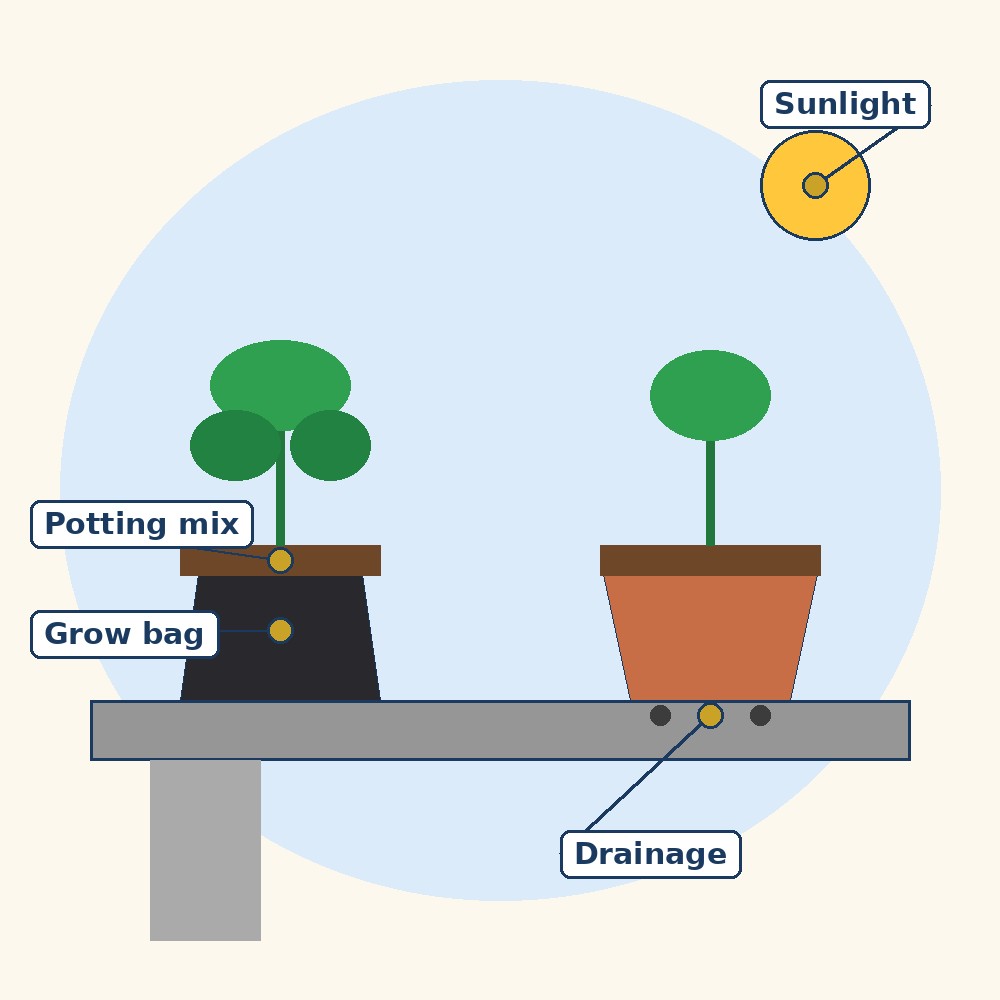
Diagram (labels are printed on the image): A rooftop garden: sunlight, a grow bag, light potting mixture, and drainage holes that stop waterlogging.
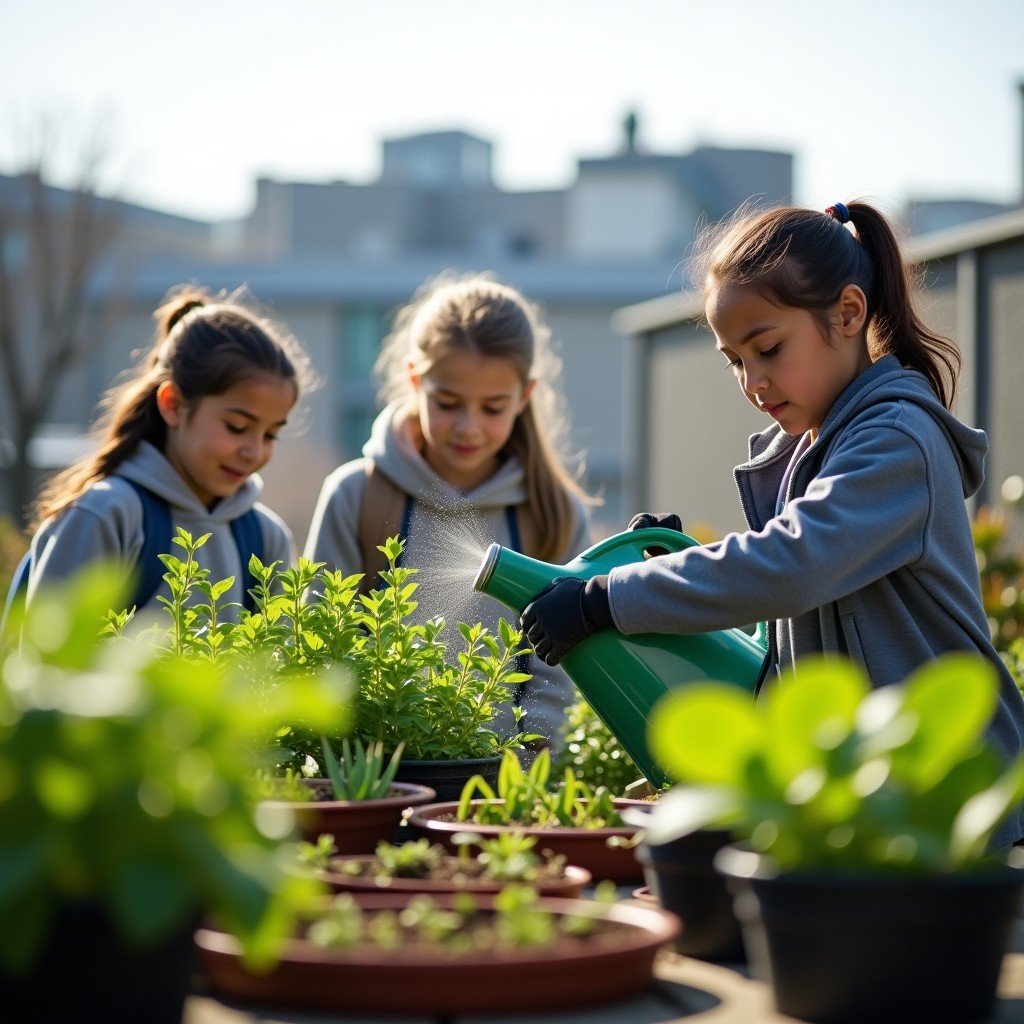
Plants growing in containers on a rooftop. A general picture about rooftop gardening; it is not a scene from the book.
What the chapter is about
Rooftop gardening means growing plants on the roof of a house, school or building — vegetables, fruits, herbs and flowers in pots, grow bags or specially prepared beds. It is especially useful in cities and towns, where open land for farming is limited. A rooftop garden reduces dependence on market produce, improves air quality, keeps buildings cooler during summers, and makes the surroundings beautiful.
The yield varies with the type of plant (leafy greens, fruits or flowers), the gardening method (soil, pots or water-based systems) and the care given. Even so, even a small space of just 1 square metre on a rooftop can yield about 10 kg of vegetables. This chapter is a project: you plan the garden, visit real rooftop gardens, choose materials and tools, prepare pots, maintain the plants, and finally harvest, pack and transport the produce.
Planning: scoping, process chart and site visit
Scoping the work. First decide: which plants should be grown? Use Chapter 1’s agro-climatic discussion to choose plants whose life cycle is 2–3 months. Consider sunlight needed, water needed (prefer plants that need little water), investment in pots and growing media, weight of pots, and usefulness — for example, vegetables for the midday meal, or flowers for the festival or wedding season. Also decide where on the roof they will grow.
Process chart. A process chart lists every task with estimated dates of completion and the person responsible: layout of the rooftop garden, soil testing and potting mixture preparation, germination test, sowing, maintenance (irrigation and weeding), protection from pests, monitoring growth and providing nutrients, harvesting, and packaging and transport.
Site visit. Visit rooftop gardens with your teacher — at residences, offices, hospitals, hotels or educational institutes — and learn from experienced practitioners. Record the process followed, tools and materials used and their storage and maintenance, safety protocols, schedules, quality criteria for inputs, process and output, and any digital tools or apps used.
Layout, materials and tools
Designing the layout. Leave adequate space between pots for watering and maintenance. Choose the part of the roof that receives at least 5–6 hours of direct sunlight every day; areas with partial shade suit herbs and leafy vegetables, while sun-loving plants like tomatoes and cucurbits go in open areas. Weight and safety matter most: pots, growing media and materials can overload a roof and damage the building, so heavy containers such as large pots or cement planters should sit close to the roof edges or above beams, with weight distributed evenly.
Selecting materials. Terracotta pots let air and moisture pass, preventing waterlogging around roots. Plastic pots are lightweight. Grow bags are flexible and easy to move. Cement pots have limited use since they are heavy and retain heat. Wooden containers let air pass, preventing temperature fluctuations and waterlogging. Recycled material — old buckets with holes drilled in the bottom, old sinks — works well and costs little. Never use only soil: the potting mixture must be light and nutrient-rich.
Selecting tools. A hand trowel digs soil and transplants seedlings; pruning scissors cut stems and shape plants (keep blades closed when not in use); a watering can or spray bottle waters gently, especially seedlings; buckets and trays carry soil mix and collect drainage water (never overload buckets, to avoid strain). Store sharp tools safely after use, and never leave them lying around.
Chart / Table: Containers for a rooftop garden
| Container | Advantage | Disadvantage / care |
|---|---|---|
| Terracotta pot | Air and moisture pass; prevents waterlogging | Heavy; place near beams or roof edges |
| Plastic pot | Lightweight | Can heat up; check drainage holes |
| Grow bag | Flexible, easy to move | Needs a tray for drainage water |
| Cement pot | Sturdy | Heavy and retains heat — limited use |
| Recycled bucket | Cheap, reuses waste | Must have holes drilled in the bottom |
Bill of Materials, potting mixture and sowing
Bill of Materials (BoM). The BoM estimates costs in advance, avoids wastage by buying only what is necessary, and organises the work step by step. List every material and tool with quantity and estimated cost, and include the cost of labour — the estimated time spent doing the work.
Preparing the potting mixture. Ordinary garden soil is too dense and heavy for pots: when watered, its particles pack together. Instead, mix cocopeat, vermiculite or perlite with compost or vermicompost and soil in a 1:1:1 proportion — light to carry, rich in nutrients, and free-draining. Test the pH as described in Chapter 1, and amend if needed.
Pot preparation and sowing. Collect material keeping weight (lightweight is better) and nutrient supply (manure or compost) in mind, prepare the 1:1:1 mixture, test its pH, and sow only after a germination test has shown the seed is viable. Good preparation at this stage prevents most later problems.
Maintenance: water, pests and weeds
Irrigation. Less water causes water stress (demand exceeding supply) and poor growth; heavy watering suffocates roots. Pots are unforgiving: in open soil, roots can grow deep in search of water and excess water percolates away — neither advantage exists in a pot. So irrigate with care. To estimate how much water the garden needs, measure the Water Holding Capacity (WHC) of the potting mixture: the maximum amount of water it can hold. The chapter’s task starts with 500 g of potting mixture in a container, weighs it, waters it, and compares weights to find how much water it holds.
Plant protection. Diseases and pests cannot be eliminated completely — they are part of ecology — but damage can be limited. Integrated management combines physical methods (removing diseased leaves and insect larvae), chemical methods (spraying organic pesticide) and biological methods (rearing beneficial insects). Observe each plant for symptoms such as spots or insect bites, and identify the pest using a mobile app or by sending photographs to experts.
Weeds. Weeds are unwanted plants in the garden. Remove them physically (hand-weeding, mechanised weeders), by mulching — organic mulching with bark, wood chips, straw, hay, grass clippings or shredded leaves, or plastic sheets — or by spraying chemical weedicides. To pull a weed by hand: identify it, loosen the soil gently around it, hold it firmly at the base near the soil surface, and pull slowly and steadily so the roots come out.
Harvesting, packaging and transport
Timely harvest ensures quality and a longer shelf life. Delayed harvest makes produce overripe, tasteless or quick to spoil. Handle gently — rooftop gardens produce small quantities, so every fruit, leaf or flower is valuable — and harvest in the early morning or late evening, when plants lose less water and wilt less. Use scissors, pruning shears or small knives for a clean cut; pulling damages the plant.
Packaging keeps produce fresh longer. Leafy vegetables like spinach, coriander and mint: wrap in a clean, damp cloth or newspaper and refrigerate soon after. Fruits like tomatoes and chillies: store in baskets, trays or ventilated corrugated cardboard boxes — never in tight plastic bags with no aeration, which trap moisture and cause rotting. Many fruits emit ethylene gas, which speeds ripening; ventilated boxes let the gas escape, so fruits store longer, especially during transport. Herbs: tie small bunches neatly with jute string or paper.
Key Terms
- Rooftop gardening — Growing plants on a roof in pots, grow bags or prepared beds.
- Grow bag — A flexible, lightweight container for growing plants, easy to move.
- Potting mixture — A light, nutrient-rich mix (1:1:1 of cocopeat/vermiculite/perlite, compost and soil) used instead of garden soil in pots.
- Cocopeat — Light, spongy material from coconut husk that holds water without weighing much.
- WHC — Water Holding Capacity: the maximum amount of water a potting mixture can hold.
- Water stress — Poor growth because the plant’s demand for water exceeds supply.
- Mulching — Covering soil with organic material or plastic sheets to suppress weeds and hold moisture.
- Integrated pest management — Combining physical, chemical (organic) and biological methods to limit pest damage.
- Ethylene — A gas naturally emitted by fruits that speeds up ripening.
- Bill of Materials (BoM) — A costed list of materials, tools and labour for a project.
Remember
- Rooftop gardens suit cities: little open land, but cooler buildings, cleaner air and fresh produce.
- Layout needs 5–6 hours of direct sun, space between pots, and heavy pots near edges or beams.
- Potting mixture is 1:1:1 — never garden soil alone, which is too heavy and packs tight.
- In pots, water carefully: too little stresses plants, too much suffocates roots.
- Protect plants by physical, organic-chemical and biological methods together — never one alone.
- Harvest early morning or late evening, handle gently, and pack leafy vegetables in damp cloth.
Exam Tip / Common Mistake
Common mistake: recommending tight plastic bags for all produce. They suit nothing that needs air: leafy vegetables need a damp cloth, and fruits need ventilated boxes so ethylene escapes. Packaging is chosen by the produce, not by what bag is nearest.
- Rooftop gardening grows food, herbs and flowers on roofs where open land is scarce.
- Plan first: scope (2–3 month crops), process chart, and a site visit to learn from practitioners.
- Layout needs 5–6 hours of sun and safe weight distribution; potting mix is 1:1:1, light and rich.
- Maintain with careful watering (know the WHC), integrated pest management and mulching against weeds.
- Harvest on time, handle gently, and package by type — damp cloth for leaves, ventilated boxes for fruits.
Practice set — try it yourself
- Why is ordinary garden soil unsuitable for rooftop pots?
Hint: Think weight, and what happens to its particles when watered. - Write the 1:1:1 potting mixture recipe in your own words.
Hint: One light material, one compost, one soil. - What is Water Holding Capacity, and why measure it?
Hint: It tells you how much water the mix can actually hold. - Name three mulching materials and one benefit of mulching.
Hint: Bark, straw and grass clippings are all in the chapter. - Why harvest in the early morning or late evening rather than at noon?
Hint: Heat, water loss and wilting.
Questions with Answers
- What is rooftop gardening, and why is it useful in cities?
Growing plants on the roof of a house, school or building in pots, grow bags or prepared beds. In cities open land is limited, so roofs become green spaces that give vegetables, fruits, herbs and flowers, reduce dependence on market produce, improve air quality, keep buildings cooler in summer and beautify surroundings. - What must a rooftop garden layout provide?
Space between pots for watering and maintenance; at least 5–6 hours of direct sunlight daily (partial shade for herbs and leafy vegetables, open sun for tomatoes and cucurbits); and safe weight distribution, with heavy containers near roof edges or above beams so the roof is never overloaded. - Compare terracotta pots, grow bags and recycled buckets.
Terracotta lets air and moisture pass and prevents waterlogging, but is heavy. Grow bags are flexible and easy to move. Recycled buckets are cheap and reuse waste, but must have holes drilled in the bottom for drainage. - How are pests and weeds managed in a rooftop garden?
Pests: integrated management — physical removal of diseased leaves and larvae, organic pesticide sprays, and beneficial insects; identify pests via apps or expert advice from photographs. Weeds: hand-weeding, mulching (organic materials or plastic sheets), or chemical weedicides; hand-pulled weeds must come out roots and all. - How should leafy vegetables and fruits be packaged differently, and why?
Leafy vegetables (spinach, coriander, mint) go in a clean, damp cloth or newspaper and into refrigeration soon. Fruits (tomatoes, chillies) go in baskets, trays or ventilated corrugated boxes: tight plastic bags trap moisture and cause rotting, and ventilation lets ethylene gas escape so fruits ripen more slowly.
Extension Questions with Answers
- Mix A is soil + compost + cocopeat; Mix B is soil only. After a month, Mix A plants are healthier and lighter to carry, while Mix B pots are heavy and waterlogged. Why?
Mix A is light, drains freely and feeds plants from compost, while cocopeat holds water without packing tight. Soil alone is dense and heavy, compacts when watered, and holds stagnant water around roots — so plants grow weakly and pots stay waterlogged. - On a site visit, one garden uses grow bags and another uses clay pots. Give one advantage and one disadvantage of each, and recommend one for your school garden.
Grow bags: easy to move and light, but need trays for drainage. Clay (terracotta) pots: prevent waterlogging through porous walls, but are heavy and breakable. For a school roof, grow bags usually win: light weight protects the roof and students can move them — provided drainage trays are used. - Tomato plants turn yellow despite regular watering, and the pots are waterlogged from blocked drainage holes. What went wrong, and what two precautions prevent it?
Blocked holes trapped water, suffocating roots, so leaves yellowed even though water was plentiful. Prevention: check and clear drainage holes before planting and at every watering, and always use a free-draining 1:1:1 potting mixture rather than dense soil. - Five kilograms of spinach packed half in plastic bags and half in damp cloth: after two days the damp-cloth spinach is fresher. Why, and what lesson follows?
The damp cloth keeps leaves moist without sealing in stagnant water, while the sealed plastic bag traps moisture and heat, speeding decay. Lesson: packaging must match the produce — breathable and moist for leaves, ventilated for fruits. - Your school receives 15 six-inch pots and spinach, tomato and marigold seeds. Which plants would you select, and why?
Choose by agro-climatic fit, usefulness, life cycle and water need: spinach (leafy, short cycle, useful for the midday meal, modest water), marigold (flowers for festivals, hardy, low water) and a few tomatoes (useful fruit, but thirstier and needing open sun) — balancing food, decoration and the roof’s sun and water limits, rather than planting everything at once.
How to use this page: Read the summary, say the Key Terms in your own words, then try the practice set without looking. Use the Questions with Answers to check yourself afterwards. Ask your teacher or parent to check your answers.