

Chapter 1: Introduction to Agricultural Practices
India’s old farming wisdom plus new science — soil, seed, water and weather working together.
Original notes — ready CBSE (NCERT, English Medium) • Class 9 • Skill Education • Book: Kaushal Vikas
Chapter 1: Introduction to Agricultural Practices — EG’s own notes, in simple words
Book: Kaushal Vikas (CBSE, Class 9) | Chapter 1 | Unit: Unit I: Work with Life Forms | Medium: English
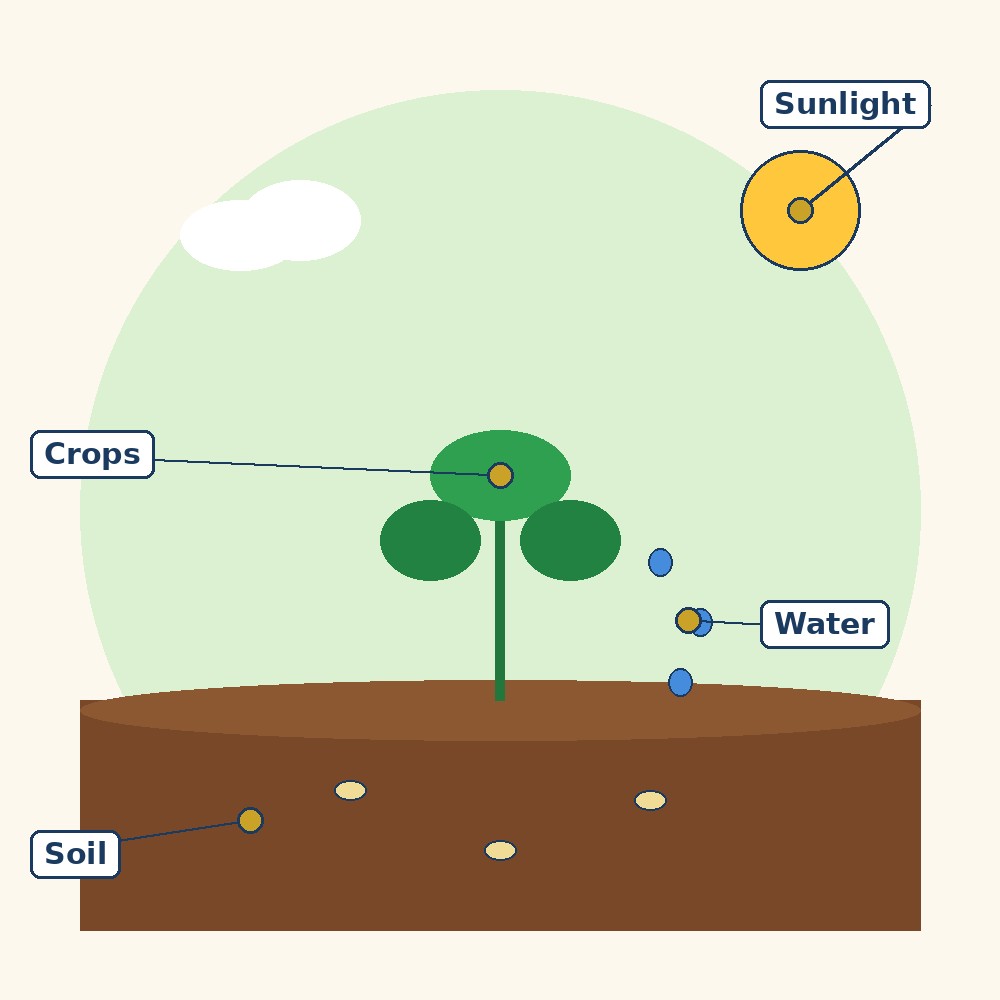
Diagram (labels are printed on the image): Sunlight and weather, the growing crop, water at the roots, and the soil with its seed — the four partners of farming.
Students learning farming basics in the school garden. A general picture about farming; it is not a scene from the book.
What the chapter is about
India is one of the oldest agricultural civilisations in the world, and today it is among the world leaders in farm output — leading in vegetables, fruits, milk, eggs and fish. Farming is not only about growing food: it builds life skills, and it offers jobs and entrepreneurship, especially as new technologies such as drones, robotics, biotechnology and Artificial Intelligence (AI) enter agriculture. According to the Economic Survey of India 2024–25, agriculture contributes 16% of India’s GDP and provides employment to 46.1% of the workforce.
The old texts already knew a great deal. The Krishi-Parashara gives a detailed account of traditional farming — soil preparation, crop selection, irrigation methods, seasonal planning and pest management — blending scientific observation with ecology. Those natural methods are still relevant today for problems like soil degradation, changing climate and the excessive use of chemical fertilisers.
This chapter is the starting point of Unit I, Work with Life Forms. It teaches you to read your own place before you grow anything: its climate, its soil, its seeds and its water. Later chapters turn this knowledge into projects — rooftop gardening, precision farming, and the additional vocations of mushroom cultivation, aquaponics, pisciculture, backyard poultry and non-timber forest produce.
Agro-climatic relationship: climate decides the crop
One critical factor in farming is climate. India has diverse agro-climatic regions: from the Himalayas to the coast of Kerala, cropping patterns change from region to region. Some parts grow rice, others wheat, cotton, soyabean, sugarcane or millets, and yet others fruits. A crop that thrives in one region may fail in another, so the first farming decision is always: what suits this place?
The India Meteorological Department (IMD) records meteorological observations and provides Agrotechnological Advisory Services (AAS). Its weather forecasts and advisories help farmers plan crops in the kharif, rabi and summer seasons, warn about rainfall or snow, and help other agencies predict outbreaks of livestock disease. A school meteorological observatory — with a rain gauge, a dry-wet bulb thermometer and a wind vane — lets students take the same kind of local readings and use them to decide plant selection, sowing, harvesting and irrigation.
Processes: soil testing, seed selection, organic inputs
Soil testing and amendment. Testing soil health matters for maintaining fertility. Soil testing covers physical parameters (soil texture, water holding capacity), chemical parameters (pH, nutrients, organic matter) and biological parameters (presence of microbes). Collect samples from different spots and mix them, because soil quality can vary even within a small area. Avoid shady areas, like under trees, and places where fertilisers are stored. Remove stones, leaves and debris, dry the soil in sunlight for a few hours, crush the clumps and sieve the mixture. Then test — for example, test the pH — and amend the soil as needed: organic matter improves sandy soil’s water holding, and lime reduces acidity.
Seed selection. If the seed is weak or unhealthy, the plant will also be weak, no matter how fertile the soil is. A germination test estimates the percentage of seeds that will actually sprout, so you know how many seeds to plant. Before sowing, seeds are treated to raise germination and protect against insects and diseases. A simple treatment for cereal crops like wheat and rice uses common salt (NaCl) in water: salt increases the density of water, so damaged or hollow seeds float and can be removed, while healthy seeds sink and are kept for sowing.
Organic fertilisers and pesticides. Vermicompost is made from agro waste and cow dung, layered in a pit under a green shade-net, with worms introduced and the pit watered and covered with a gunny bag to hold moisture. In the chapter’s caselet, students used 50 kg of agro waste and 50 kg of cow dung, harvested the vermicompost after six days, sieved it and packed it into 1 kg bags. Dashaparni arka is an organic pesticide made from ten materials: leaves of neem, karanj, custard apple, papaya, castor, marigold, lantana, bael, tulsi and hibiscus (200 g of leaves), with 220 g cow dung and 500 ml cow urine in 15 L of water in a 20 L bucket, fermented for 30–40 days, then sprayed at 15 ml per 1 L of water.
Chart / Table: Rainfall needs of some crops
| Crop | Rainfall needed (mm) |
|---|---|
| Rice | 1500–3000 |
| Wheat | 750–1000 |
| Jawar | 500–1000 |
| Pulses | 400–500 |
| Groundnut | 500–1250 |
| Soyabean | 500–1000 |
| Maize | 500–1000 |
Read the table with real rainfall data before choosing a crop. Rice needs far more rain than any other crop in the list; in a region whose yearly rainfall ranges roughly between 330 and 975 mm, rice can never be a safe choice, while pulses fit most years.
Chart / Table: Steps of good agricultural practice
| Step | What you do |
|---|---|
| Know the climate | Use IMD advisories and local observatory readings; match the crop to the season (kharif, rabi, summer) |
| Test the soil | Sample from several spots, test texture, pH, nutrients and microbes, then amend |
| Select seed | Run a germination test; treat seed (salt-water floating test for cereals) and sow healthy seed only |
| Feed and protect | Use vermicompost and organic pesticides like Dashaparni arka; water carefully |
| Harvest and sell | Harvest at the right time and follow the value chain to the consumer |
Value chain, vocations and working safely
The value chain in agriculture is the series of steps through which farm produce passes to reach the consumer. Prices change depending on where and how people buy: vegetables bought in supermarkets are often 300–400% more expensive than those bought in mandis. Knowing the chain helps a young farmer understand where value is added — and where it is lost.
This chapter also helps you choose the vocation you will take up in Unit I: rooftop gardening and precision farming are covered in detail in Chapters 2 and 3, and guidelines are given for mushroom cultivation, aquaponics, pisciculture, backyard poultry and non-timber forest produce (Chapter 4). Before choosing, explore vocations around you — through experts, site visits, libraries, online resources, government sites and reports — and map the resources available to you.
While doing agricultural work, always handle tools and materials as per the instructions of the teacher or expert, or as specified on packet labels and in manuals. Weather instruments, soil tests and seed tests are only useful when their readings are recorded honestly and used for the next decision.
Key Terms
- Agriculture — Growing crops and raising animals for food and other uses.
- Agro-climatic region — An area with a similar climate, which therefore suits similar crops.
- IMD — India Meteorological Department; records weather and issues forecasts.
- AAS — Agrotechnological Advisory Services; IMD’s farming advice based on weather data.
- Soil testing — Checking physical, chemical and biological health of soil before growing.
- pH — A measure of how acidic or alkaline the soil is.
- Germination test — A test that estimates what percentage of seeds will actually sprout.
- Vermicompost — Compost made with the help of worms from agro waste and cow dung.
- Dashaparni arka — An organic pesticide made from ten leaf types, cow dung and cow urine.
- NTFP — Non-Timber Forest Produce: useful forest products other than timber, like honey, lac, medicinal plants and bamboo.
- Value chain — The steps farm produce passes through from the field to the consumer.
Remember
- India is among the oldest agricultural civilisations and a world leader in vegetables, fruits, milk, eggs and fish.
- Climate decides the crop: match crops to your agro-climatic region and season.
- Test soil (texture, pH, nutrients, microbes) from mixed samples before amending it.
- Healthy seed matters more than fertile soil alone — test germination and remove floating seeds.
- Vermicompost and Dashaparni arka are the chapter’s organic fertiliser and pesticide.
- The value chain explains why the same vegetable costs far more in a supermarket than in a mandi.
Exam Tip / Common Mistake
Common mistake: naming a crop without checking rainfall. Rice needs 1500–3000 mm, so it is wrong for a low-rainfall region even if it is the most famous crop. Always match the crop’s rainfall range to the region’s actual rainfall data before you answer.
- Agriculture is 16% of India’s GDP and employs 46.1% of the workforce; old wisdom (Krishi-Parashara) and new technology both matter.
- Climate decides cropping: use IMD forecasts and AAS advisories for kharif, rabi and summer planning.
- Test soil from mixed samples (texture, pH, nutrients, microbes) and amend it — compost for sandy soil, lime for acidity.
- Select seed by germination test and the salt-water floating test; sow only healthy, sinking seed.
- Feed with vermicompost, protect with Dashaparni arka, and follow the value chain from field to consumer.
Practice set — try it yourself
- Why should soil samples be taken from several spots and mixed?
Hint: Think about how much soil can differ inside one small field. - Explain the salt-water test for cereal seeds in two sentences.
Hint: Salt changes the water — what floats, and what sinks? - List the ten leaves used in Dashaparni arka.
Hint: Neem, karanj and tulsi are three of them. - How does an IMD advisory help a farmer in the rabi season?
Hint: Sowing, irrigation and disease warnings. - A farmer’s soil is sandy and acidic. Suggest two amendments and one reason for each.
Hint: One holds water, the other cuts acidity.
Questions with Answers
- Why is agriculture important for India?
India is one of the oldest agricultural civilisations and a world leader in vegetables, fruits, milk, eggs and fish. Agriculture contributes 16% of GDP and employs 46.1% of the workforce, and it also builds life skills and offers jobs and entrepreneurship through drones, robotics, biotechnology and AI. - What is the agro-climatic relationship?
It means climate decides which crops suit a region: from the Himalayas to Kerala’s coast, cropping patterns change — rice in some parts, wheat, cotton, soyabean, sugarcane, millets or fruits in others. Farmers must match the crop to the region’s climate and season. - What does soil testing check, and how is a sample collected?
It checks physical factors (texture, water holding capacity), chemical factors (pH, nutrients, organic matter) and biological factors (microbes). Soil is taken from different spots and mixed, avoiding shady places and fertiliser stores; stones and leaves are removed, the soil is sun-dried, clumps are crushed and the mixture is sieved before testing. - How does the salt-water seed treatment work?
Common salt (NaCl) dissolved in water increases the water’s density, so damaged or hollow cereal seeds float while healthy seeds sink. The floating seeds are removed and only the healthy, sinking seeds are sown, after a germination test has estimated how many will sprout. - How are vermicompost and Dashaparni arka prepared?
Vermicompost: agro waste and cow dung layered in a pit under a shade-net, worms added, kept moist under a gunny bag; in the caselet, 50 kg of each gave compost in six days, sieved and packed in 1 kg bags. Dashaparni arka: 200 g of ten kinds of leaves plus 220 g cow dung and 500 ml cow urine in 15 L water, fermented 30–40 days, sprayed at 15 ml per litre of water.
Extension Questions with Answers
- A region’s rainfall over eight years ranged from 333 mm to 974 mm. Which crop — rice, wheat or pulses — is the safest choice, and why?
Pulses (400–500 mm) fit most years in that range. Rice (1500–3000 mm) never gets enough rain there, and wheat (750–1000 mm) fails in the dry years (333–494 mm), so pulses are the only safe choice of the three. - A team is building a meteorological observatory to monitor conditions for lac production by Kerria lacca. Which two instruments should it prioritise, and why?
A thermometer (with a dry-wet bulb thermometer for humidity) and a rain gauge. Lac insects need a warm, humid climate on suitable host trees, so temperature, humidity and rainfall are the conditions that decide whether the insect population — and lac yield — will thrive. - Why are the same vegetables 300–400% costlier in a supermarket than in a mandi?
Because of the value chain: every step between field and consumer — transport, grading, packaging, storage, retail space and staff — adds cost. The mandi is closer to the field with fewer steps, so the price stays lower. - How would you choose between rooftop gardening, precision farming and mushroom cultivation as your Unit I vocation?
By exploring vocations around you and mapping resources: what space, materials, experts and markets are available, what your agro-climatic conditions allow, and what is useful for your school or community. The chapter gives full project detail for the first two and guidelines for mushroom cultivation and the other additional vocations. - Why does the chapter insist on testing soil before adding fertiliser?
Because you cannot know what the soil lacks until you test it: its texture, pH, nutrients and microbes decide which amendment will help. Adding fertiliser blindly can waste money, worsen acidity or salinity, and still leave the real deficiency untreated.
How to use this page: Read the summary, say the Key Terms in your own words, then try the practice set without looking. Use the Questions with Answers to check yourself afterwards. Ask your teacher or parent to check your answers.