

Chapter 8: Taal or Talam and Raga or Ragam in Indian Music
Music • Keep the beat with taal and talam, and colour your mind with raga and ragam.
Original notes — ready CBSE (NCERT, English Medium) • Class 6 • Arts • Book: Kriti
Taal or Talam and Raga or Ragam in Indian Music — EG's own notes, in simple words
Book: Kriti (CBSE, Class 6) | Chapter 8 | Medium: English
Section: Music
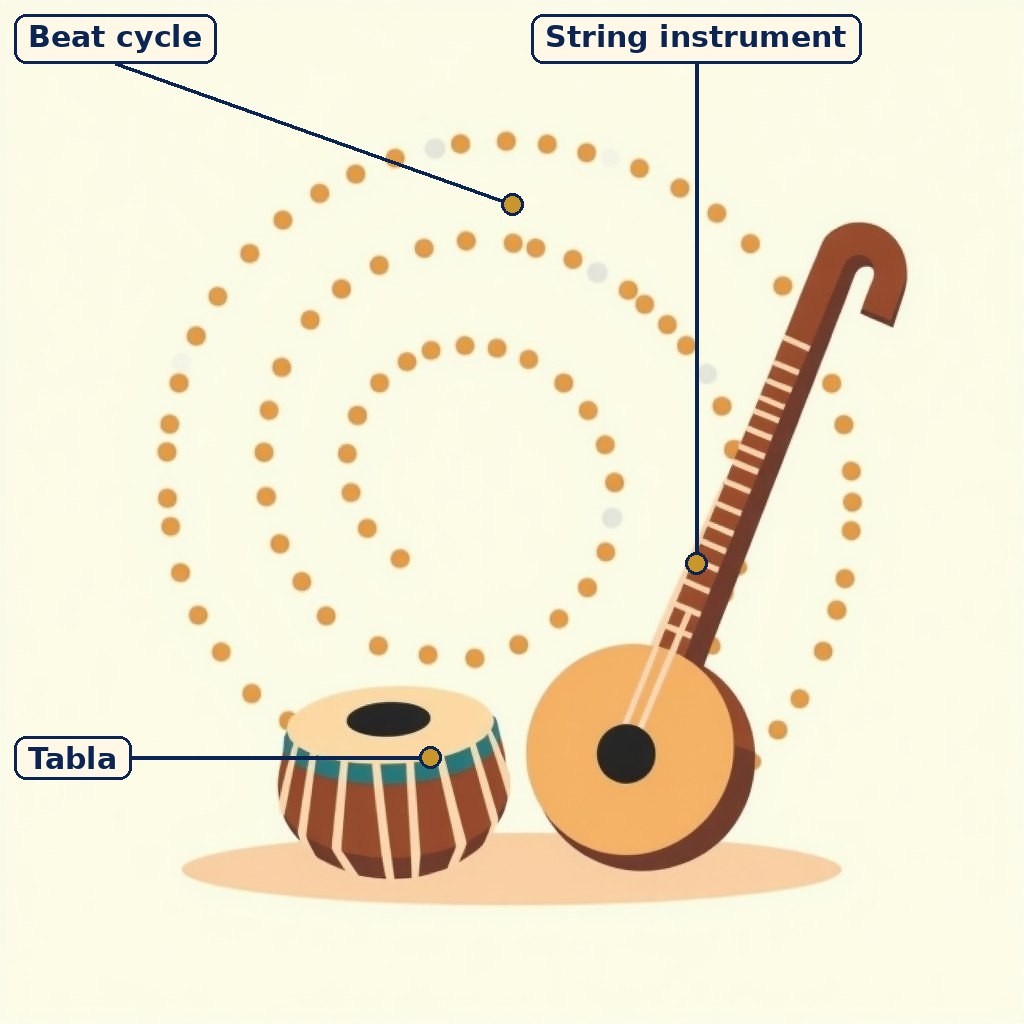
Diagram (labels are printed on the image): A hand clapping a beat pattern, with beat counts marked. A general teaching picture about keeping the beat; the hand is an illustration, not a real performance.

Musicians playing classical instruments together in rhythm. A general picture about Indian classical music; no real concert is pictured.
What the chapter is about
Understand the concept of taal or talam and rhythm in North and South Indian classical music. There are two different styles of classical music in India: Carnatic or South Indian classical music, and Hindustani or North Indian classical music. The taal or talam in each style has been explained to you in the earlier pages. In Carnatic music, talam is used to keep the beat. Each talam has a fixed number of beats and is repeated. This is known as a talam cycle or a cycle of beats. The parts of a talam are known as angas. The three angas are: drutam, anudrutam and laghu.
Drutam is a clap followed by the wave of the hand. It has two beats. It is represented as O. Anudrutam is just a clap. It has one beat and is represented as U, and it is less used in comparison to the above two. Laghu is a clap followed by counting of fingers. It can be 3, 4, 5, 7 or 9 beats. It is represented as | followed by the number of beats (as subscript). When the laghu has three beats, we call it Tisra or Tishra; when it has four beats, we call it Chaturasra; when it has five beats, we call it Khanda; when it has seven beats, we call it Misra; and when it has nine beats, we call it Sankeerna. When the laghu has three beats, therefore, is a cycle of six beats (4 + 2). It is represented as O | with the laghu number 4. When the laghu has four beats, followed by two drutams, it is a cycle of eight beats (4 + 2 + 2). It is represented as | with the laghu number 4, followed by O O. The chapter also gives two taal patterns to practise: a 16-beat pattern, “dha dhin dhin dha dha dhin dhin dha dha tin tin ta ta dhin dhin dha”, and an 8-beat pattern, “Dha Ge Na Ti Na Ka Dhin Na”.
Carnatic music uses instruments like the violin and the flute. The compositions are usually in the Sanskrit, Telugu, Kannada, Malayalam and Tamil languages. Hindustani music uses its own instruments, shown in pictures in the book. Songs are composed usually in Hindi, Sanskrit and Brijbhasha. Watch videos to understand taal and talam, and raga and ragam, and their moods! When writing the notes in the higher octave, the notes are represented by a dot on top, like S with a dot above. The notes in the lower octave are represented by a dot below, like S with a dot below. The notes in the middle octave are represented by just the note, like S.
Let us know another interesting terminology used for a specific set of notes in a raga. If a raga has five notes, it is known as audava. If a raga has six notes, it is known as shadava. If a raga has seven notes, it is known as sampurna. A raga is based on a scale. Every scale has notes in ascending and descending order. Imagine a staircase made of notes! The notes in the scale change according to the raga. Compositions in Indian classical music are typically called bandish in Hindustani classical music and kriti in Carnatic classical music. If you decorate a scale by using alankar or gamaka (ornamentations), repeating certain notes, and playing special phrases, it can become a raga. Listen to the raga. Each raga is ornamented with gamakas in its set of important notes and special phrases. In Sanskrit, raga means something that colours the mind. Every raga evokes certain emotional responses in the mind. This is called rasa.
Here are two raga examples. Raga Bilawal, in Taal Teentaal, has the ascending notes S R G M P D N and the higher S, and the descending notes higher S, N D P M G R S. Its composer is Traditional. Raga Yaman's predominant mood is shringar, or love. There are many popular songs composed in this raga. Learn and sing them! The ascending notes in Raga Yaman are N R G, the higher M, D N and the higher S. The descending notes in Raga Yaman are the higher S, N D P, the higher M, G R S. Note that the M in Yaman is higher than the regular M that you have sung before. This small shift in one note alters the mood of the song! The chapter's Yaman song describes Lord Krishna playing the flute and the people of Vrindavan dancing to its melody: “Brindavan ki kunj gali” and “Aa ja baja ii Kanha bansuri”. In the Hindustani music notation system, * denotes the extension of a word, and *- denotes the extension of a swara. A song on the guru is also given in the chapter, in the same higher-M scale, set to Teentaal.
Tyagaraja, Muthuswami Dikshitar and Shyama Shastri are known as the trinity of Carnatic music. They are considered the pioneer composers of Carnatic music. A mudra is a signature word of a composer. A kriti is a composition in Carnatic classical music, in praise of a God or a Goddess. One kriti example in the chapter is composed in a seven-beat rhythmic cycle divided as 3 + 2 + 2. The notes in this kriti are the same as the notes in the earlier scale, except for a higher M. This song is about Lord Vishnu, who is the protector of the universe, and describes his compassion and glory. Finally, singing techniques: gamakas are special decorations that musicians use to make their music sound more beautiful and expressive. The pitch of the note is modulated by oscillating or gliding to the next note.
What you should learn
- Define talam, its cycle, and its three angas: drutam, anudrutam, laghu.
- Build cycles from angas: 4 + 2 = 6 beats, and 4 + 2 + 2 = 8 beats.
- Compare Carnatic and Hindustani classical music: instruments and languages.
- Explain raga: scale, ascending and descending notes, ornamentation, rasa.
- Name Bilawal and Yaman, and the Carnatic trinity, and explain kriti and gamaka.
Key Terms
- Taal / Talam — The beat cycle in North (taal) and South (talam) Indian classical music; each cycle has a fixed number of beats and is repeated.
- Anga — A part of a talam: drutam, anudrutam or laghu.
- Drutam — A clap followed by the wave of the hand; 2 beats; represented as O.
- Anudrutam — Just a clap; 1 beat; represented as U; less used than the other two angas.
- Laghu — A clap followed by counting of fingers; 3, 4, 5, 7 or 9 beats; represented as | followed by the beat number.
- Raga / Ragam — A scale decorated with ornamentation, repeated notes and special phrases; in Sanskrit it means something that colours the mind.
- Aroha / Avaroha — The ascending notes and the descending notes of a raga's scale.
- Bandish / Kriti — A composition: called bandish in Hindustani classical music and kriti in Carnatic classical music.
- Gamaka / Alankar — Ornamentation, decoration of notes, that makes music more beautiful and expressive.
- Mudra — The signature word of a composer.
- Rasa — The emotional response a raga evokes in the mind.
In Raga Yaman, the M is higher than the regular M. That small shift in one note alters the mood of the song — which is why Yaman's mood is shringar, love.
Try it: clap a talam cycle
- Clap and wave for drutam (2 beats, O).
- Clap once for anudrutam (1 beat, U).
- Clap and count fingers for laghu (for example, 4 beats, | with subscript 4).
- Build a six-beat cycle (4 + 2) and an eight-beat cycle (4 + 2 + 2), and repeat each cycle.
- Sing the 16-beat pattern and the 8-beat pattern from the chapter, keeping the beat with your claps.
Chart / Table: The three angas
| Anga | What you do | Beats | Symbol |
|---|---|---|---|
| Drutam | Clap followed by wave of the hand. | 2 | O |
| Anudrutam | Just a clap. | 1 | U |
| Laghu | Clap followed by counting of fingers. | 3, 4, 5, 7 or 9 | | + beat number |
Remember
- Talam cycle: fixed beats, repeated; parts are angas.
- Drutam = O (2), anudrutam = U (1), laghu = | + number (3, 4, 5, 7, 9).
- Cycles: 4 + 2 = 6 beats; 4 + 2 + 2 = 8 beats.
- Raga = decorated scale; audava 5, shadava 6, sampurna 7 notes.
- Bilawal (Teentaal) and Yaman (shringar, higher M); kriti = Carnatic composition.
Exam Tip / Common Mistake
Common mistake: saying drutam is just a clap, or that a raga is only a scale. Drutam is clap PLUS wave (2 beats); anudrutam is just a clap (1 beat). A raga is a scale decorated with ornamentation, repeated notes and special phrases, and it colours the mind with a rasa.
Practice set — try it yourself
- What is a talam cycle?
Hint: Think about fixed beats, repeated. - Name the three angas with their beats and symbols.
Hint: O, U and |. - Build a six-beat and an eight-beat cycle from angas.
Hint: 4 + 2 and 4 + 2 + 2. - What is the difference between Carnatic and Hindustani music?
Hint: Think about instruments and languages. - How does a scale become a raga?
Hint: Think about decoration and special phrases.
Questions with Answers
- What is talam, and what are its three angas?
In Carnatic music, talam is used to keep the beat. Each talam has a fixed number of beats and is repeated, which is known as a talam cycle. Its parts, the angas, are: drutam, a clap followed by the wave of the hand, 2 beats, represented as O; anudrutam, just a clap, 1 beat, represented as U, less used than the other two; and laghu, a clap followed by counting of fingers, 3, 4, 5, 7 or 9 beats, represented as | followed by the beat number. - How are talam cycles built from angas? Give two examples.
A cycle is built by adding angas. A laghu of 4 beats plus a drutam of 2 beats gives a cycle of six beats (4 + 2), represented as O | with subscript 4. A laghu of 4 beats plus two drutams gives a cycle of eight beats (4 + 2 + 2), represented as | with subscript 4, followed by O O. - Compare Carnatic and Hindustani classical music.
Carnatic (South Indian) music uses instruments like the violin and flute, and its compositions are usually in Sanskrit, Telugu, Kannada, Malayalam and Tamil. Hindustani (North Indian) music uses its own instruments, shown in pictures in the book, and its songs are usually composed in Hindi, Sanskrit and Brijbhasha. Compositions are typically called kriti in Carnatic music and bandish in Hindustani music. - What is a raga, and how many notes can it have?
A raga is based on a scale, with notes in ascending and descending order. If you decorate a scale with alankar or gamaka (ornamentations), repeat certain notes, and play special phrases, it can become a raga. In Sanskrit, raga means something that colours the mind, and every raga evokes emotional responses called rasa. By note count: five notes is audava, six notes is shadava, and seven notes is sampurna. - Describe Raga Bilawal and Raga Yaman.
Raga Bilawal, in Taal Teentaal, has ascending notes S R G M P D N and the higher S, and descending notes higher S, N D P M G R S; its composer is Traditional. Raga Yaman's predominant mood is shringar, love; its ascending notes are N R G, the higher M, D N and the higher S, and its descending notes are the higher S, N D P, the higher M, G R S. Yaman's M is higher than the regular M, and that small shift alters the mood. Its song describes Lord Krishna playing the flute and the people of Vrindavan dancing to its melody.
Extension questions with answers — covering more NCERT exercise types
- Who are the trinity of Carnatic music, and what is a mudra?
Tyagaraja, Muthuswami Dikshitar and Shyama Shastri are the trinity of Carnatic music and its pioneer composers. A mudra is a composer's signature word. - Describe the kriti example in the chapter.
It is a composition in Carnatic classical music in praise of a God, set in a seven-beat rhythmic cycle divided as 3 + 2 + 2. Its notes are the same as the earlier scale's notes, except for a higher M. It is about Lord Vishnu, protector of the universe, and describes his compassion and glory. - What are gamakas, and what do the notation marks * and *- mean?
Gamakas are special decorations musicians use to make music more beautiful and expressive; the pitch is modulated by oscillating or gliding to the next note. In Hindustani notation, * denotes the extension of a word, and *- denotes the extension of a swara. - How are higher, lower and middle octave notes written?
Higher octave notes are written with a dot on top, like S with a dot above; lower octave notes with a dot below; and middle octave notes as just the note, like S.
- Talam: cycle of fixed beats; angas drutam (O, 2), anudrutam (U, 1), laghu (| + number).
- Cycles: 4 + 2 = 6; 4 + 2 + 2 = 8.
- Raga = decorated scale; audava 5, shadava 6, sampurna 7; rasa colours the mind.
- Bilawal (Teentaal); Yaman (shringar, higher M); trinity + kriti + gamaka.
How to use this page: Read the summary, say the Key Terms in your own words, then try the practice set without looking. Check your answers against Questions with Answers, and ask your teacher or parent to check your work.