

Chapter 9: Melodies of Diversity
Music • Songs from many regions, languages and faiths — one India, many melodies.
Original notes — ready CBSE (NCERT, English Medium) • Class 6 • Arts • Book: Kriti
Melodies of Diversity — EG's own notes, in simple words
Book: Kriti (CBSE, Class 6) | Chapter 9 | Medium: English
Section: Music
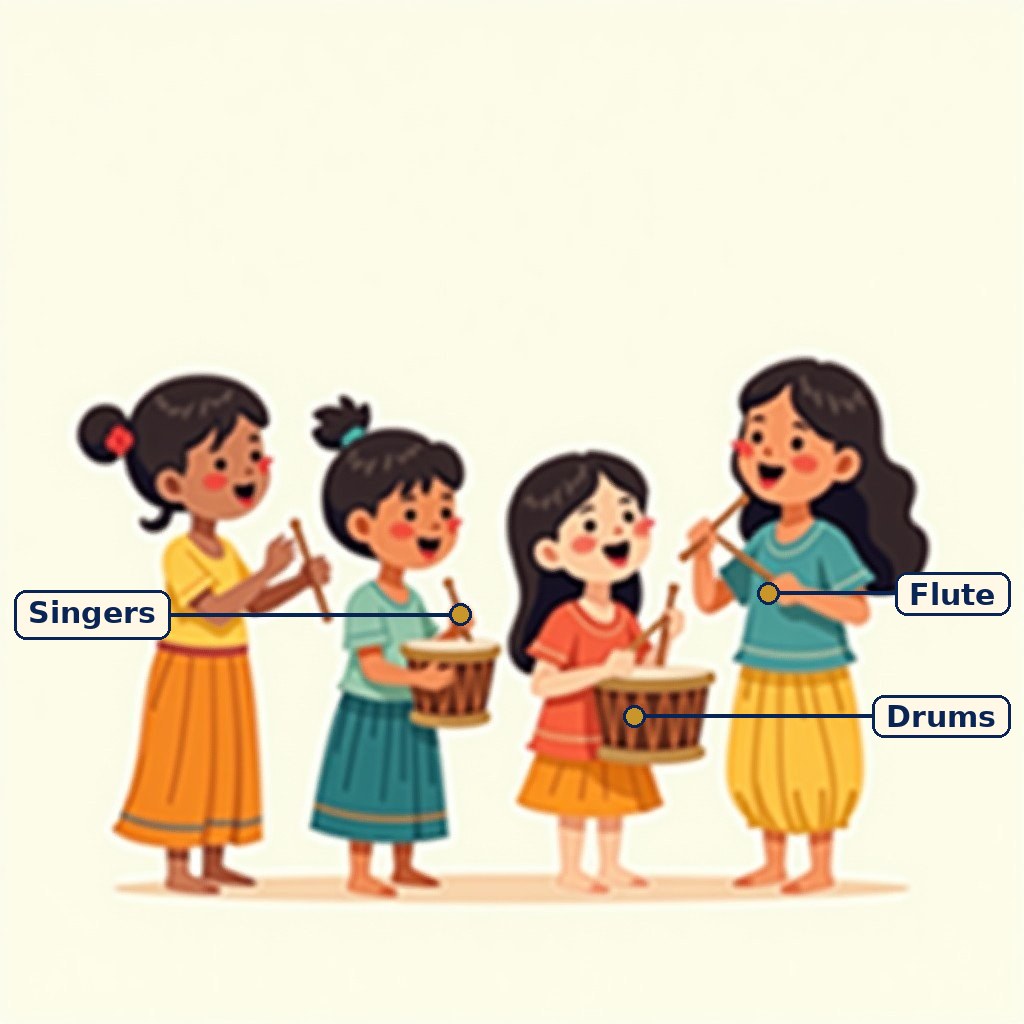
Diagram (labels are printed on the image): Children from different regions singing and playing together. A general teaching picture about musical diversity; the clothes are examples, not exact regional dress.
A folk music gathering at a fair. A general picture about regional songs; no real event is pictured.
What the chapter is about
Objective: listening and learning songs from various genres of Indian music. We have suggested a list of songs from different regions of India. Teachers are asked to teach at least five songs from this list. You can also teach regional songs that you think the children will enjoy learning. After learning about the different types of songs indigenous to each region in our country, you must have realised the relevance of the title of this chapter, “Melodies of Diversity”.
The chapter opens with a song in Manipuri. The bird, Urit, did not hear the mother's call or the father's call. Clap your hands and call the bird. The red-coloured bird, Urit, is similar to a dove that has a belly and flies high. Then comes a song in Malayalam, associated with the traditional boat races, particularly the famous snake boat races that take place in the backwaters of Kerala. These boat races are an integral part of the cultural festivities in the state, and they are accompanied by lively and rhythmic boat songs. The song depicts the beauty of a region in Kerala, and it expresses a desire to sing and enjoy the natural surroundings.
An Assamese song follows. The singer expresses affection for the earth and discusses finding joy on it, rather than in the colours of the sky or the pearls of the ocean. The singer feels that all aspects of nature, like sunlight or forests, are on the earth and are extremely valuable. A Gujarati song metaphorically describes life as a journey through the sea: the boatman symbolises someone who provides direction and purpose, while the pearls represent valuable moments or treasures gained through these experiences. The same pages describe a traditional form of music and a folk dance, often performed during a festival, with traditional rhythm instruments, melodic instruments such as the harmonium and the flute, and body percussion such as clapping, stomping and tapping with sticks, adding more rhythmic layers. The melodic patterns evoke a sense of joy and celebration, and the dancer is singing about her love for Lord Krishna.
A joyful folk song celebrates the beauty of Karnataka. The song invites you to dance and see the beauty of things around, including the magnificent Chitradurga fort in Karnataka. This song explores the joy of singing, and it has rhythmic elements which make it catchy. Then come a Punjabi song and a Marathi song. The Punjabi song expresses love and yearning for the return of loved ones and the cherished moments spent together. The Marathi lyrics pay homage to Chhatrapati Shivaji Maharaj, praising his lineage, valour and achievements, and they express reverence and admiration for his leadership and courage.
Indian music has drawn greatly from the traditions and practices of the society. Bhakti, or devotion, stands out as the primary motif in Indian musical expressions. Children must have seen people worshipping and singing different types of devotional compositions. One Marathi composition by Saint Tukaram is sung by Bharat Ratna Bhimsen Joshi, and its hymns exemplify the devotional aspect of music. Another song is performed in gurudwaras: it advises against worrying excessively, because everything is ultimately determined by a divine will. God has created plants and creatures in water, and provides sustenance to them as well. Guru Nanak asks his disciples to stop worrying and have faith: be it the river or the oceans, the creatures that live in them are able to survive, as they live in accordance with the laws of nature, and the Almighty takes care of all creatures. The same song conveys the message, “Recognise a true human being as one who deeply feels, and empathises with, the distress and pain of others. God resides in the hearts of such compassionate individuals.”
A Sufi song in Persian follows. “The Faithful are One Soul” is a poem from a collection of anecdotes and stories inspired by the Quran and written in Persian by Jalaluddin Muhammad Balkhi, also known as Rumi. The poem speaks of the one divinity within all of us: when we remove the barriers of our bodily covering, we realise that the life force driving each of us, the soul, is the same. A Christian hymn asks us to keep one's faith and devotion to the Almighty, and praises and worships Jesus Christ as the king of kings. So we had fun learning many types of Indian music — classical music, regional music, devotional music and more. We realise that learning songs from various regions is not only fun, but also helps us understand the local culture and tradition of different states in our country. Pick different types of songs and learn them. Present them in the class, assembly, or to your friends and family.
What you should learn
- Listen to and learn songs from various genres and regions of Indian music.
- Notice what each regional song says about its people, place, festivals and daily life.
- Recognise bhakti (devotion) as a primary motif in Indian musical expressions.
- Present songs you learn in class, assembly, or to friends and family.
Key Terms
- Folk song — A traditional song of a region or community, passed down over time and often sung at festivals, work or celebrations.
- Bhakti — Devotion; the primary motif in Indian musical expressions, seen in devotional compositions across faiths.
- Boat song — A lively, rhythmic song sung with boat races, as in the snake boat races of Kerala's backwaters.
- Diversity — Many different kinds living together — here, many regions, languages, genres and faiths in Indian music.
Teachers are asked to teach at least five songs from the chapter's list, and may also teach other regional songs that children will enjoy learning.
Chart / Table: Songs across India in this chapter
| Language / place | What the song is about |
|---|---|
| Manipuri | The red bird Urit, called with claps, like a dove that flies high. |
| Malayalam (Kerala) | Snake boat races in the backwaters; beauty of a Kerala region; joy of singing in nature. |
| Assamese | Affection for the earth; sunlight, forests and all nature on earth are extremely valuable. |
| Gujarati | Life as a sea journey; the boatman gives direction and purpose; pearls are valuable moments. |
| Kannada (Karnataka) | Joyful folk song celebrating Karnataka, inviting dance, including Chitradurga fort. |
| Punjabi | Love and yearning for the return of loved ones and cherished moments together. |
| Marathi | Homage to Chhatrapati Shivaji Maharaj: lineage, valour, achievements, leadership and courage. |
| Devotional (many faiths) | Bhakti across traditions: Tukaram, Guru Nanak, Sufi poetry of Rumi, and a Christian hymn. |
Remember
- Different regions have different melodies, languages, instruments and rhythms.
- Songs tell us about festivals, work, rivers, nature, heroes and daily life.
- Bhakti (devotion) is a primary motif across Indian musical expressions.
- Learning other regions' songs helps us understand their local culture and tradition.
Exam Tip / Common Mistake
Common mistake: ranking regional songs as better or worse, or writing only that “India has many songs”. Good answers name a song's language and region, say what it is about, and say what it teaches about its people — for example the Kerala boat song and its snake boat races, or the Assamese song's affection for the earth.
Practice set — try it yourself
- What is a folk song?
Hint: Think about traditional songs of a region. - Why do songs differ from region to region?
Hint: Think about language, instruments and occasions. - What does the Kerala boat song teach us about Kerala?
Hint: Think about backwaters, boat races and festivities. - What is bhakti, and why is it important in Indian music?
Hint: Think about devotion across faiths. - Learn a song from another region and present it to your class.
Hint: Note its language, meaning and mood.
Questions with Answers
- What are melodies of diversity?
They are the many different songs and tunes from different regions of India, each with its own language, instruments and rhythm, across genres like classical, regional and devotional music. - What is the Malayalam boat song about?
It is associated with the traditional boat races, particularly the famous snake boat races in the backwaters of Kerala, which are an integral part of the state's cultural festivities and are accompanied by lively, rhythmic boat songs. It depicts the beauty of a region in Kerala and expresses a desire to sing and enjoy the natural surroundings. - What does the Assamese song say about the earth?
The singer expresses affection for the earth and finds joy on it, rather than in the colours of the sky or the pearls of the ocean, feeling that all aspects of nature, like sunlight and forests, are on the earth and are extremely valuable. - What message does the gurudwara song in the chapter convey?
It advises against worrying excessively, because everything is ultimately determined by a divine will, and the Almighty takes care of all creatures. It also conveys: recognise a true human being as one who deeply feels, and empathises with, the distress and pain of others, for God resides in the hearts of such compassionate individuals. - What does “The Faithful are One Soul” teach?
It is a Sufi poem by Jalaluddin Muhammad Balkhi (Rumi), from a collection inspired by the Quran. It speaks of the one divinity within all of us: when we remove the barriers of our bodily covering, we realise that the life force driving each of us, the soul, is the same.
Extension questions with answers — covering more NCERT exercise types
- What does the Gujarati sea-journey song symbolise?
Life is metaphorically a journey through the sea. The boatman symbolises someone who provides direction and purpose, while the pearls represent valuable moments or treasures gained through these experiences. - What do the Punjabi and Marathi songs in the chapter express?
The Punjabi song expresses love and yearning for the return of loved ones and the cherished moments spent together. The Marathi lyrics pay homage to Chhatrapati Shivaji Maharaj, praising his lineage, valour and achievements, with reverence and admiration for his leadership and courage. - Why should we learn songs from other regions, according to the chapter's closing?
Because learning songs from various regions is not only fun, but also helps us understand the local culture and tradition of different states in our country. We should pick different types of songs, learn them, and present them in class, assembly, or to friends and family.
- Songs from many regions: Manipuri, Malayalam, Assamese, Gujarati, Kannada, Punjabi, Marathi.
- Boat songs, earth songs, sea-journey songs, hero songs — each teaches about its people.
- Bhakti across faiths: Tukaram, Guru Nanak, Rumi, Christian hymn.
- Learn at least five, and present them to class, assembly, friends and family.
How to use this page: Read the summary, say the Key Terms in your own words, then try the practice set without looking. Check your answers against Questions with Answers, and ask your teacher or parent to check your work.