

Chapter 7: Musical Instruments
Music • Hear how instruments change a song — melody, rhythm, and a bowl instrument you can make yourself.
Original notes — ready CBSE (NCERT, English Medium) • Class 6 • Arts • Book: Kriti
Musical Instruments — EG's own notes, in simple words
Book: Kriti (CBSE, Class 6) | Chapter 7 | Medium: English
Section: Music
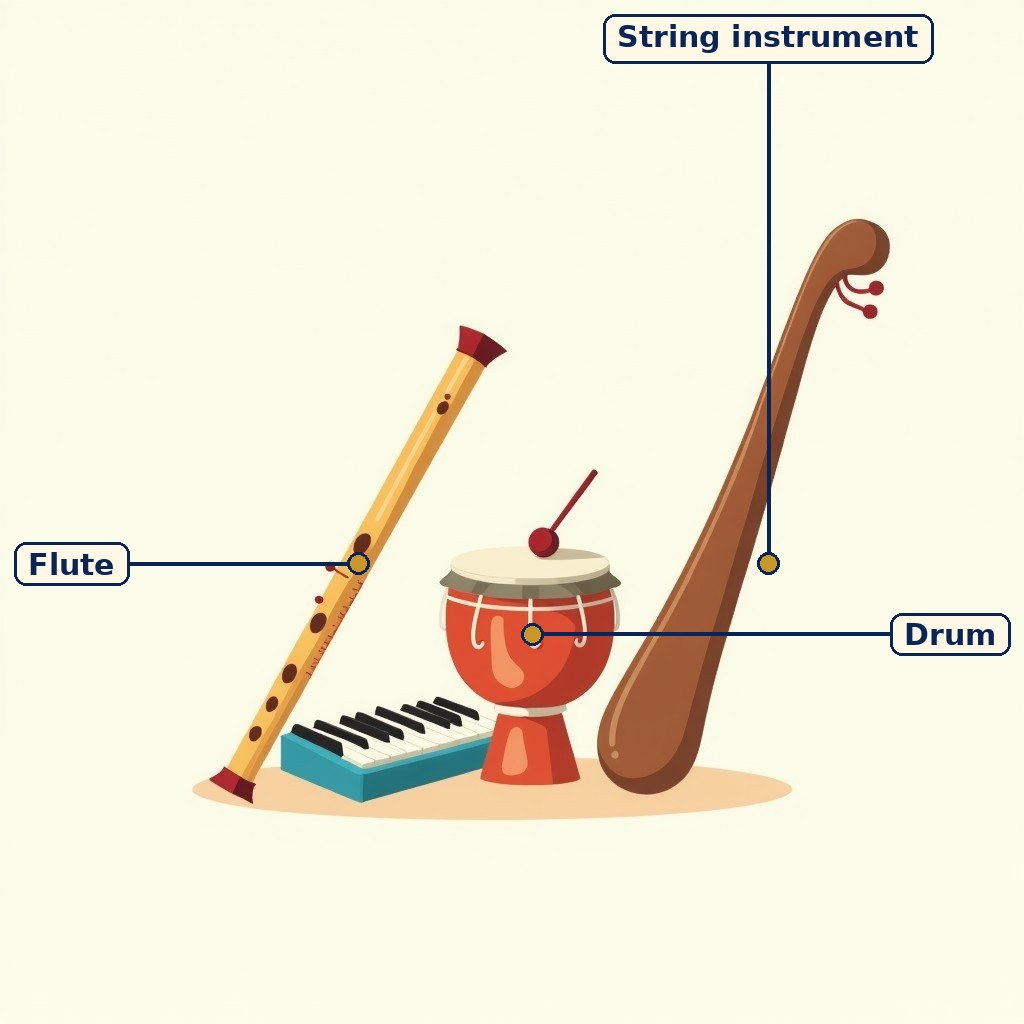
Diagram (labels are printed on the image): Indian musical instruments: strings, drums and wind instruments together. A general teaching picture about instrument families; the instruments are examples, not book pictures.

Bowls filled with different amounts of water, played by striking their rims. A general picture about the bowl instrument; the bowls are examples.
What the chapter is about
Understanding the relevance of instruments in a musical piece and exploring instrument families: that is the objective of this chapter. Instruments are used to create a layered and rich sound of notes and rhythm. Sing this song with any musical instrument that is available in your classroom. Or, use body parts to clap, stamp and so on, to sing the song with rhythm. Listen to the song ‘Shyamale Meenakshi’. Now try singing it by yourself. Now, sing with an audio track. How has using body parts helped you to enjoy it? How does an instrument accompanying the song affect the experience of a musical piece? Now, sing with a new set of instruments: a violin and one more instrument, and a piano and drums. Did you have a preference, and why? What was your experience singing on a new set of instruments?
The two important components of music are melody and tempo. Based on these, instruments are classified as melody instruments and rhythm instruments. Instruments are further classified based on how they are played. Refer to the picture in the book to understand the classification of musical instruments. The book's picture names these instruments: Veena, Tabla, Violin, Dhol, Santoor, Flute, Morsing, Shehnai, Ghatam, Harmonium, Khartal and Shankh. Try these exercises: name two instruments that are used for rhythm; name two instruments that are used for melody; name two melody instruments that are played by plucking strings; and name two rhythm instruments that are made with metal. Listen to a story being told accompanied by an instrument. Explain how the instrument enhances the depth of the storytelling. Try to listen to a story while playing this instrument, and record your emotions.
Here is an interesting instrument that consists of a set of glass, metal or clay bowls, each having varying levels of water. The artist strikes the rim of each bowl with a wooden stick and produces music. It is a melody and a rhythm instrument. We can categorise it as a wind instrument because the air present above the water level in each bowl vibrates to produce sound. This is also a percussive instrument because the sound is produced by striking a membrane or a surface, which is the rim of the bowls. Let us make one with the bowls that are available in your kitchen. You will need five sturdy bowls, a can of water, and two pencils or wooden sticks. Arrange the bowls on a table in a single row. Fill the bowls with varying amounts of water: you could fill the first bowl with one cup of water, the second one with three-fourths of a cup, the third bowl with one-half cup, and the fourth bowl with one-fourth cup of water. Your very own bowl instrument is ready for use. Gently strike the rim of every bowl with the pencil or stick, and make your own music. Observe how the pitch is different when you strike different bowls.
Watch a visual and auditory introduction to instruments from India, curated by the Indian Music Experience Museum, Bengaluru. Which one of these instruments do you like, and why? Take note of the different ways instruments can be classified. The school can invite local artists for a workshop and a demonstration. Encourage the children to interact with the artists, to find out how they learnt from their teachers, and to make a life sketch of any local musician: what type of life do they lead, and any other experience the artists are willing to share. Also encourage students to learn an instrument and their basic playing techniques, as per the availability of the teacher. Instruments create a rich musical experience. Instruments can be classified based on their utility and the material with which they are created. Listen to the songs that you enjoy. Identify the instruments used, and classify them in different categories.
What you should learn
- Explain why instruments matter in a musical piece, using Shyamale Meenakshi.
- Classify instruments by melody/rhythm, by how they are played, by utility and material.
- Name the instruments pictured in the book.
- Make and play the bowl instrument, and observe how pitch changes.
Key Terms
- Melody instrument — An instrument classified by melody, one of the two important components of music.
- Rhythm instrument — An instrument classified by rhythm, used with melody and tempo in a musical piece.
- Tempo — One of the two important components of music, along with melody.
- Wind instrument — An instrument in which air vibrates to produce sound; the bowl instrument counts as one, because the air above the water vibrates.
- Percussive instrument — An instrument in which sound is produced by striking a membrane or a surface, like the rim of the bowls.
- Pitch — How high or low a sound is; striking different bowls gives different pitches.
The bowl instrument is both a melody and a rhythm instrument, both a wind instrument (air above the water vibrates) and a percussive instrument (sound comes from striking the rim). One instrument can belong to more than one family.
Try it: make your own bowl instrument
- Take five sturdy bowls, a can of water, and two pencils or wooden sticks.
- Arrange the bowls on a table in a single row.
- Fill the bowls with varying amounts of water: one cup, three-fourths of a cup, one-half cup, and one-fourth cup.
- Gently strike the rim of every bowl with the pencil or stick, and make your own music.
- Observe how the pitch is different when you strike different bowls.
Chart / Table: Instruments pictured in the book
| Instrument | What the book shows |
|---|---|
| Veena, Violin, Santoor, Flute, Shehnai, Harmonium | Named in the book's instrument picture. |
| Tabla, Dhol, Morsing, Ghatam, Khartal, Shankh | Named in the book's instrument picture. |
| Bowl instrument (glass, metal or clay bowls) | Made and played in the chapter; wind and percussive; melody and rhythm. |
Remember
- Instruments make a layered, rich sound of notes and rhythm.
- Two components: melody and tempo; families: melody and rhythm instruments.
- Classify also by how played, by utility, and by material.
- Bowl instrument: wind (air vibrates) + percussive (struck rim); pitch varies.
- Shyamale Meenakshi: sing alone, with body parts, with instruments, with a track.
Exam Tip / Common Mistake
Common mistake: saying the bowl instrument is only a wind instrument, or only a rhythm instrument. It is both: wind because the air above the water vibrates, percussive because the sound comes from striking the rim, and it is a melody AND a rhythm instrument.
Practice set — try it yourself
- Sing Shyamale Meenakshi alone, then with body percussion, then with an instrument.
Hint: Compare the experiences. - Name two melody instruments and two rhythm instruments.
Hint: Use the book's picture. - Name two melody instruments played by plucking strings.
Hint: Think about plucked strings. - Name two rhythm instruments made with metal.
Hint: Think about metal instruments. - Make the bowl instrument and compare pitches.
Hint: Five bowls, varying water.
Questions with Answers
- Why are instruments relevant in a musical piece?
Instruments are used to create a layered and rich sound of notes and rhythm. Singing Shyamale Meenakshi alone, with body parts (clapping, stamping), with a classroom instrument, with a new set of instruments (violin and another instrument, piano and drums), and with an audio track all give different experiences, and an accompanying instrument changes how a musical piece feels. - How are instruments classified?
The two important components of music are melody and tempo, and based on these, instruments are classified as melody instruments and rhythm instruments. They are further classified based on how they are played, and also based on their utility and the material with which they are created. - Which instruments are named in the book's picture?
Veena, Tabla, Violin, Dhol, Santoor, Flute, Morsing, Shehnai, Ghatam, Harmonium, Khartal and Shankh. - Describe the bowl instrument and why it belongs to two families.
It is a set of glass, metal or clay bowls, each with varying levels of water; the artist strikes the rim of each bowl with a wooden stick and produces music. It is a melody and a rhythm instrument. It is a wind instrument because the air above the water level in each bowl vibrates to produce sound, and a percussive instrument because the sound is produced by striking a membrane or a surface, the rim of the bowls. - How do you make and play your own bowl instrument?
Take five sturdy bowls, a can of water, and two pencils or wooden sticks. Arrange the bowls in a single row on a table. Fill them with varying amounts of water: one cup, three-fourths of a cup, one-half cup, and one-fourth cup. Gently strike the rim of every bowl with the pencil or stick, make your own music, and observe how the pitch is different when you strike different bowls.
Extension questions with answers — covering more NCERT exercise types
- How does an instrument change storytelling?
Listen to a story told accompanied by an instrument, and explain how the instrument enhances the depth of the storytelling; then try listening to a story while playing an instrument yourself, and record your emotions. - What can the school and the Indian Music Experience Museum add?
The school can invite local artists for a workshop and demonstration, and children can interact with them, find out how they learnt, and make a life sketch of a local musician. The Indian Music Experience Museum, Bengaluru, has curated a visual and auditory introduction to instruments from India, which children can watch and discuss, noting which instrument they like and why.
- Instruments: layered, rich sound of notes and rhythm.
- Melody and tempo; melody and rhythm instruments; played, utility, material.
- Bowl instrument: wind + percussive; melody + rhythm; pitch varies with water.
- Book's instruments: Veena to Shankh, twelve names.
How to use this page: Read the summary, say the Key Terms in your own words, then try the practice set without looking. Check your answers against Questions with Answers, and ask your teacher or parent to check your work.