

Chapter 1: Understanding Social Science
What is Social Science — and why does it explain your whole day, from breakfast to bedtime?
Original notes — ready CBSE (NCERT, English Medium) • Class 9 • Social Science • Book: Understanding Society: India and Beyond — Part 1
Chapter 1: Understanding Social Science — EG's own notes, in simple words
Book: Understanding Society: India and Beyond — Part 1 (CBSE, Class 9) | Chapter 1 | Medium: English
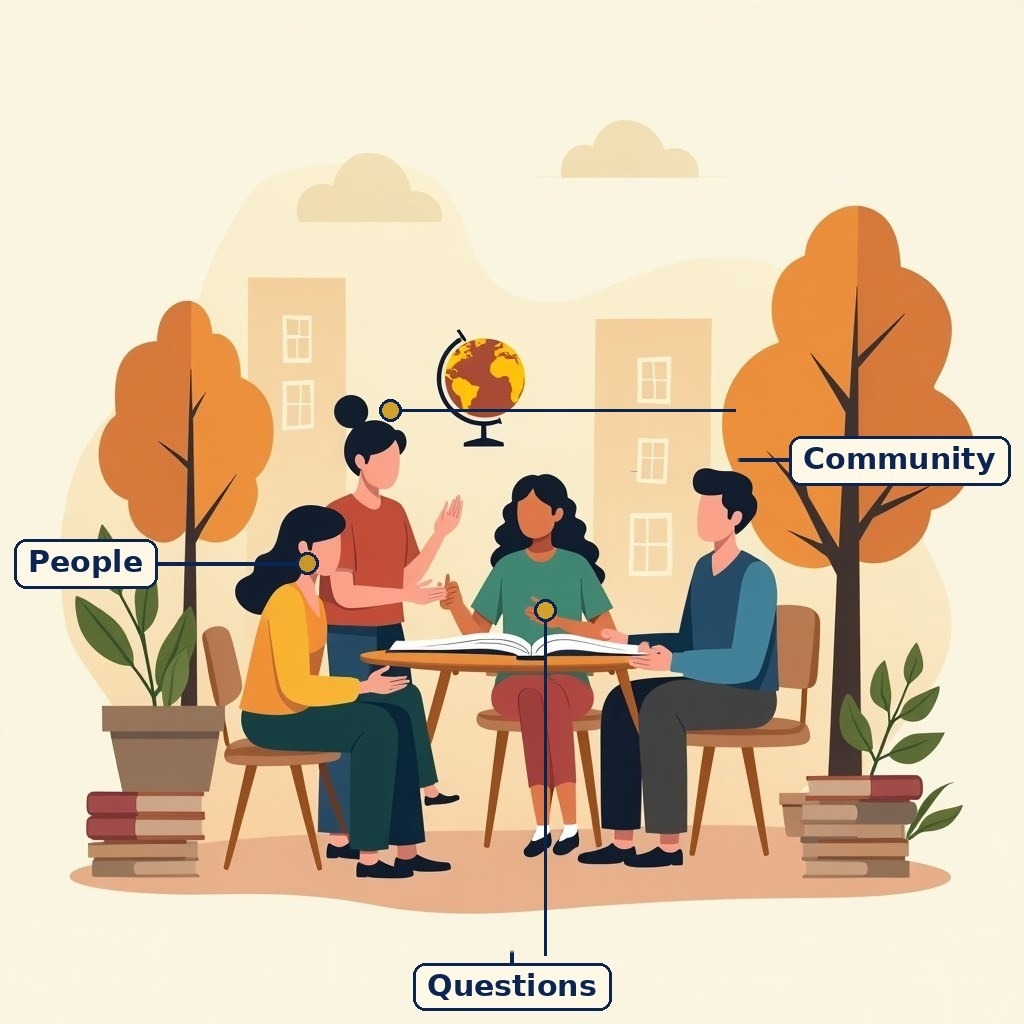
Diagram (labels are printed on the image): People, their community and the questions they ask about society. A general picture about social science, not a scene from the book.

People observing everyday life in a market street. A general picture about studying society, not a book scene.
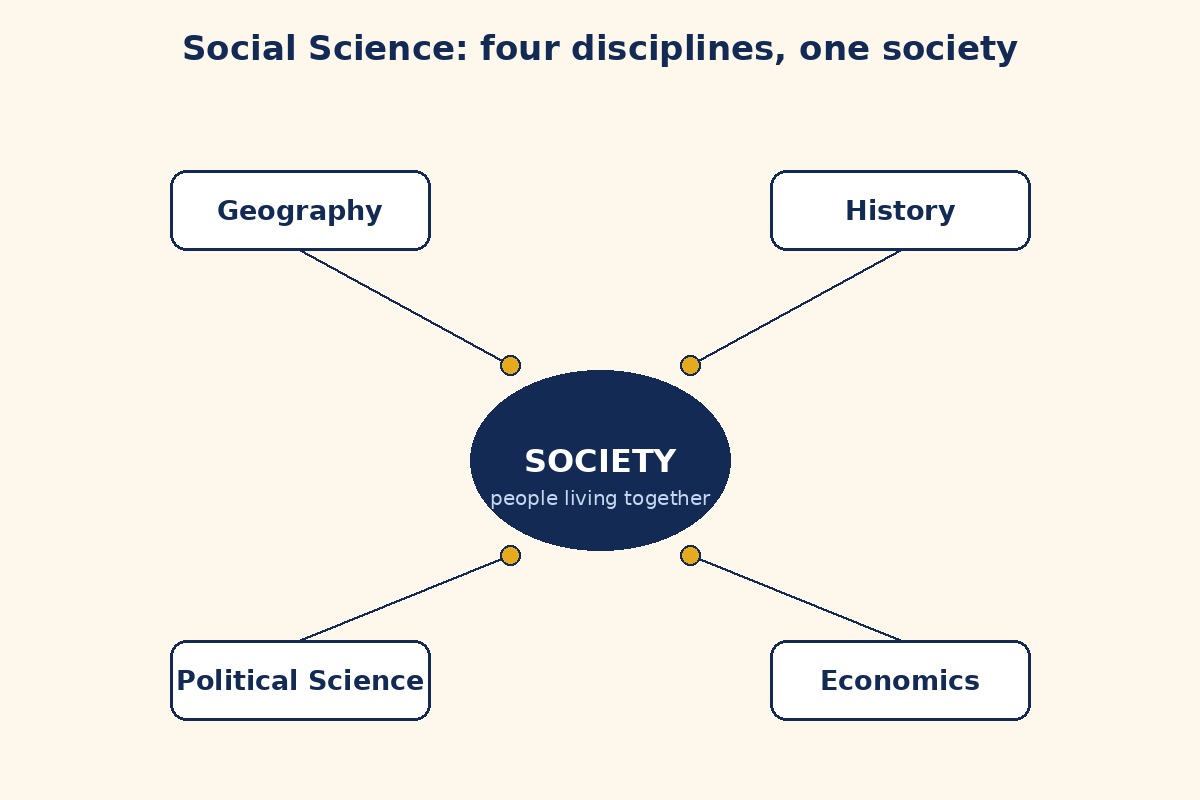
New diagram (labels are printed on the image): Four disciplines — Geography, History, Political Science and Economics — all studying one society from different angles. The gold dots sit on the central idea each discipline connects to.
What the chapter is about
Social Science is the systematic study of human society. It does not only tell us what happened or where things are located. It explains why events happen, how people live together, how environments influence life, how governments function, how economies work, and how the past and the present together shape the world. Natural sciences such as Physics, Chemistry and Biology study the natural world; Social Science studies society, institutions, cultures and human interactions.
Social Science in everyday life
Think about one day of your life. Your house is built with materials from different places. Your food is harvested, processed, transported, bought and sold by many people before it reaches your plate. You travel on roads planned and maintained by public authorities, study in a school shaped by education policies, and use electricity generated far away and delivered through a huge network. Even the simplest daily activity depends on governance, economic production, social cooperation and the natural environment. Society does not function by chance: it is shaped by history, geography, institutions, resources and human choices. Social Science explores such questions through careful observation, evidence and logical reasoning.
Society through time: Indian knowledge traditions
Society has not always been as it is today. Early communities depended directly on nature; over thousands of years people learnt to grow crops, domesticate animals, build settlements, develop tools, exchange goods and organise governance. Villages grew into towns, and towns into cities. In India, this spirit of inquiry has deep roots. Early thinkers valued discussion, questioning and logical reasoning. The idea of the Panchamahabhutas — five great elements: earth (Prithvi), water (Apah), fire (Agni), air (Vayu) and space (Akasha) — described the world as an interconnected system in which human life is embedded, shaping settlement, occupations, food habits and health practices. The idea of vasudhaiva kutumbakam, "the world is one family", expresses the interconnectedness of human societies. Early reflections on governance linked political authority with public welfare: the Arthashastra, attributed to Kautilya and composed about 2,300 years ago, examined administration, economic management, taxation and the duties of rulers toward their people.
Four core disciplines — and the wider family
No single field can fully explain society. A drought, for example, affects crops (environment), farmers' incomes (economy), government relief (politics), migration to cities (society) and traditional ways of coping with scarcity (culture). In Grades 9–10, Social Science draws mainly on four core disciplines. Geography studies the Earth, its environments, and relationships between people and their surroundings — where things are, why they are there, and how places affect one another. Its tools include maps, globes, atlases, Geographical Information System (GIS) and infographics. History studies the human past and how societies change over time, using sources such as archaeology, literature, travelogues, memoirs, correspondence, genealogical records, folklore, oral traditions and revenue documents. Political Science analyses governance, power, and the rights and responsibilities of citizens — constitutions, governments, institutions, social movements and foreign policy. Economics explores how societies produce, distribute and use resources to meet their needs. Other disciplines — Sociology, Philosophy, Anthropology and Psychology — belong to the wider Social Science family and are developed further in higher grades.
Sources historians use
Modern historiography relies increasingly on empirical evidence — information collected by actual observation or experimentation — and on scientific methods such as archaeology, carbon-14 dating and human genetics. Material remains such as monuments, excavated sites, artefacts, sculptures and paintings are archaeological sources. Texts, decrees or records inscribed on durable materials like stone or metal plates are epigraphic sources. Coins, currency and medals are numismatic sources: their metal, inscriptions and symbols reveal facts about economy, chronology, rulers, trade, political boundaries and culture. Literary sources include manuscripts such as the Samaveda and the Tamil text Tirukkural, preserved on palm leaf. One famous Indian tradition of preserving cultural memory is the itihasa-purana tradition, which shares historical information through stories and gives cultural meaning to events and people.
Why study Social Science?
The house you live in, the water you use, the roads you travel on, the school you attend, the markets you visit and even the digital spaces you use are all part of systems created and managed by society. Social Science explains why differences of language, custom and occupation exist within one country, and how Indian culture binds this diversity together through an underlying unity. In a democratic society, understanding how governments function prepares you to participate responsibly in civic life. It also trains you to ask informed questions about shared challenges — environmental protection, public health, employment, urban growth — and about their causes, effects and possible solutions. Most importantly, it connects past, present and future: past decisions shaped the present, and today's actions will shape the future. Social Science is therefore a journey — from understanding how societies evolved, to analysing how they function today, to imagining how they can become better.
What you should learn
After this chapter you should be able to: define Social Science and explain why it studies "why" and not only "what" and "where"; give everyday examples showing how governance, economy, cooperation and environment shape one day of life; name the four core disciplines and the question each one asks; distinguish the wider family (Sociology, Philosophy, Anthropology, Psychology); identify archaeological, literary, epigraphic and numismatic sources with one example each; and explain the Indian ideas of Panchamahabhutas, vasudhaiva kutumbakam and the Arthashastra's view of rulers' duties.
Key Terms
- Social Science — The systematic study of human society: how people live together, organise themselves, use resources and make decisions.
- Discipline — A distinct field of study within Social Science, such as Geography or Economics, each asking its own kind of question.
- Geography — The study of the Earth, its environments, and relationships between people and their surroundings.
- History — The study of the human past and how societies change over time.
- Political Science — The study of governance, power, institutions, and the rights and responsibilities of citizens.
- Economics — The study of how societies produce, distribute and use resources to meet their needs.
- Empirical evidence — Information collected by actual observation or experimentation.
- Epigraphic source — A historical source consisting of texts or records inscribed on durable materials such as stone or metal plates.
- Numismatic source — A historical source comprising coins, currency or medals.
- Panchamahabhutas — The five great elements of Indian philosophical tradition: earth, water, fire, air and space.
Remember
- Social Science explains why, not only what and where.
- One event — like a drought — needs several disciplines to be understood fully.
- The four core disciplines in Grades 9–10 are Geography, History, Political Science and Economics.
- History uses archaeological, literary, epigraphic and numismatic sources, plus scientific methods like carbon-14 dating.
- Indian knowledge traditions valued discussion, questioning and logical reasoning long before modern disciplines.
- Power, in Indian political thought, was viewed as a responsibility, not merely a privilege.
Exam Tip / Common Mistake
Common mistake: defining Social Science as "the study of society" and stopping there, or listing the four disciplines without their questions. In answers, always pair each discipline with its question — Geography asks where and why there, History asks what changed over time, Political Science asks who decides and how power works, Economics asks how needs are met with limited resources. Another common slip: calling every old object a "source" without naming its type — inscriptions are epigraphic, coins are numismatic.
Chart / Table: The four core disciplines at a glance
| Discipline | Main question | Example from your day |
|---|---|---|
| Geography | Where is it, and why there? | Why your town grew beside a river or a road |
| History | How did this change over time? | How your town's market or school came to exist |
| Political Science | Who decides, and is it fair? | Who maintains your roads and makes school rules |
| Economics | How are needs met with limited resources? | Why food prices rise or fall in your market |
Practice set — try it yourself
- What does Social Science study, in one line?
Hint: Think about people living together, not one subject alone. - Name the four main disciplines combined in this book.
Hint: Think: past, places, power, prices. - Why does one question sometimes need more than one discipline?
Hint: Think of the road example — who decided, what it cost, where it runs. - What is evidence in Social Science?
Hint: Think of records, observations and what people report. - Give one question a geographer would ask and one question an economist would ask about your town.
Hint: Think: land and weather for one, jobs and prices for the other.
Questions with Answers
- What is Social Science?
Social Science is the systematic study of human society — how people live together, organise themselves, use resources and make decisions. It explains not only what happened or where things are, but why events occur, and it connects the four core disciplines of Geography, History, Political Science and Economics. - How is Social Science different from natural science?
Natural sciences such as Physics, Chemistry and Biology study the natural world. Social Science studies society, institutions, cultures and human interactions — the human-made world of families, communities, governments and economies. - Why does one question sometimes need several disciplines?
Because real events have many sides. A drought affects crops (Geography/environment), farmers' incomes (Economics), government relief measures (Political Science), migration to cities (society) and traditional coping methods (culture). One discipline alone gives only part of the answer. - What are epigraphic and numismatic sources? Give one use of each.
Epigraphic sources are texts inscribed on durable materials like stone or metal plates; they give direct evidence about rulers, administration and society. Numismatic sources are coins and medals; their metal, inscriptions and symbols reveal facts about economy, chronology, rulers and trade. - What does the Arthashastra show about early Indian thinking?
Attributed to Kautilya about 2,300 years ago, it examined administration, economic management, taxation and rulers' duties toward their people. It shows that systematic thinking about governance and the economy existed in India long before modern disciplines developed, and that power was seen as a responsibility.
Extension Questions with Answers
- Why does the chapter say society "does not function by chance"?
Because daily life runs on systems — roads planned by authorities, food moved by producers and traders, schools shaped by policies, electricity delivered through networks. Each system has a history, rules and human choices behind it, so explaining society means tracing those systems, not accepting things as accidents. - How do the Panchamahabhutas and vasudhaiva kutumbakam help Social Science?
The Panchamahabhutas present nature as an interconnected system in which human life is embedded, which helps explain settlement, occupation, food and health as linked to environment. Vasudhaiva kutumbakam — "the world is one family" — expresses interdependence across regions and cultures, which is exactly what Social Science studies in global interactions. - Why is evidence more important than opinion in Social Science?
Opinions and stories can be mistaken for facts. Evidence — observations, interviews, surveys, documents, artefacts, inscriptions and coins, compared across sources — lets us test claims, check conclusions and separate what is supported from what is merely believed. - How does studying Social Science make someone a better citizen?
It explains how governments function, how decisions are made, and how laws, rights and responsibilities guide shared life. A citizen who understands these systems can participate responsibly, ask informed questions about public issues, and respect diversity while recognising underlying unity. - What does "the past shapes the present" mean, with an example?
Decisions and developments from earlier times still structure today's life — for example, a town that grew beside a river or a trade route still has its market, roads and occupations shaped by that history. Understanding that chain helps us make wiser choices for the future instead of repeating past mistakes.
- Social Science = systematic study of human society; it asks why, not only what and where.
- Everyday life runs on systems of governance, production, cooperation and environment.
- Four core disciplines: Geography, History, Political Science, Economics — plus a wider family.
- Sources: archaeological, literary, epigraphic (inscriptions), numismatic (coins); modern methods include carbon-14 dating.
- Indian traditions: Panchamahabhutas, vasudhaiva kutumbakam, Arthashastra — discussion, reasoning and duty-bound power.
How to use this page: Read the summary, say the Key Terms in your own words, then try the practice set without looking. Use the Questions with Answers to check yourself afterwards. Ask your teacher or parent to check your answers.