

Chapter 7: Work, Energy, and Simple Machines
Original notes — ready CBSE (NCERT, English Medium) • Class 9 • Science • Book: Exploration
Chapter 7: Work, Energy, and Simple Machines — EG's own notes, in simple words
Book: Exploration (CBSE, Class 9) | Chapter 7 | Medium: English
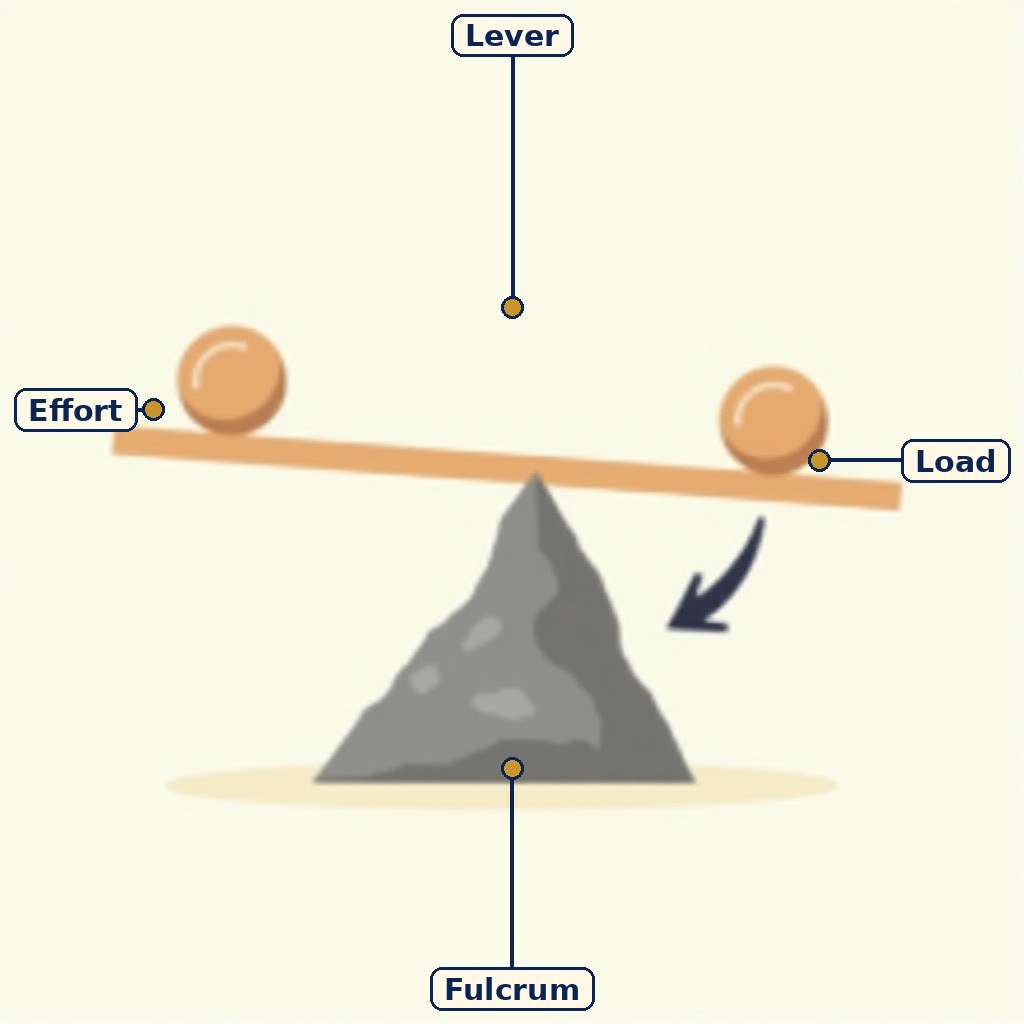
Diagram (labels are printed on the image): Diagram (labels are printed on the image): A lever at work: effort at one end, a fulcrum in the middle, and the load lifted at the other end. A general diagram for study, not a figure copied from the book.

Energy all around — cycling uphill, falling water and swinging. A general picture about work and energy, not a book scene.
What the chapter is about
In science, work is done when a force moves an object in the direction of the force. Pushing a wall that does not move is hard effort, but scientifically no work is done, because there is no displacement. Work is measured in joules, and it equals force multiplied by displacement in the direction of the force.
Energy is the capacity to do work. A moving object has kinetic energy, which depends on its mass and speed, while an object raised above the ground has potential energy, which depends on its height and mass. Energy changes from one form to another — a falling ball loses potential energy and gains kinetic energy — but the total energy stays conserved. Power is the rate at which work is done, measured in watts.
Simple machines make work easier, though they do not reduce the total work. A lever, a pulley, an inclined plane, a wheel and axle, a screw and a wedge all let a small effort balance a larger load, or move a load over a longer distance. Machines are judged by their mechanical advantage, the ratio of load to effort.
What you should learn
Notice when work is really done in the scientific sense, how kinetic and potential energy trade places, and how a simple machine trades force for distance.
Key Terms
- Work — Force multiplied by displacement in the direction of the force; measured in joules.
- Kinetic energy — Energy of a moving object, depending on its mass and speed.
- Potential energy — Stored energy of an object due to its position, such as height above the ground.
- Power — The rate of doing work; measured in watts.
- Mechanical advantage — The ratio of load lifted to effort applied by a machine.
Remember
- No displacement, no work — in the scientific sense.
- Work is measured in joules; power in watts.
- Kinetic energy grows with mass and speed; potential energy grows with height.
- Energy is conserved: it changes form, it is not created or destroyed.
Exam Tip / Common Mistake
Common mistake: saying a machine reduces the work needed. A machine reduces the effort, or changes its direction, but the total work stays the same — you trade a smaller force for a longer distance.
Chart / Table: Forms of energy and simple machines
| Point | Detail |
|---|---|
| Kinetic energy | Energy of motion |
| Potential energy | Stored energy of position |
| Lever | A bar turning on a fulcrum |
| Pulley | A wheel with a rope, changing the direction of effort |
| Inclined plane | A slope that makes lifting easier |
Practice set — try it yourself
- A force of 20 N pushes a box 3 m. How much work is done?
Hint: Think about force multiplied by displacement. - Why is pushing a wall that does not move not work in science?
Hint: Think about displacement. - A ball at the top of a hill has which form of energy? What happens as it rolls down?
Hint: Think about height and motion. - Name three simple machines used at home.
Hint: Think about tools that make jobs easier. - How does a pulley make lifting easier?
Hint: Think about the direction of the effort.
Questions with Answers
- When is work said to be done in science?
Work is done when a force acts on an object and the object moves in the direction of the force. Work equals force multiplied by displacement in that direction, measured in joules. - What is the difference between kinetic and potential energy?
Kinetic energy is the energy of a moving object and depends on its mass and speed. Potential energy is stored energy due to position, such as a ball held above the ground, and depends on height and mass. - What is the law of conservation of energy?
Energy can change from one form to another, but it cannot be created or destroyed. The total energy of a closed system stays the same. - What is power?
Power is the rate at which work is done, that is, work divided by time. Its unit is the watt. - How does a lever make work easier?
A lever turns on a fulcrum. When the effort is applied farther from the fulcrum than the load, a small effort can lift a larger load, giving a mechanical advantage — though the effort must move through a larger distance.
How to use this page: Read the summary, say the Key Terms in your own words, then try the practice set without looking. Use the Questions with Answers to check yourself afterwards. Ask your teacher or parent to check your answers.