

Chapter 12: Patterns in Life: Diversity and Classification
Original notes — ready CBSE (NCERT, English Medium) • Class 9 • Science • Book: Exploration
Chapter 12: Patterns in Life: Diversity and Classification — EG's own notes, in simple words
Book: Exploration (CBSE, Class 9) | Chapter 12 | Medium: English
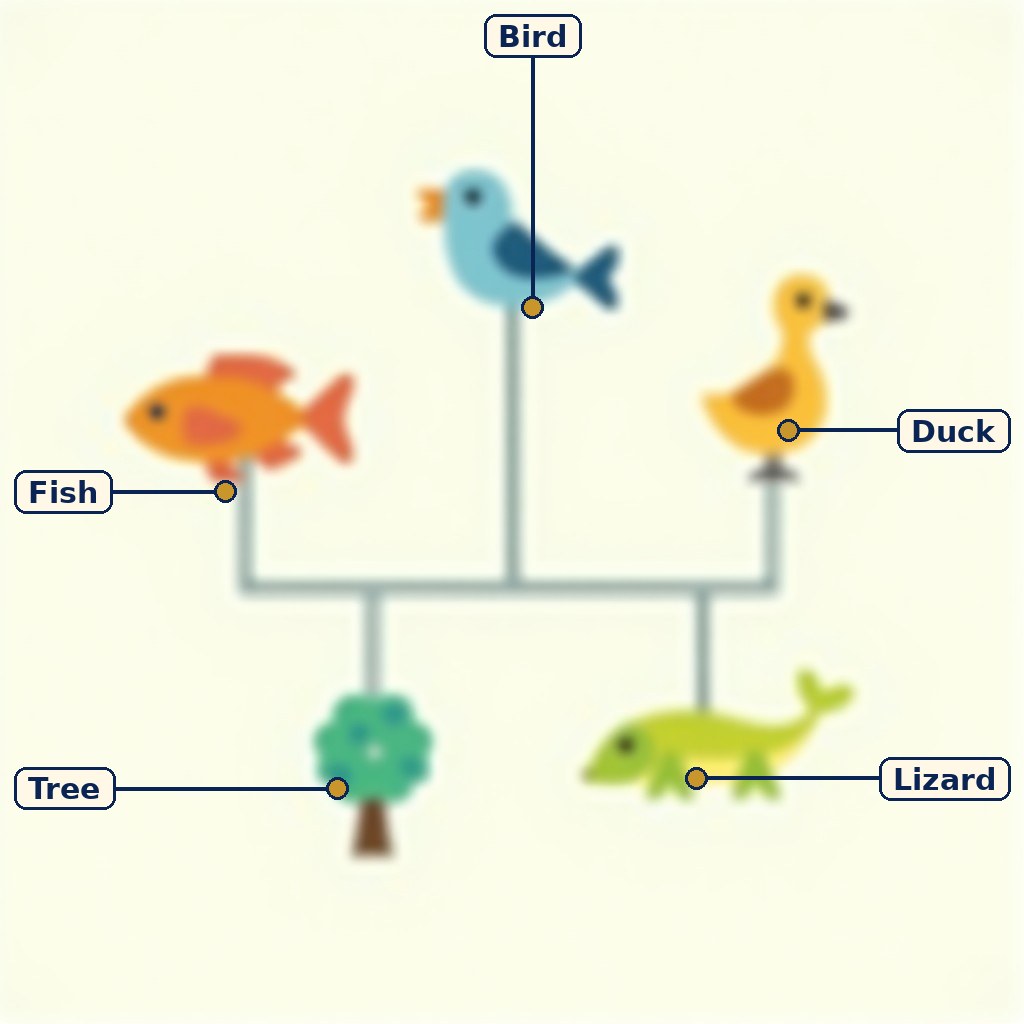
Diagram (labels are printed on the image): Diagram (labels are printed on the image): A branching tree of life carrying a fish, a bird, a duck, a tree and a lizard — different living things grouped by their similarities. A general diagram for study, not a figure copied from the book.
The diversity of life — animals and plants of many kinds sharing one world. A general picture about classification, not a book scene.
What the chapter is about
Life on Earth is astonishingly diverse. Millions of kinds of organisms live in oceans, forests, deserts and even inside other living things. To study this diversity, scientists group organisms by their similarities and differences — this grouping is called classification.
Classification follows a hierarchy, from large groups to small ones: kingdom, phylum (or division in plants), class, order, family, genus and species. The species is the smallest unit, made of organisms that can breed together. The five-kingdom system groups life into Monera, Protista, Fungi, Plantae and Animalia.
Every organism also gets a scientific name with two parts — its genus and its species — written in Latin, such as Homo sapiens for human beings. This binomial nomenclature gives every kind of organism one name recognised by scientists everywhere, whatever language they speak.
What you should learn
Notice how the hierarchy narrows from kingdom to species, which organisms belong to each of the five kingdoms, and how scientific names are written.
Key Terms
- Classification — Grouping organisms by their similarities and differences.
- Species — The smallest unit of classification; organisms that can breed together.
- Kingdom — The largest group in classification, such as Plantae or Animalia.
- Binomial nomenclature — The two-part scientific naming system: genus followed by species.
- Biodiversity — The variety of living things in an area or on Earth.
Remember
- Hierarchy: kingdom, phylum, class, order, family, genus, species.
- Five kingdoms: Monera, Protista, Fungi, Plantae, Animalia.
- Scientific name = genus + species, written in Latin.
- Classification is based on similarities and differences.
Exam Tip / Common Mistake
Common mistake: writing a scientific name with both words capitalised. Only the genus starts with a capital letter; the species is written in small letters, for example Homo sapiens.
Chart / Table: The five kingdoms
| Point | Detail |
|---|---|
| Monera | Single-celled organisms without a true nucleus, such as bacteria |
| Protista | Mostly single-celled organisms with a nucleus, such as amoeba |
| Fungi | Organisms that absorb food, such as mushrooms |
| Plantae | Multicellular organisms that make food by photosynthesis |
| Animalia | Multicellular organisms that eat other organisms for food |
Practice set — try it yourself
- List the levels of classification from largest to smallest.
Hint: Think about the hierarchy from kingdom downwards. - Name the five kingdoms.
Hint: Think about bacteria, single-celled life, fungi, plants and animals. - Write the scientific name of human beings correctly.
Hint: Think about genus capital, species small. - Why do scientists use Latin scientific names?
Hint: Think about one name for all languages. - A mushroom belongs to which kingdom? Why?
Hint: Think about how fungi get their food.
Questions with Answers
- What is classification?
Classification is the grouping of organisms based on their similarities and differences, so that the diversity of life can be studied in an organised way. - List the hierarchy of classification from largest to smallest.
Kingdom, phylum (division in plants), class, order, family, genus and species. - What are the five kingdoms? Give one example of each.
Monera (bacteria), Protista (amoeba), Fungi (mushroom), Plantae (mango tree) and Animalia (human being). - What is binomial nomenclature?
Binomial nomenclature is the system of giving every organism a two-part scientific name: the genus name, written first with a capital letter, followed by the species name, written in small letters, both in Latin — for example, Homo sapiens. - Why is classification useful?
Classification makes the study of millions of organisms manageable, shows relationships between organisms, and gives every organism one scientific name recognised worldwide.
How to use this page: Read the summary, say the Key Terms in your own words, then try the practice set without looking. Use the Questions with Answers to check yourself afterwards. Ask your teacher or parent to check your answers.