

Chapter 3: From Page to Stage
Original notes — ready CBSE (NCERT, English Medium) • Class 8 • Arts • Book: Kriti
Chapter 3: From Page to Stage — EG's own notes, in simple words
Book: Kriti (CBSE, Class 8) | Chapter 3 | Section: Theatre | Medium: English
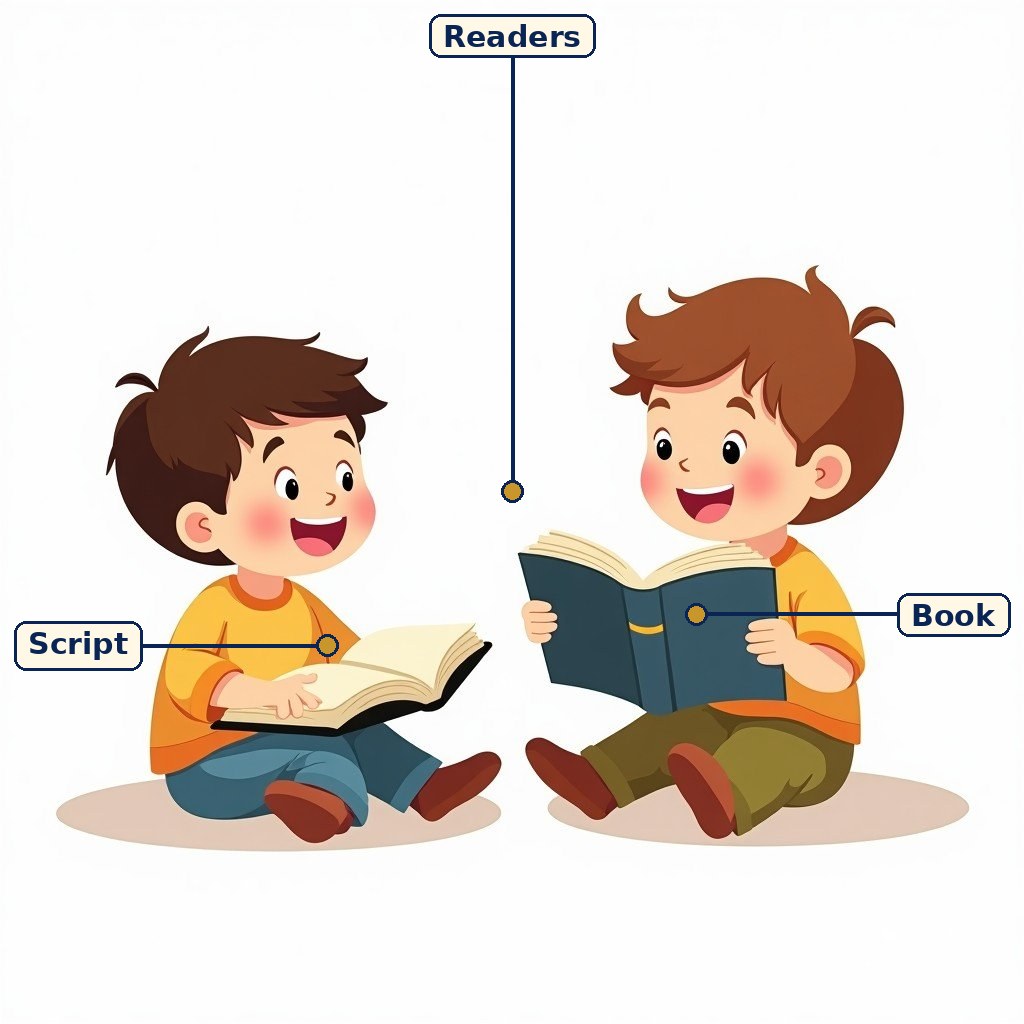
Diagram (labels are printed on the image): Two children reading from books — the first step of the page-to-stage journey: reading and understanding the script before rehearsal and performance. A general picture; it is not a scene from the book.

Rehearsal: trying lines, movements and positions before the show.
What the chapter is about
A play begins as words on a page. Turning it into a performance is a step-by-step journey. First the group reads and understands the script, then it plans who plays whom, where people stand, and how they move. Only after many rehearsals is it ready for an audience.
Rehearsal is where the play grows. Performers try lines in different ways, practise entries and exits, and learn to work with lights, sound and simple props. Mistakes during rehearsal are useful — they show what needs more practice.
The final performance is a team effort. Actors, the director, and helpers with costumes, sound and lights all matter. When the page becomes a stage, the story is no longer only read — it is seen, heard and felt by everyone present.
What you should learn
A play travels from page to stage through reading, planning, rehearsal and teamwork, and the performance is the shared result.
Key Terms
- Rehearsal — Repeated practice of a play before the final performance.
- Director — The person who guides the whole production and helps performers shape their roles.
- Blocking — Planning where performers stand and move on stage.
- Prop — A small object used by performers on stage, such as a book or a basket.
- Cue — A signal — a line, sound or movement — that tells a performer it is their turn.
Remember
- Every performance starts with understanding the script.
- Rehearsal turns words into movement, timing and teamwork.
- Mistakes in rehearsal help the play improve.
- A show needs actors and backstage helpers working together.
Exam Tip / Common Mistake
Common mistake: thinking rehearsal is only about memorising lines. Rehearsal also practises movement, timing, listening and working with props and sound.
Chart / Table: Steps from page to stage
| Point | Detail |
|---|---|
| Read and understand | Discuss the story, characters and feelings |
| Cast and plan | Decide roles, positions and movements |
| Rehearse | Practise lines, timing and cues many times |
| Add design | Costumes, props, lights and sound |
| Perform | Share the finished play with an audience |
Practice set — try it yourself
- What happens first when a group decides to stage a play?
Hint: Think about reading before acting. - Why is rehearsal more than memorising lines?
Hint: Think about movement, timing and teamwork. - What is blocking, and why does it matter?
Hint: Think about where people stand so everyone can be seen. - How do props and sound help a performance?
Hint: Think about what they add that words alone cannot. - Why is the final show a team effort?
Hint: List everyone besides the actors who helps.
Questions with Answers
- What are the main steps from page to stage?
First, read and understand the script. Then cast roles and plan positions and movements. Next, rehearse many times, add costumes, props, lights and sound, and finally perform for an audience. - Why is rehearsal important?
Rehearsal lets performers learn their lines, practise timing and cues, try movements, and fix problems before an audience watches. It builds confidence and teamwork, so the show runs smoothly. - What does a director do?
A director guides the whole production. The director helps performers understand their characters, decides the overall shape of scenes, and coordinates actors with lights, sound and staging. - How do cues work on stage?
A cue is a signal that tells a performer to act — for example, another character's last line, a sound, or a light change. Good cues keep the play flowing without awkward pauses. - Why should backstage helpers be thanked after a show?
Because the show depends on them. They manage costumes, props, lights and sound, and solve problems quietly, so the actors can perform and the audience can enjoy the story.
How to use this page: Read the summary, say the Key Terms in your own words, then try the practice set without looking. Use the Questions with Answers to check yourself afterwards. Ask your teacher or parent to check your answers.