

Chapter 2: One Stage, Many Scripts
Original notes — ready CBSE (NCERT, English Medium) • Class 8 • Arts • Book: Kriti
Chapter 2: One Stage, Many Scripts — EG's own notes, in simple words
Book: Kriti (CBSE, Class 8) | Chapter 2 | Section: Theatre | Medium: English
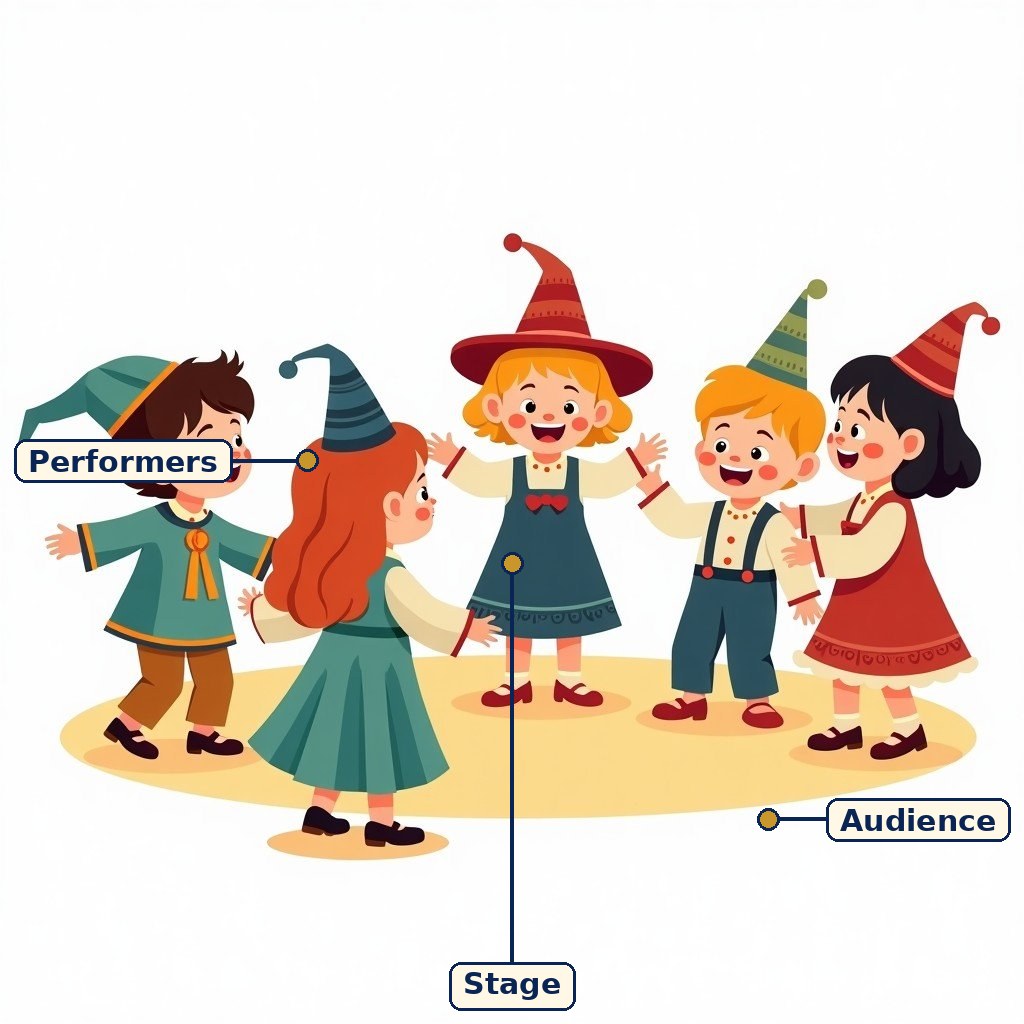
Diagram (labels are printed on the image): Children in different costumes performing together — different scripts, different characters, one shared performance. A general picture about variety on stage; it is not a scene from the book.
Different scripts, props and costumes waiting for their turn on the same stage.
What the chapter is about
One stage can hold many different stories. A comedy makes people laugh, a serious play makes them think, and a folk tale can carry an old lesson in a new way. The stage itself stays the same, but each script brings its own characters, mood and message.
Scripts differ in many ways: their language, their setting, their length and their purpose. Some are written for children, some retell history, and some are invented by the performers themselves. Learning to notice these differences helps us enjoy each play on its own terms.
When many scripts share one stage, performers and audiences learn respect for variety. We learn that there is no single right way to tell a story, and that different communities and traditions have their own rich ways of performing.
What you should learn
Many kinds of scripts — funny, serious, folk, historical — can all be performed on one stage, each with its own style and message.
Key Terms
- Script — The written text of a play, including dialogue and stage directions.
- Genre — A type or kind of play, such as comedy, tragedy or folk drama.
- Comedy — A play meant to amuse and make the audience laugh.
- Folk tale — A traditional story passed down in a community, often retold in performance.
- Setting — The time and place where a play's story happens.
Remember
- One stage can present many kinds of stories.
- Scripts differ in language, mood, length and purpose.
- Different traditions have their own ways of performing.
- Enjoy each play on its own terms instead of comparing unfairly.
Exam Tip / Common Mistake
Common mistake: judging every play by whether it is funny. A serious or sad play can be excellent too — ask what feeling or idea it wanted to leave with you.
Chart / Table: Kinds of scripts you may meet
| Point | Detail |
|---|---|
| Comedy | Makes the audience laugh |
| Serious drama | Makes the audience think and feel deeply |
| Folk play | Retells a traditional community story |
| Historical play | Brings a past event to life |
| Children's play | Made specially for young audiences |
Practice set — try it yourself
- Why can one stage show many different plays?
Hint: Think about what stays the same and what changes each time. - How is a comedy different from a serious drama?
Hint: Think about the feeling each one wants to create. - Why might a folk tale be performed as a play?
Hint: Think about how stories travel and stay alive. - What makes a script suitable for children?
Hint: Think about language, length and themes. - Name two kinds of plays and one thing you would enjoy in each.
Hint: Pick kinds you know and explain your reasons.
Questions with Answers
- What does 'one stage, many scripts' mean?
It means a single stage can host many different plays. Each script brings its own story, characters, mood and message, so the same space can feel completely different from one performance to the next. - How do scripts differ from each other?
Scripts differ in language, setting, length, purpose and style. Some aim to make people laugh, others to teach, remember history or retell folk tales, and each uses its own kind of dialogue and action. - Why is variety on stage valuable?
Variety lets audiences meet many stories, cultures and ideas. It teaches respect for different traditions and helps performers try new styles instead of repeating one kind of play. - What is a folk play?
A folk play is a performance based on a traditional story from a community. It often uses simple staging, music and familiar characters, and keeps an old story alive for a new audience. - How should an audience respond to a play that is not funny?
By asking what the play wanted them to feel or think. Laughter is only one goal of theatre; a play can also move, surprise or teach its audience, and that is a success too.
How to use this page: Read the summary, say the Key Terms in your own words, then try the practice set without looking. Use the Questions with Answers to check yourself afterwards. Ask your teacher or parent to check your answers.