

Chapter 8: A Journey through States of Water
Ice, water, vapour — one substance, three states, one endless journey.
Original notes — ready CBSE (NCERT, English Medium) • Class 6 • Science • Book: Curiosity
A Journey through States of Water — EG's own notes, in simple words
Book: Curiosity (CBSE, Class 6) | Chapter 8 | Medium: English

Diagram (labels are printed on the image): The water cycle: sun heats water, vapour rises, clouds form, rain falls, and rivers return water to the sea. A general teaching picture.

Rain returning water to rivers and land — part of the endless water cycle.
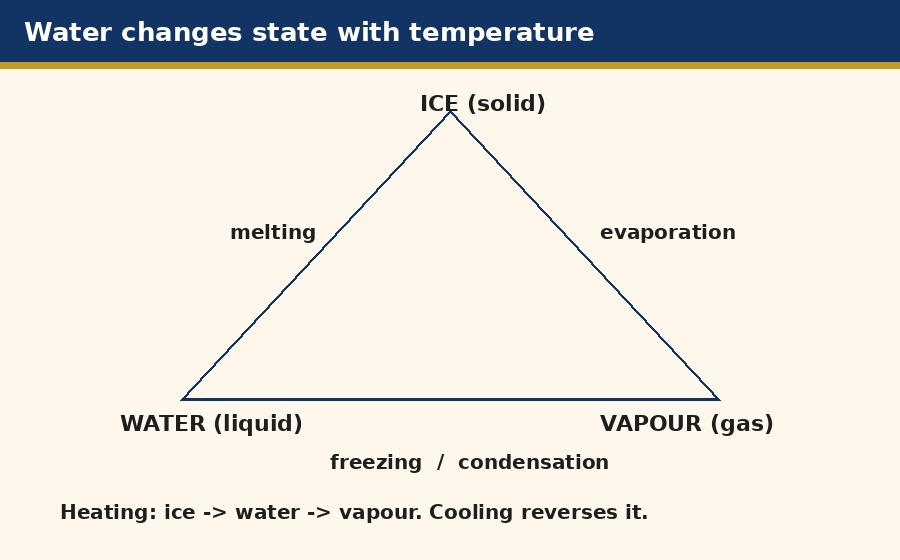
Diagram (labels are printed on the image): Heating moves water from ice to liquid to vapour; cooling moves it back. Melting and freezing are reverses of each other, as are evaporation and condensation.
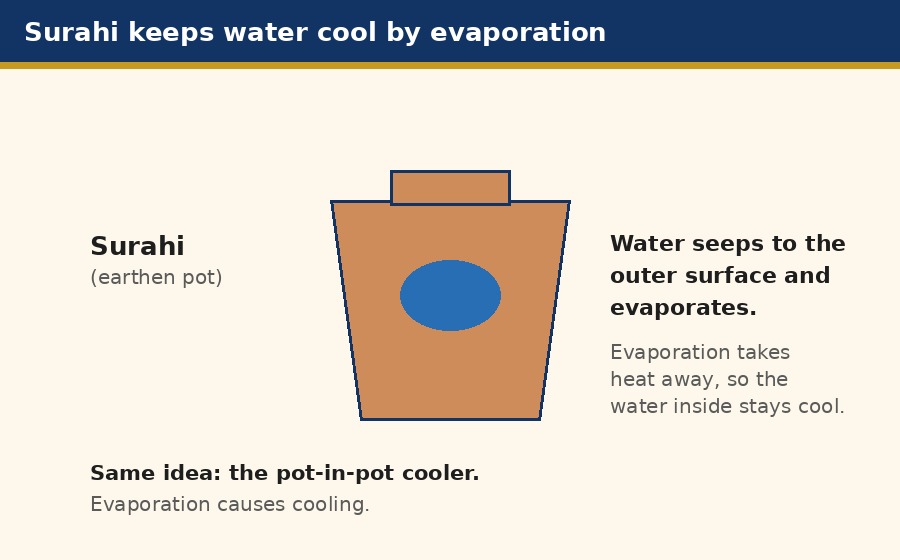
Diagram (labels are printed on the image): A surahi (earthen pot) keeps water cool: water seeps to the outer surface and evaporates there, taking heat away with it — the same evaporation cooling behind the pot-in-pot cooler.
What the chapter is about
Water is special because it is found in all three states of matter in nature: solid ice and snow, liquid water in rivers and seas, and gaseous water vapour in the air. Water vapour is invisible — the white cloud above a kettle is not vapour but tiny liquid droplets formed when vapour cools. The state of water depends on temperature: heating moves it towards vapour, cooling moves it towards ice.
Four changes link the states, in pairs. Melting is solid to liquid on heating; ice melts at 0 °C, its melting point. Freezing is liquid to solid on cooling, the reverse of melting. Evaporation is liquid to vapour; it happens from the surface at any temperature, not only when water boils. Boiling is different: it is rapid evaporation throughout the liquid, and for water it happens at 100 °C, its boiling point. Condensation is vapour to liquid on cooling, the reverse of evaporation — it is why droplets appear on the outside of a cold bottle and why dew forms on grass.
Evaporation does not happen at the same speed always. It is faster when the temperature is higher, when the surface area is larger (water spread out in a plate dries faster than water in a narrow bottle), when wind blows (wind carries vapour away), and when the air is dry. Wet clothes dry faster on a hot, windy day than on a cold, humid day — and evaporation causes cooling, which is why we feel cool when sweat evaporates and why earthen pots (matkas) keep water cool.
These changes drive the water cycle, a journey with no beginning and no end. Heat from the Sun evaporates water from seas, lakes, rivers and land; plants also lose water as vapour, which is called transpiration. The vapour rises, cools high up, and condenses into tiny droplets that gather as clouds. When the droplets grow heavy, they fall back as precipitation — rain, snow or hail. Some water collects in rivers, lakes and seas; some seeps into the ground and becomes groundwater. Then the Sun heats it again, and the journey repeats.
The water cycle matters for life and for us. Rain fills the rivers and wells we drink from, and groundwater is stored rain that we pump up in dry seasons. Wasting or polluting water breaks this gift: polluted water cannot be used safely, and water wasted today is missing tomorrow. Saving water, harvesting rain and keeping rivers clean protect the cycle itself.
What you should learn
- Name water's three states and where each is found in nature.
- Pair the changes: melting ↔ freezing, evaporation ↔ condensation; tell evaporation from boiling.
- Explain what speeds up evaporation: temperature, surface area, wind, dry air.
- Tell the water cycle in order: evaporation, condensation, precipitation, collection — plus transpiration and groundwater.
- Explain evaporation cooling, with sweat and the earthen pot as examples.
Water vapour itself is invisible. The white “steam” above a kettle is vapour that has already cooled and condensed into tiny liquid droplets. In answers, never describe vapour as white.
A puddle dries even without boiling. Boiling is only the fast version at 100 °C. If a question says water “evaporated”, do not write that it must have boiled.
Key Terms
- States of matter — The forms matter takes: solid, liquid and gas.
- Melting — Change of a solid into a liquid on heating.
- Melting point — The temperature at which a solid melts; for ice, 0 °C.
- Freezing — Change of a liquid into a solid on cooling.
- Evaporation — Change of a liquid into vapour, usually from the surface, at any temperature.
- Boiling — Rapid evaporation throughout a liquid at its boiling point; for water, 100 °C.
- Condensation — Change of vapour into liquid on cooling.
- Water vapour — Water in its gaseous state; invisible.
- Precipitation — Water falling from clouds as rain, snow or hail.
- Water cycle — The continuous journey of water between Earth and sky: evaporation, condensation, precipitation, collection.
- Transpiration — Loss of water as vapour from plant leaves.
Remember
- Three states: solid ice/snow, liquid water, gaseous water vapour (invisible).
- Melting (solid → liquid, at 0 °C) ↔ freezing (liquid → solid).
- Evaporation (liquid → vapour, any temperature, from surface) ↔ condensation (vapour → liquid).
- Boiling: rapid evaporation throughout the liquid, at 100 °C for water.
- Faster evaporation: higher temperature, larger surface, more wind, drier air.
- Water cycle order: evaporation → condensation → precipitation → collection (groundwater included).
Exam Tip / Common Mistake
Common mistake: writing that water vapour is white, or that evaporation only happens on heating to 100 °C. Remember: vapour is invisible, evaporation happens at all temperatures, and only boiling needs 100 °C.
Chart / Table: Changes of state of water
| Change | What happens |
|---|---|
| Melting | Ice → water (on heating) |
| Freezing | Water → ice (on cooling) |
| Evaporation | Water → vapour (on heating) |
| Condensation | Vapour → water (on cooling) |
Table: Changes of state of water
| Change | From → to | Heating or cooling? | Example |
|---|---|---|---|
| Melting | Solid → liquid | Heating | Ice cube melting in a glass |
| Freezing | Liquid → solid | Cooling | Water turning to ice in a freezer |
| Evaporation | Liquid → vapour | Heating (any temperature) | Puddle drying in the Sun |
| Boiling | Liquid → vapour (rapid) | Heating to 100 °C | Water boiling in a kettle |
| Condensation | Vapour → liquid | Cooling | Droplets on a cold bottle, dew, clouds |
Table: The water cycle step by step
| Step | What happens | Driven by |
|---|---|---|
| Evaporation | Water from seas, lakes, land becomes vapour | Heat of the Sun |
| Transpiration | Plants lose water vapour from leaves | Heat of the Sun |
| Condensation | Vapour cools into droplets, forming clouds | Cold air high up |
| Precipitation | Droplets fall as rain, snow or hail | Droplets growing heavy |
| Collection | Water gathers in rivers, lakes, seas and groundwater | Flow and seeping |
Practice set — try it yourself
- Name the three states of water with one example of each in nature.
Hint: Think about ice, rivers and invisible vapour. - What is the difference between evaporation and boiling?
Hint: Think about surface versus whole liquid, and temperature. - Where does the water in clouds come from?
Hint: Think about evaporation from Earth. - Why do water drops appear on a cold bottle taken from a fridge?
Hint: Think about vapour cooling. - Describe the water cycle in four steps.
Hint: Go in order: evaporate, condense, rain, collect.
Questions with Answers
- Name the three states of water and give the process that changes each into the next.
The three states are solid (ice), liquid (water) and gas (water vapour). Heating melts ice into water, and further heating evaporates water into vapour. Cooling condenses vapour into water, and further cooling freezes water into ice. - What is evaporation? How is it different from boiling?
Evaporation is the change of a liquid into vapour from its surface, and it happens at all temperatures. Boiling is rapid evaporation from the whole liquid, and it happens only at a fixed temperature, 100 °C for water. - Explain how clouds are formed.
Water from seas, rivers, lakes and wet land evaporates into invisible water vapour. The vapour rises, cools high in the sky, and condenses on tiny dust particles into small liquid droplets. A large collection of these droplets is seen as a cloud. - Why do droplets form on the outside of a cold bottle?
The air around us contains invisible water vapour. When this vapour touches the cold surface of the bottle, it cools and condenses into liquid droplets on the outside. - Describe the water cycle in order.
First, water evaporates from oceans, lakes and land, and plants also release vapour. Next, the vapour rises, cools and condenses into clouds. Then the water falls back as rain, snow or hail, which is called precipitation. Finally, the water collects in rivers, lakes and underground, and the cycle repeats.
More NCERT-exercise questions — extra practice
- Why is water called special among substances found in nature?
Because it is found naturally in all three states of matter: solid as ice and snow, liquid as water in rivers and seas, and gas as water vapour in the air. - Fill in the blanks: Ice melts at ______ °C and water boils at ______ °C.
0; 100. - True or False: Water vapour is the white cloud seen above a boiling kettle. Correct the statement if false.
False. Water vapour is invisible. The white cloud is vapour that has cooled and condensed into tiny liquid droplets. - What is the difference between evaporation and boiling?
Evaporation happens slowly from the surface of a liquid at any temperature. Boiling is rapid evaporation throughout the liquid, happening only at the boiling point — 100 °C for water. - Wet clothes dry faster on a hot, windy day than on a cold, still day. Explain using factors affecting evaporation.
Higher temperature gives water particles more energy to escape, and wind carries the vapour away so more water can evaporate. Both factors speed up evaporation. - Why do droplets appear on the outside of a cold bottle taken out of a fridge?
Water vapour in the warm air touches the cold surface, cools down and condenses into liquid droplets. This is condensation. - Put the water cycle in order: precipitation, evaporation, condensation, collection. Add where transpiration fits.
Evaporation (including transpiration from plants) → condensation (clouds) → precipitation (rain, snow, hail) → collection (rivers, lakes, seas, groundwater). - Why does sweat evaporating make us feel cool?
Evaporation takes heat from the skin to turn liquid sweat into vapour. Losing that heat cools the body — evaporation causes cooling. - What is groundwater, and how does it get there?
Groundwater is water stored under the ground. It gets there when rainwater seeps through the soil instead of flowing away into rivers and seas. - Give examples of liquids other than water that evaporate.
Surgical spirit, nail-polish remover and petrol all evaporate — and spirit and nail-polish remover evaporate even faster than water, which is why skin feels cool where spirit is applied. Any liquid whose particles can escape from the surface can evaporate. - A fan does not warm anything, yet it dries wet clothes. Fans also make us feel cool. Explain this apparent puzzle.
A fan moves air. Moving air carries water vapour away from the wet surface, so more water can evaporate, and evaporation is faster — that is how clothes dry. The same evaporation takes heat from the skin, which is why moving air feels cool even though the fan itself adds no cold. - Space around natural grass feels cooler than space around green plastic grass. Why?
Natural grass cools its surroundings two ways: its leaves lose water as vapour (transpiration) and water evaporates from the soil, and evaporation takes heat away. Plastic grass has no water to lose, so there is no transpiration and no evaporation cooling — it stays hot. - Sludge removed from drains is left in heaps beside the drain for 3–4 days before being taken to a garden or field as manure. How does waiting help?
While it waits, water evaporates from the sludge. The heap becomes lighter, so transport costs less, and drier sludge is safer for people to handle — less dripping, less mess. Evaporation does the drying work for free. - How does a surahi keep water cold in summer? What is a pot-in-pot cooler?
A surahi is a porous earthen pot: a little water seeps through to the outer surface and evaporates there, taking heat from the pot and the water inside, so the water stays cool. A pot-in-pot cooler works the same way — a smaller pot inside a larger earthen pot, with wet sand between them; evaporation from the outer pot cools the inner one. - How is water present in the solid state in nature?
As ice (frozen lakes and rivers in winter, ice in a freezer), as snow on mountains and in cold regions, and as hailstones that fall during storms. All three are the same substance — water in its solid state. - Compare the three states of water: shape, flow and spreading.
Ice (solid) keeps its shape whatever the container, and does not flow or spread. Water (liquid) flows, takes the shape of its container, spreads while keeping its volume constant. Water vapour (gas) has no fixed shape and spreads out through the entire space available — it is present even at room temperature, invisibly, in the air around us. - What is humidity, and how does it affect how fast wet clothes dry?
Humidity is how much water vapour the air already holds. When the air is humid (damp), evaporation is slow, because the air cannot take much more vapour; when the air is dry (low humidity), evaporation is fast. That is why clothes dry faster on a dry, windy day than on a damp, still day. - The seat of a two-wheeler parked in the Sun has become very hot. How can you cool it down?
Sprinkle a little water on it (or cover it with a wet cloth) and let the water evaporate — evaporation takes heat from the seat and cools it. Parking in shade, or covering the seat before parking, prevents the heating in the first place. - Reflect on the statement: 'Water is our responsibility before it is our right.' What does it mean in daily life?
It means we must first save water and keep it clean — turn off taps, fix leaks, harvest rain, never throw waste into rivers — and only then claim our share. Wasted or polluted water is missing or unsafe for everyone else, so caring for water comes before using it.
- Water: ice (solid), water (liquid), vapour (gas, invisible).
- Pairs: melting ↔ freezing; evaporation ↔ condensation. Boiling = rapid evaporation at 100 °C.
- Evaporation speeds up with heat, surface area, wind and dry air; it causes cooling.
- Water cycle: evaporation → condensation → precipitation → collection.
- Rain feeds rivers and groundwater — save water and keep it clean.
- Evaporation cooling in daily life: surahi and pot-in-pot cooler, sweat, and a fan drying clothes by carrying vapour away.
How to use this page: Read the summary, say the Key Terms in your own words, then try the practice set without looking. Use the Questions with Answers to check yourself afterwards. Ask your teacher or parent to check your answers.