

Chapter 5: Measurement of Length and Motion
Measure length fairly, and name motion by its path.
Original notes — ready CBSE (NCERT, English Medium) • Class 6 • Science • Book: Curiosity
Measurement of Length and Motion — EG's own notes, in simple words
Book: Curiosity (CBSE, Class 6) | Chapter 5 | Medium: English
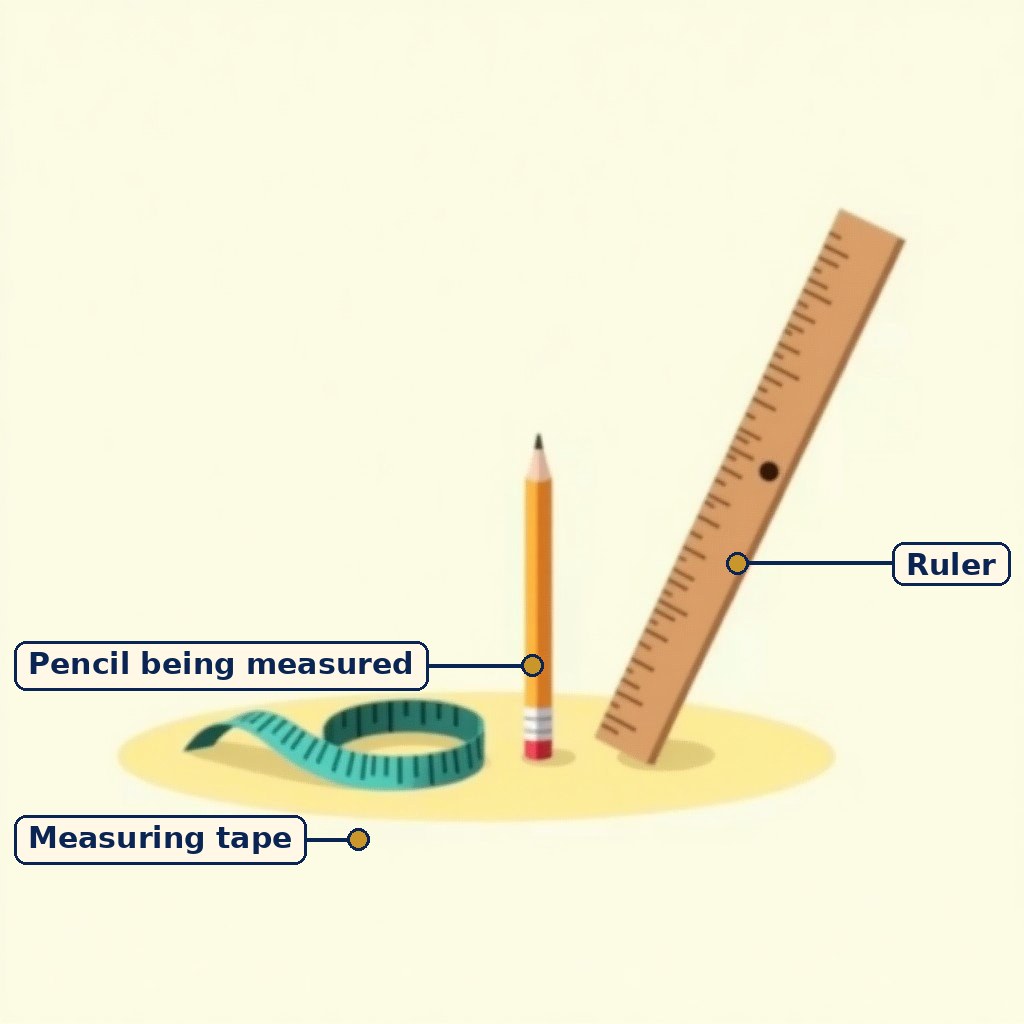
Diagram (labels are printed on the image): A ruler measuring a pencil, with a measuring tape nearby. A general teaching picture about measuring length.

Children in different kinds of motion — circular, to-and-fro and straight. A general picture, not a book scene.
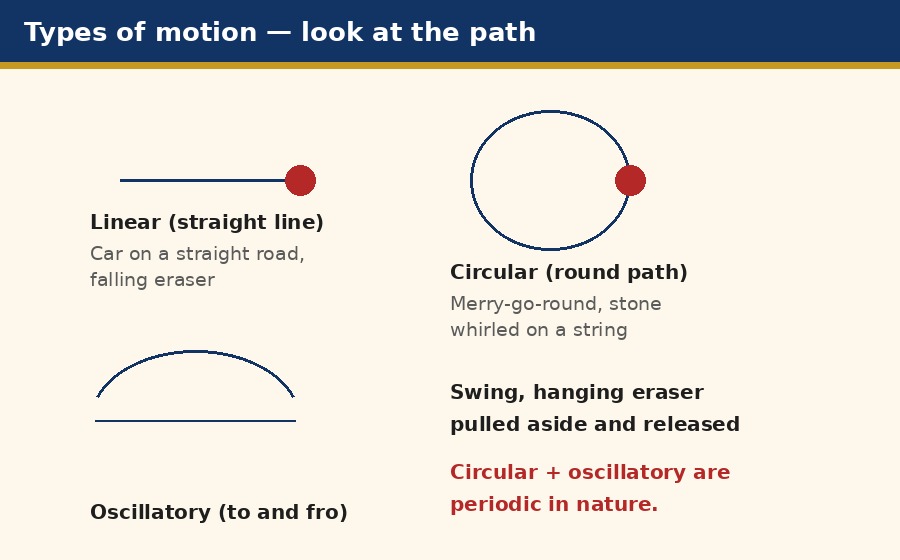
Diagram (labels are printed on the image): Motion is named by its path: straight line (linear), round (circular), and to and fro about a fixed position (oscillatory). Circular and oscillatory motion are periodic in nature.
What the chapter is about
Long ago people measured with the handspan — Deepa's mother calls it balisht — and with other body parts such as the length of the hand, foot, fist or fingers. The trouble is that one person's handspan is not another person's: the same table measured by two people gave two different numbers, because their handspans are of different sizes. That is why we need standard units, accepted everywhere, so that a measurement in one place means the same in another.
The standard unit of length is the metre (m), in the International System of Units (SI units). Smaller lengths are measured in centimetres (cm) and millimetres (mm), and long distances in kilometres (km). The conversions are: 1 km = 1000 m, 1 m = 100 cm, and 1 cm = 10 mm. So 1 m = 1000 mm. A metre scale is divided into 100 equal centimetres, and each centimetre into 10 millimetres, so on a 15-cm scale 1 mm is the smallest value of length you can measure. Choose the unit to suit the size: the thickness of a coin in millimetres, the length of a pencil in centimetres, the height of a door in metres, and the distance between towns in kilometres. Common tools are a ruler (for small lengths), a measuring tape (for longer or curved lengths) and a metre scale (for lengths up to a metre). You may also see another scale marking, inches, where 1 inch = 2.54 cm.
Measuring correctly matters as much as the tool. Place the scale in contact with the object along its length, with the zero mark exactly at one end of the object — if the zero end is worn out, start from another clear mark and subtract. Keep the eye exactly above the mark being read; looking from an angle gives a wrong reading. For a curved line, lay a thread along it, mark the thread, then measure the thread straight against a scale.
Motion means change of position with time, judged with respect to a reference point. A body is at rest if its position does not change with respect to the reference point, and in motion if it does. But rest and motion are judged against something else: a passenger sitting in a moving bus is at rest compared with the bus (the reference point), but in motion compared with the roadside trees. Motion is therefore always relative to a chosen reference point. Reference points are used in daily life too: a kilometre stone that says 'Delhi 70 km' gives a position 70 km away from Delhi, with Delhi as the reference point.
Motion is named by its path. Linear motion is along a straight line, like a car on a straight road, a falling eraser, or students marching in a parade. Circular motion follows a circle, like a stone tied to a string being whirled, or a merry-go-round. Oscillatory motion is to-and-fro motion about a fixed position, like a swing, a hanging eraser pulled to one side and released, or the free end of a thin metal strip pressed at one end. Circular and oscillatory motion are periodic in nature, because they repeat after a fixed interval of time — but 'periodic' describes this repeating nature, it is not a separate fourth type. One journey can show more than one kind at different portions: on a rollercoaster track, straight portions are linear and curved portions are circular.
What you should learn
- Explain why non-standard units (handspan, foot, fist, fingers) cannot be compared, and why standard units are needed.
- Convert confidently: 1 km = 1000 m, 1 m = 100 cm, 1 cm = 10 mm.
- Measure correctly: zero at the end, eye above the mark, thread for curved lines.
- Judge rest and motion against a reference point, with the bus-passenger example.
- Name motion by its path: linear, circular, oscillatory — and note that circular and oscillatory motion are periodic in nature.
If the zero end of your scale is broken or worn, do not guess from the broken edge. Start the object at the 1 cm or 2 cm mark, read the other end, and subtract the starting mark. That gives the true length.
Reading a scale from an angle makes the mark look shifted. Always bring your eye directly above the mark you are reading — this is the most common measurement error in exams.
Key Terms
- Measurement — Finding how much of something there is, using a standard unit.
- Standard unit — A unit accepted everywhere, so measurements can be compared.
- Metre (m) — The standard unit of length.
- Centimetre (cm) — A smaller unit of length; 100 cm = 1 m.
- Millimetre (mm) — A still smaller unit; 10 mm = 1 cm.
- Kilometre (km) — A large unit for long distances; 1 km = 1000 m.
- Rest — The state of a body that does not change its position with time.
- Motion — Change of position of a body with time.
- Linear motion — Motion along a straight line.
- Circular motion — Motion along a circular path.
- Oscillatory motion — Motion to and fro about a fixed position.
- Periodic motion — Motion that repeats itself after a fixed interval of time; circular and oscillatory motion are periodic in nature.
Remember
- Handspans, and the lengths of the hand, foot, fist and fingers, differ from person to person, so they are not standard units.
- Standard unit of length: metre. 1 km = 1000 m; 1 m = 100 cm; 1 cm = 10 mm.
- Ruler: small lengths. Measuring tape: long or curved lengths. Metre scale: up to 1 m.
- Correct measuring: zero at one end, eye above the mark, thread for curves.
- Rest and motion are relative — they depend on what you compare with.
- Linear: straight line. Circular: round path. Oscillatory: to and fro about a fixed position. Periodic: repeats after a fixed time (circular and oscillatory are periodic).
Exam Tip / Common Mistake
Common mistake: converting wrongly (writing 1 m = 10 cm, or 1 km = 100 m) and naming motion by the object instead of the path. In answers, always write the conversion chain, and always name the path: “straight line, so linear.”
Chart / Table: Units of length
| Unit | Equals |
|---|---|
| 1 kilometre (km) | 1000 metres |
| 1 metre (m) | 100 centimetres |
| 1 centimetre (cm) | 10 millimetres |
| 1 millimetre (mm) | Smallest value on a 15-cm scale |
Table: Units of length — choose the right one
| Unit | Equals | Used for |
|---|---|---|
| Millimetre (mm) | — | Thickness of a coin, a sharp pencil point |
| Centimetre (cm) | 10 mm | Length of a pencil, a notebook |
| Metre (m) | 100 cm | Height of a door, length of a room |
| Kilometre (km) | 1000 m | Distance between towns and cities |
Table: Types of motion by path
| Type | Path | Examples |
|---|---|---|
| Linear | Straight line | Car on a straight road, train on a straight track, falling eraser |
| Circular | Circle | Stone whirled on a string, merry-go-round |
| Oscillatory | To and fro about a fixed position | Pendulum, swing, vibrating metal strip |
| Periodic (nature, not a type) | Repeats after a fixed interval of time | Circular motion and oscillatory motion are periodic in nature |
Practice set — try it yourself
- Convert 3 km into metres and 250 cm into metres.
Hint: Use 1 km = 1000 m and 100 cm = 1 m. - Why are standard units needed?
Hint: Think about handspans differing between people. - Name the motion of: a train on a straight track, a merry-go-round, a pendulum.
Hint: Think about the path of each. - A ruler's 0 mark is worn out. How can you still measure correctly?
Hint: Think about starting from another mark and subtracting. - Is a sleeping dog in motion or at rest? Explain.
Hint: Think about change of position.
Questions with Answers
- Why do we need standard units of measurement?
Standard units are the same everywhere, so measurements can be compared and understood by everyone. Non-standard units like a handspan or the length of a foot differ from person to person, so the same object would be measured differently by different people. - Convert: (a) 5 km to metres, (b) 400 cm to metres, (c) 2 m to centimetres.
(a) 5 km = 5 × 1000 = 5000 m. (b) 400 cm = 400 ÷ 100 = 4 m. (c) 2 m = 2 × 100 = 200 cm. - What precautions should be taken while measuring length with a scale?
Place the scale straight along the object, start from the 0 mark (or subtract the starting reading), and keep the eye exactly above the mark being read, otherwise the reading will be wrong. - Define motion and name the three types with one example each.
Motion is the change of position of a body with time, with respect to a reference point. Linear motion: a car on a straight road. Circular motion: a merry-go-round. Oscillatory motion: a swing moving to and fro. Circular and oscillatory motion are also periodic in nature, because they repeat after a fixed interval of time. - A stone tied to a string is whirled in a circle. What type of motion is this, and why?
It is circular motion, because the stone moves along a circular path around the hand holding the string, even though its speed may stay the same.
More NCERT-exercise questions — extra practice
- Why can a handspan not be used as a standard unit of length?
Because handspans differ from person to person. The same object measured by two people would give different numbers, so the measurements could not be compared. - Fill in the blanks: 1 km = ______ m; 1 m = ______ cm; 1 cm = ______ mm.
1000; 100; 10. - Convert: (a) 3 km into metres, (b) 250 cm into metres, (c) 5 cm into millimetres.
(a) 3 × 1000 = 3000 m. (b) 250 ÷ 100 = 2.5 m. (c) 5 × 10 = 50 mm. - True or False: A passenger sitting in a moving bus is at rest. Explain.
True, compared with the bus — the passenger's position relative to the bus does not change. But compared with the roadside, the same passenger is in motion. Rest and motion are relative. - Which tool would you use to measure (a) the length of a curved rope, (b) the distance between two cities, (c) the thickness of a coin?
(a) A measuring tape, or a thread measured afterwards against a scale. (b) Kilometres, using a vehicle's odometer or a map scale — not a ruler. (c) A ruler in millimetres. - Why must the eye be exactly above the mark when reading a scale?
Because looking from an angle makes the mark appear shifted, giving a wrong reading. The eye directly above the mark gives the true value. - A scale's zero mark is worn out. How can you still measure a pencil correctly with it?
Place the pencil's one end at a clear mark, say 2 cm, read the other end, say 17 cm, and subtract: 17 − 2 = 15 cm. The pencil is 15 cm long. - Name the type of motion in each case: (a) a pendulum, (b) a swing, (c) a car on a straight road, (d) the Moon around the Earth.
(a) Oscillatory (to and fro about a fixed position; also periodic in nature). (b) Oscillatory (to and fro). (c) Linear (straight line). (d) Circular (round path). - A ball runs on a rollercoaster track with straight and curved portions. Which types of motion does it show, and where?
On the straight portions it shows linear motion, and on the curved portions circular motion. One journey can show different types of motion on different portions of the track — that is why the chapter asks you to match each portion of the track to its motion. - Match the length to a suitable unit: (a) distance between Delhi and Lucknow, (b) thickness of a coin, (c) length of an eraser, (d) length of a school ground.
(a) Kilometre — towns are far apart. (b) Millimetre — a coin is very thin. (c) Centimetre — an eraser is a few centimetres long. (d) Metre — a ground is tens of metres long. - True or False: (i) A car moving on a straight road shows linear motion. (ii) Any object changing its position with respect to a reference point with time is in motion. (iii) 1 km = 100 cm.
(i) True — straight-line path means linear motion. (ii) True — that is the chapter's definition of motion. (iii) False — 1 km = 1000 m = 100,000 cm, not 100 cm. - Which of these is NOT a standard unit of length: millimetre, centimetre, kilometre, handspan?
Handspan. Millimetre, centimetre and kilometre are standard units (fractions and multiples of the metre); a handspan differs from person to person, so it is not standard. - Your school is 1.5 km from your home. Express this distance in metres.
1.5 × 1000 = 1500 m. - What is the smallest value you can measure with a 15-cm scale? Why do different scales have different smallest values?
1 mm — the scale is divided into centimetres, each split into 10 millimetres. Different scales are divided differently (for example, a metre scale into centimetres, a measuring tape into millimetres or centimetres), so the smallest value each can read is different. Always check the divisions before measuring. - Tasneem wants to make a metre scale from plywood, paper, cloth, stretchable rubber or steel. Which material should she NOT use, and why?
Stretchable rubber. It stretches, so its length — and every mark on it — changes when pulled, and measurements made with it cannot be trusted. A rigid material like plywood or steel keeps its length. - Give two examples each of linear, circular and oscillatory motion.
Linear: a car on a straight road, a falling eraser. Circular: a merry-go-round, a stone whirled on a string. Oscillatory: a swing, the free end of a thin metal strip pressed at one end. - Your friend's height is 1.45 m. Express it in centimetres and in millimetres.
1.45 m = 145 cm = 1450 mm (multiply by 100 for centimetres, by 1000 for millimetres). - How do you measure the curved base of a tumbler or bottle?
Lay a thread along the curved part, mark the thread where the curve ends, then lay the thread straight against a scale and read its length. A rigid scale cannot follow a curve, but a thread can. - List three objects you would measure in millimetres, three in centimetres and three in metres.
Millimetres: thickness of a coin, thickness of a page, diameter of a pencil lead. Centimetres: length of a pencil, length of a notebook, breadth of a leaf. Metres: height of a door, length of a room, length of a school ground. - Ancient Indian units included the angula (finger width), dhanusa and yojana. Which of these is still used by some craftspeople today?
The angula is still used by traditional craftspeople like carpenters and tailors. Ruled objects that could be scales have also been excavated from Harappan sites — India has a long history of measurement.
- Non-standard units differ per person; standard units (m, cm, mm, km) can be compared.
- 1 km = 1000 m, 1 m = 100 cm, 1 cm = 10 mm.
- Measure: zero at the end, eye above the mark, thread for curves.
- Rest/motion are relative to a reference point.
- Path names motion: linear, circular, oscillatory. Circular and oscillatory are periodic in nature.
How to use this page: Read the summary, say the Key Terms in your own words, then try the practice set without looking. Use the Questions with Answers to check yourself afterwards. Ask your teacher or parent to check your answers.