

Chapter 3: Mindful Eating: A Path to a Healthy Body
Eat with attention, and give the body every nutrient it needs.
Original notes — ready CBSE (NCERT, English Medium) • Class 6 • Science • Book: Curiosity
Mindful Eating: A Path to a Healthy Body — EG's own notes, in simple words
Book: Curiosity (CBSE, Class 6) | Chapter 3 | Medium: English

Diagram (labels are printed on the image): A balanced plate with cereals, pulses, vegetables, fruit and water. A general teaching picture of a balanced diet.
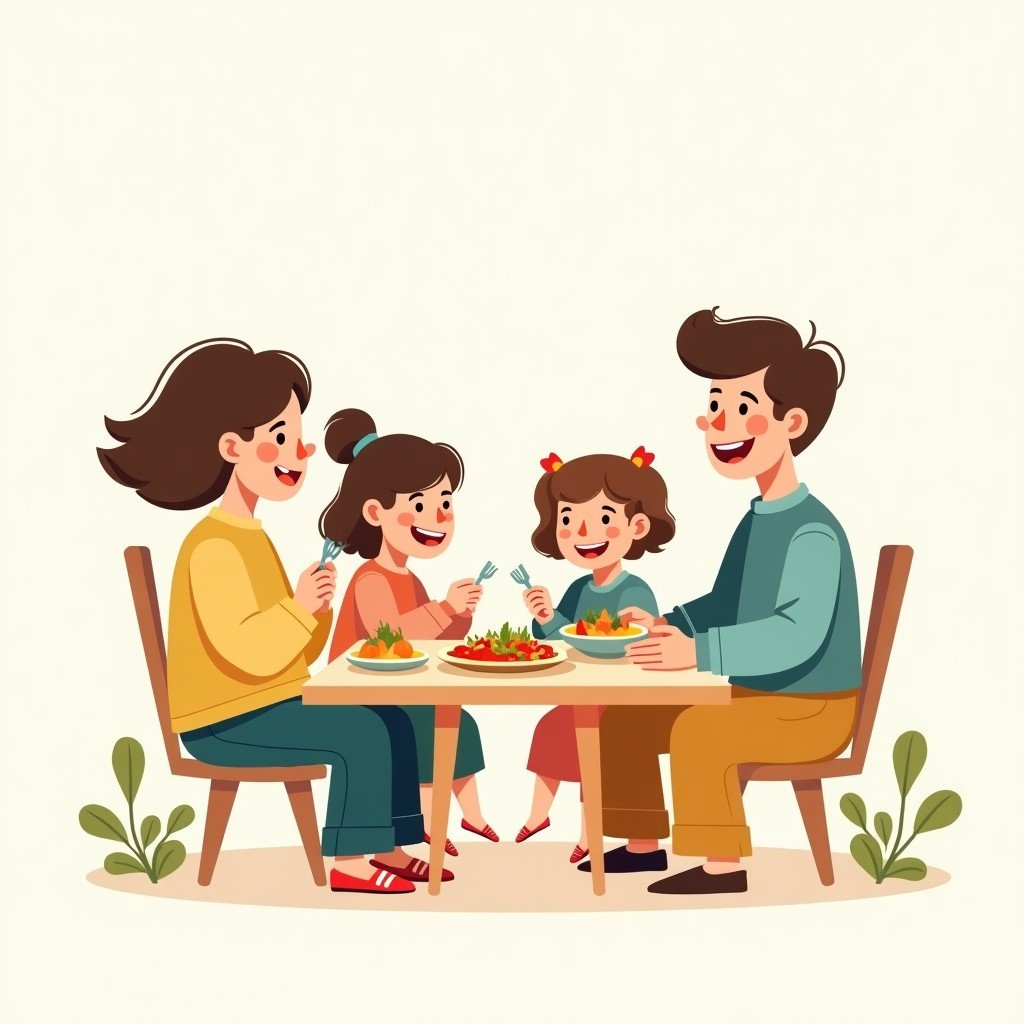
A family eating mindfully together — a general picture about healthy eating habits.

Diagram (labels are printed on the image): A balanced plate holds cereals, pulses, vegetables, fruits, milk or curd, and water. No single food gives the body everything it needs.

Diagram (labels are printed on the image): Three food tests from the chapter: iodine solution turns blue-black for starch, copper sulphate and caustic soda turn violet for protein, and an oily patch on paper shows fat.
What the chapter is about
Mindful eating means eating with attention — noticing what we eat, how much we eat, and how our body feels. It is the opposite of eating hurriedly while watching a screen and not noticing the food at all. When we eat slowly, chew well and stop when we feel full, we enjoy food more and avoid eating more than we need.
Our body also sends signals. Hunger tells us it is time to eat; fullness tells us to stop. Mindless eating ignores those signals: eating because of boredom, sadness or habit, or eating while distracted, often leads to overeating, stomach pain and poor food choices. One simple mindful habit is to eat one meal a day without any screen, taking small bites and tasting every bite.
Food is broken down in the body into nutrients, and each nutrient has a job. Carbohydrates and fats mainly give energy. Proteins build and repair the body — they are needed most by growing children. Vitamins and minerals protect us from diseases and keep body processes working. Roughage, the fibre in fruits, vegetables and whole grains, keeps digestion smooth, and water carries nutrients, removes waste and keeps the body cool.
Foods are grouped by what they mainly give us. Cereals like rice and wheat give carbohydrates. Pulses, milk, eggs and meat give proteins. Vegetables and fruits give vitamins, minerals and roughage. Fats and oils give energy but are needed only in small amounts. A balanced diet contains the right amounts of all these groups — no single food gives everything.
When a nutrient is missing for a long time, a deficiency disease can appear. Lack of vitamin A can cause night blindness; lack of vitamin B1, beriberi; lack of vitamin C, scurvy; lack of vitamin D, rickets (weak, soft bones); lack of iron, anaemia (weakness, pale skin); lack of calcium, weak bones and teeth; and lack of iodine, goitre (swelling of the neck glands). A varied diet is the best protection, because different foods supply different nutrients.
Two more ideas matter. Food miles: food that travels far costs more fuel and is often less fresh, so local and seasonal foods are usually a wiser choice. And food wastage: food takes water, soil and hard work to grow, so taking only as much as we can eat, and saving leftovers properly, respects both the food and the people who grew it. Too much junk food — high in fat, salt and sugar but low in nutrients — makes us unhealthy, especially when it replaces real meals.
Testing food, millets, and the journey from farm to plate
Some nutrients can be found with simple tests. For starch, put 2–3 drops of diluted iodine solution on the food: a blue-black colour shows starch is present. Sugar is also a carbohydrate, but it is not starch, so it does not turn blue-black with iodine. For fat, wrap the food in paper and press it: an oily patch that lets light shine faintly through shows fat is present. For protein, the teacher makes a paste of the food, adds water, then two drops of copper sulphate solution and 10 drops of caustic soda solution: a violet colour shows protein is present. These chemicals are harmful, so only the teacher handles them, and nothing is tasted or smelled. One food can show more than one nutrient — peanuts, for example, show both protein and fat.
Foods are also grouped by their main job in the body. Carbohydrates and fats are energy-giving foods. Proteins are body-building foods. Vitamins and minerals are protective foods, because they protect the body from diseases. A balanced diet must contain all three groups, plus roughage and water, in the right amounts for a person's age, work and health.
Millets are small, nutrition-rich grains from India — jowar, bajra, ragi and sanwa (barnyard millet). They are also called nutri-cereals because they give vitamins, minerals like iron and calcium, and dietary fibre, and they grow easily in different climates. Millets are healthy, but eating only millets is still not enough: the body needs foods from every group, so millets should be part of a balanced diet, not the whole of it.
Food also has a journey. The story of a chapati runs: farmer grows wheat, threshing and winnowing of grains, storage of grains, transport to a retail shop, grinding of grains and packing, and finally food on our plate. The whole distance a food item travels from producer to consumer is its food miles. Shorter food miles mean lower transport cost and pollution, support for local farmers, and fresher food. Vitamin D has a special job in this story too: it helps the body absorb calcium for healthy bones and teeth, which is why a doctor treating a broken bone may give calcium tablets and vitamin D syrup together.
Cooking itself has changed over time. Earlier, most cooking was done on a chulha, and grinding was done by hand with a sil-batta. Today most homes use a modern gas stove and an electric grinder. These culinary practices changed with technology, better transport and better communication. Packaged foods must carry nutrient information on their covers, and some foods are fortified — extra nutrients are added during processing, as in iodised salt. The Food Safety and Standards Authority of India (FSSAI) regulates food quality in India.
What you should learn
- Practise mindful eating: no screen, small bites, chew slowly, stop at fullness.
- Link each nutrient to its job: energy, body-building, protection, or smooth digestion.
- Name the main food groups and what each mainly supplies.
- Match common deficiency diseases to the missing nutrient.
- Explain food miles and why wasting food is harmful, not just wasteful.
Before taking a snack, ask: “Am I hungry, or just bored, sad, or watching a screen?” Mindful eating starts with listening to the body's own signal, not to habit.
The harm of junk food is not only what it contains, but what it pushes out. A packet of chips instead of lunch means the proteins, vitamins and roughage of a real meal are missed entirely.
Key Terms
- Mindful eating — Eating with full attention — noticing taste, smell, texture and hunger and fullness signals.
- Nutrient — A useful substance in food that the body needs.
- Carbohydrate — A nutrient that mainly gives energy.
- Protein — A nutrient that builds and repairs body parts.
- Fat — A nutrient that gives energy and keeps the body warm; needed only in small amounts.
- Vitamin — A nutrient needed in small amounts to protect the body and keep it working well.
- Mineral — A nutrient from food that builds bones and teeth and helps the body work, e.g. iron and calcium.
- Roughage — The fibre in plant foods that helps food move through the body and prevents constipation.
- Balanced diet — A diet containing the right amounts of all the nutrients the body needs.
- Deficiency disease — An illness caused by the lack of a nutrient in the diet over a long time.
- Junk food — Food high in fat, salt or sugar but low in useful nutrients.
- Food miles — The distance food travels from where it is grown to where it is eaten.
- Millets (nutri-cereals) — Small nutrition-rich grains such as jowar, bajra, ragi and sanwa, giving vitamins, minerals and fibre.
- Starch test — Iodine solution turns blue-black when starch is present; sugar, though a carbohydrate, does not.
- Protein test — Copper sulphate solution and caustic soda solution turn violet when protein is present (teacher demo only).
- Fat test — Pressing food in paper leaves an oily patch, through which light shines faintly, when fat is present.
Remember
- Mindful eating: attention, slow chewing, no distractions, stop when full.
- Carbohydrates and fats give energy; proteins build and repair; vitamins and minerals protect.
- Roughage keeps digestion smooth; water carries nutrients and removes waste.
- Balanced diet = right amounts of every food group, not one perfect food.
- Vitamin A: night blindness. Vitamin C: scurvy. Vitamin D: rickets. Iron: anaemia. Iodine: goitre.
- Local, seasonal food travels fewer food miles; wasted food wastes water, soil and labour.
Exam Tip / Common Mistake
Common mistake: naming nutrients without their jobs, or writing “vitamins give energy” — they protect and regulate, they do not mainly give energy. In answers, always pair the nutrient with its work, and pair a deficiency disease with the missing nutrient.
Chart / Table: Nutrients and their main jobs
| Nutrient | Main job |
|---|---|
| Carbohydrates | Give energy |
| Proteins | Build and repair the body |
| Fats | Give energy and keep warm |
| Vitamins and minerals | Protect from diseases |
| Roughage and water | Help digestion |
Table: Nutrients and their main jobs
| Nutrient | Main job | Good sources |
|---|---|---|
| Carbohydrate | Gives energy | Rice, wheat, potato, sugar |
| Protein | Builds and repairs the body | Pulses, milk, egg, meat |
| Fat | Gives energy, keeps warm (small amounts) | Oil, ghee, butter, nuts |
| Vitamins | Protect from diseases | Fruits, vegetables, milk |
| Minerals | Bones, teeth, body processes | Milk (calcium), green vegetables (iron) |
| Roughage | Smooth digestion | Whole grains, fruits, vegetables |
| Water | Carries nutrients, removes waste | Drinking water, juices, soups |
Table: Deficiency diseases to remember
| Missing nutrient | Disease | Sign |
|---|---|---|
| Vitamin A | Night blindness | Cannot see well in dim light |
| Vitamin B1 | Beriberi | Swelling, tingling or burning in feet and hands, trouble breathing |
| Vitamin C | Scurvy | Bleeding gums, slow healing |
| Vitamin D | Rickets | Soft and bent bones |
| Iron | Anaemia | Weakness, shortness of breath |
| Iodine | Goitre | Swelling at the front of the neck |
Practice set — try it yourself
- What is meant by mindful eating?
Hint: Think about attention, not just food choice. - Name the nutrient that builds the body and give one food rich in it.
Hint: Think about pulses, milk and eggs. - Why is roughage important although it gives no energy?
Hint: Think about digestion. - Why is junk food unhealthy?
Hint: Think about what it has too much of and too little of. - Suggest one balanced lunch for a schoolchild and name the nutrients in it.
Hint: Include energy, protein, vegetables and water.
Questions with Answers
- What is mindful eating and why does it matter?
Mindful eating means paying full attention while eating — noticing the taste, chewing well, eating slowly, and stopping when full. It matters because it helps us enjoy food, avoid overeating, and notice how food affects our body. - Name the main nutrients and state one job of each.
Carbohydrates give energy. Proteins build and repair the body. Fats give energy and keep the body warm. Vitamins and minerals protect the body from diseases. Roughage helps digestion, and water carries nutrients and removes waste. - What is a balanced diet?
A balanced diet is a diet that contains all the nutrients — carbohydrates, proteins, fats, vitamins, minerals, roughage and water — in the right amounts for age, work and health. - Why should junk food be eaten only rarely?
Junk food is high in fat, salt and sugar but low in proteins, vitamins, minerals and roughage. Eating it often gives extra calories without the nutrients the body needs, and can lead to obesity, tooth decay and other health problems. - Rahul eats only rice and potatoes every day. Is his diet balanced? Suggest an improvement.
No, his diet is not balanced, because it gives mainly carbohydrates and lacks proteins, vitamins, minerals and roughage. He should add pulses or milk for protein, green vegetables and fruits for vitamins and minerals, and drink enough water.
More NCERT-exercise questions — extra practice
- What is mindful eating? Give two habits of a mindful eater.
Mindful eating is eating with full attention to the food and to the body's hunger and fullness signals. Two habits: eating without a screen, and chewing slowly and stopping when full. - Fill in the blank: Proteins are called body-building foods because they __________ the body.
Build and repair. - True or False: Vitamins mainly give us energy. Correct the statement if false.
False. Carbohydrates and fats mainly give energy; vitamins protect the body from diseases and keep body processes working. - A child eats only rice all day, every day. Which nutrients is she likely to miss, and why is that a problem?
She is likely to miss proteins, vitamins, minerals and roughage, because rice mainly gives carbohydrates. Over time this one-sided diet can cause weakness and deficiency diseases. - Match the disease to the missing nutrient: (a) scurvy, (b) anaemia, (c) goitre — with vitamin C, iron, iodine.
(a) scurvy — vitamin C; (b) anaemia — iron; (c) goitre — iodine. - What are food miles? Why is local, seasonal food often a better choice?
Food miles are the distance food travels from where it is grown to where it is eaten. Local, seasonal food travels less, so it uses less fuel and is usually fresher. - Why should we not eat while watching television or playing games?
Because distraction hides how much we are eating and hides the fullness signal, so we easily overeat and make poor food choices. - What is roughage, and why does the body need it even though it gives no energy?
Roughage is the fibre in plant foods. It gives no energy, but it helps food move through the body and prevents constipation, keeping digestion smooth. - Give two reasons why wasting food is bad, beyond the food itself being lost.
Wasted food also wastes the water, soil and hard work used to grow it, and it means food that could feed someone else is thrown away. - How do you test a food for starch? Why does sugar not turn blue-black with iodine?
Put 2–3 drops of diluted iodine solution on the food. A blue-black colour shows starch is present. Sugar does not turn blue-black because, although sugar is a carbohydrate, it is not starch — all starches are carbohydrates, but not all carbohydrates are starches. - How do you test a food for protein? Why is this a teacher-only activity?
Make a paste of the food, add water, then two drops of copper sulphate solution and 10 drops of caustic soda solution, shake and wait. A violet colour shows protein is present. It is a teacher demo because the chemicals are harmful: they must not be touched, tasted or smelled, and spills must be washed with water at once. - How do you test a food for fat?
Wrap the food in paper and press it without tearing the paper. If the paper gets an oily patch, and light shines faintly through that patch when held up, the food contains fat. - Name four millets. Why are they called nutri-cereals? Can eating only millets give the body everything it needs?
Jowar, bajra, ragi and sanwa. They are called nutri-cereals because they are rich in vitamins, minerals like iron and calcium, and dietary fibre, and they grow easily in different climates. No — millets alone do not suffice; the body also needs foods from the other groups, so millets belong inside a balanced diet. - Put the story of a chapati in order, from farm to plate.
Farmer grows wheat → threshing and winnowing of grains → storage of grains → transport to a retail shop → grinding of grains and packing → food on our plate. The total distance travelled is the food's food miles; shorter food miles cut cost and pollution, support local farmers and keep food fresh. - How have cooking practices changed in India? Give two examples.
Earlier, cooking was mostly done on a chulha and grinding by hand with a sil-batta. Today most homes use a modern gas stove and an electric grinder. The change came with technological development, improved transport and better communication. - Pick the odd one out and give a reason: (a) Jowar, Bajra, Ragi, Chana; (b) Kidney beans, Green gram, Soya bean, Rice.
(a) Chana — the others are millets (cereals), while chana is a pulse. (b) Rice — the others are pulses, while rice is a cereal. - You are offered canned fruit juice, fresh fruit juice and a fresh fruit. Which do you choose, and why?
The fresh fruit, first. It keeps its fibre and has no added sugar. Fresh juice comes next, and canned juice last, because packaged juices usually carry added sugar and much less fibre than the whole fruit. - Gourav broke his leg. His doctor gave calcium tablets, and on the next visit added vitamin D syrup. Why both?
Calcium builds bones and teeth, and vitamin D helps the body absorb calcium for bone and teeth health. The tablets supply the calcium; the vitamin D syrup helps the body actually use it, so the broken bone heals strong. - Medu eats no vegetables. He loves biscuits, noodles and white bread, and often has stomach ache and constipation. What diet changes should he make?
He should add vegetables, fruits and whole grains for roughage and vitamins, drink enough water, and cut down the junk food. Roughage helps food move through the body and prevents constipation, while the missing vegetables supply the vitamins and minerals his present diet lacks.
- Mindful eating: attention, slow chewing, no screen, stop at fullness.
- Energy: carbohydrates, fats. Body-building: proteins. Protection: vitamins, minerals.
- Roughage + water = smooth digestion and transport in the body.
- Deficiencies: A — night blindness, C — scurvy, D — rickets, iron — anaemia, iodine — goitre.
- Balanced diet + local food + no wastage = healthy body and a fairer world.
- Food tests: iodine → blue-black for starch; copper sulphate + caustic soda → violet for protein; oily patch for fat. Millets (jowar, bajra, ragi, sanwa) are nutri-cereals.
How to use this page: Read the summary, say the Key Terms in your own words, then try the practice set without looking. Use the Questions with Answers to check yourself afterwards. Ask your teacher or parent to check your answers.