

Chapter 1: The Wonderful World of Science
Curiosity, questions and the scientific method — how scientists find things out.
Original notes — ready CBSE (NCERT, English Medium) • Class 6 • Science • Book: Curiosity
The Wonderful World of Science — EG's own notes, in simple words
Book: Curiosity (CBSE, Class 6) | Chapter 1 | Medium: English

Diagram (labels are printed on the image): A curious child observing a young plant with a magnifying glass and noting it down. A general picture about scientific observation; it is not a scene from the book.
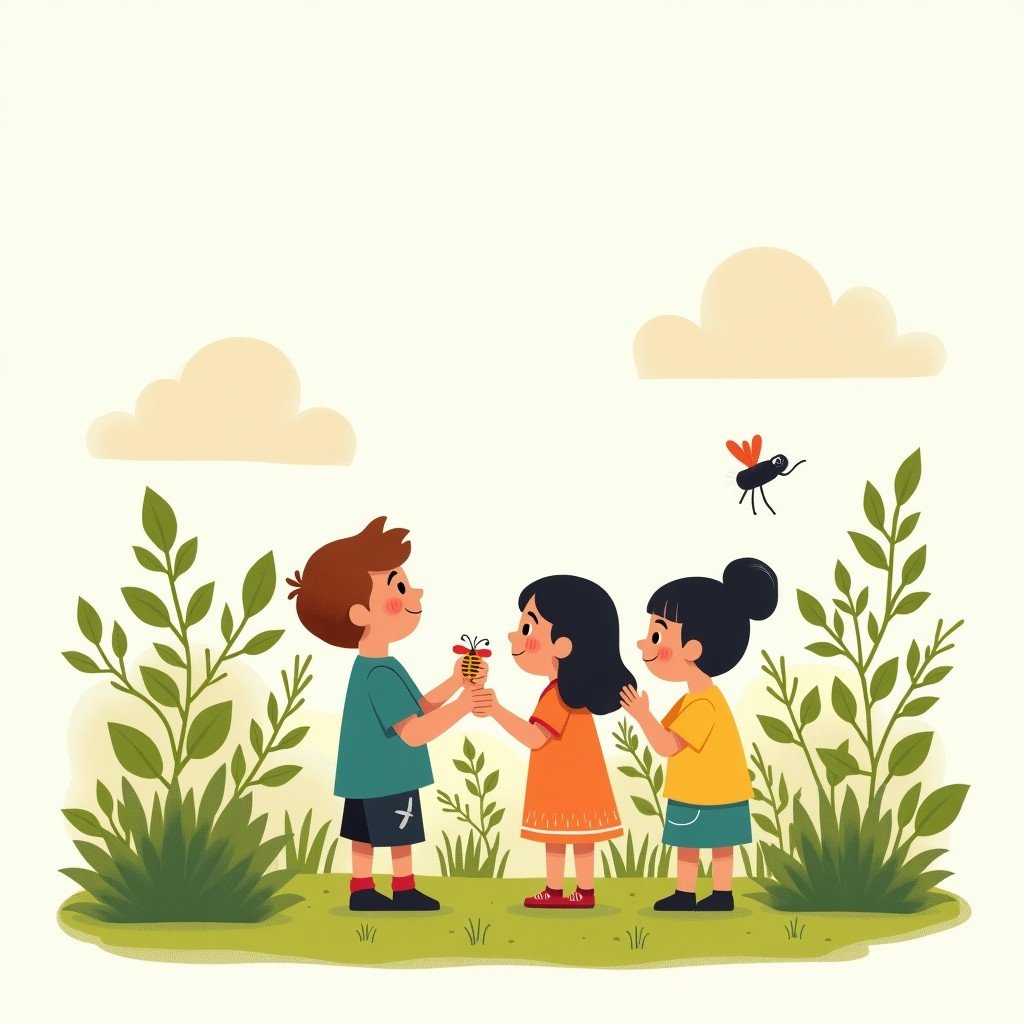
Children exploring nature with curiosity. A general picture about the wonder of science, not a book scene.

Diagram (labels are printed on the image): The scientific method in order: observe, ask a question, make a hypothesis, experiment, record data, and conclude. If the result disagrees with the guess, the guess is changed and tested again.
What the chapter is about
Science starts with wonder. A child who asks why the sky looks blue, why the Moon changes shape, or how a tiny seed becomes a big tree is already thinking the way a scientist thinks. Curiosity turns into a question, and the question turns into an investigation.
Scientists do not simply believe the first idea that comes to mind. They observe carefully, using their senses and sometimes tools such as a magnifying glass, a thermometer or a measuring scale. They write down exactly what they see, because a record that is changed later cannot be trusted.
Next comes a hypothesis, a guess that can be tested. A testable guess is different from an ordinary guess: it says what should happen if the idea is right, so an experiment can prove it wrong. In a fair test only one thing is changed at a time. For example, to test whether sunlight helps plants grow, two similar plants are kept alike in every way except light — one in sunlight and one in shade.
After the test, the scientist studies the data and draws a conclusion. If the evidence does not support the hypothesis, the scientist does not hide the result. The guess is changed and tested again. Repeating a test and getting the same result makes the conclusion stronger.
Science is all around us, not only in laboratories. Cooking, farming, medicines, transport, weather forecasts and machines all use scientific ideas. Learning science helps us understand nature, ask better questions, and take better care of ourselves and our surroundings.
Science is like a giant, unending jigsaw puzzle: every new discovery adds a piece, and sometimes a piece turns out to be in the wrong place and has to be moved, changing what we thought we knew. Science is everywhere — from the depths of the ocean to the vastness of outer space, from what is cooking in the kitchen to what is happening on the playground. The book itself previews the journey: why water freezes into ice and boils into steam, what the paper, metal key, plastic ruler, rubber eraser and magnet in a pencil box are made of, how different materials can be separated, and questions beyond the Earth about the Sun, the Moon and millions of stars. And science is rarely done alone: scientists across the world work together in large teams, so if you cannot find an answer yourself, ask your friends — it is always more fun to discover things together. To be a wise person, be a 'whys' person: keep wondering and never stop asking questions.
What you should learn
- Tell observation, question, hypothesis, experiment and conclusion apart, in order.
- Explain what makes a test fair: change only one thing at a time, keep the rest the same.
- Say why honest records and repeated tests matter for trustworthy conclusions.
- Give examples of science in everyday life: health, food, transport, communication, weather.
- Use tools for observing and measuring instead of guessing from touch or eyesight alone.
“The plant looks happy” is an opinion. “The plant in sunlight grew 4 cm taller in a week” is an observation. In science answers, give what was seen or measured, not only what you felt.
A test that does not support the guess is not a failure. It tells the scientist the idea needs changing. Hiding an unwanted result is the real mistake.
Key Terms
- Curiosity — A strong wish to know or learn something; the starting point of science.
- Observation — Noticing something carefully with the senses, sometimes with the help of tools.
- Hypothesis — A guess that can be tested by an experiment or by further observation.
- Experiment — A careful, planned test done to check an idea.
- Fair test — A test in which only one thing is changed at a time, so the result can be trusted.
- Data — The measurements and observations recorded during a test.
- Conclusion — What the evidence shows at the end of an investigation.
- Scientific method — The step-by-step way of asking questions, testing ideas and drawing conclusions from evidence.
- Evidence — Observations and measurements that support or do not support an idea.
Remember
- Science begins with curiosity and questions.
- Observations must be careful, honest and written down.
- A hypothesis is a testable guess, not just any guess.
- In a fair test, only one thing changes at a time.
- If evidence disagrees, change the idea — never hide the result.
- Repeat a test: the same result again makes the conclusion stronger.
Exam Tip / Common Mistake
Common mistake: writing that science is only a list of facts, or describing a guess without saying how it would be tested. In answers, always name the steps — observe, question, test, conclude — and say what would be kept the same in a fair test.
Chart / Table: Steps of the scientific method
| Step | What you do |
|---|---|
| 1. Observe | Notice something interesting |
| 2. Ask a question | Turn curiosity into a question |
| 3. Hypothesise | Make a testable guess |
| 4. Test | Do an experiment or observe more |
| 5. Conclude | Decide what the evidence shows |
Table: Observation with senses and with tools
| Sense or tool | What it helps us notice | Example |
|---|---|---|
| Eyes | Colour, shape, size, movement | A leaf turning towards light |
| Magnifying glass | Small details the eye misses | Tiny veins on a leaf |
| Thermometer | How hot or cold something is | Water warming in the Sun |
| Measuring scale | Length, fairly and exactly | How much a plant grew in a week |
Table: Science in everyday life
| Area of life | Science at work |
|---|---|
| Health | Medicines, vaccines, clean water |
| Food | Cooking, storing food safely, growing crops |
| Transport | Bicycles, trains, aeroplanes |
| Communication | Phones, television, internet |
| Weather | Forecasts from temperature, wind and cloud observations |
Practice set — try it yourself
- Why is curiosity called the starting point of science?
Hint: Think about what comes before a question. - What is a hypothesis?
Hint: Think about a guess that can be tested. - Why must a scientist record observations honestly?
Hint: Think about what happens if records are wrong. - Give one example of science in everyday life.
Hint: Think about cooking, farming or weather. - What should a scientist do if an experiment does not support the hypothesis?
Hint: Think about changing the guess, not hiding the result.
Questions with Answers
- What is science, in simple words?
Science is a way of understanding the world by observing carefully, asking questions, testing ideas and drawing conclusions from evidence. It is not just memorising facts; it is a method of finding out how things work. - Describe the steps of the scientific method.
First, observe something carefully. Next, ask a question about it. Then make a hypothesis, which is a testable guess. After that, test the hypothesis by an experiment or further observation. Finally, draw a conclusion from the evidence. - Why is honest recording important in science?
Honest records let others check the work and repeat the test. If observations are changed to suit a guess, the conclusion will be wrong and nobody can trust or build on the result. - How is a scientific guess different from an ordinary guess?
A scientific guess, or hypothesis, can be tested. For example, 'plants grow faster in sunlight' can be tested by growing plants in light and in shade and comparing them, while a guess that cannot be tested cannot be checked. - A student thinks seeds grow faster in warm water than in cold water. How can she test this?
She can soak equal numbers of the same seeds in warm water and in cold water, keep everything else the same, and count how many sprout each day. Comparing the two sets fairly tests her idea.
More NCERT-exercise questions — extra practice
- Which step of the scientific method comes first: hypothesis or observation?
Observation comes first. You notice something interesting, then you ask a question about it, and only then you make a hypothesis to explain it. - Fill in the blank: A guess that can be tested by an experiment is called a __________.
Hypothesis. - True or False: A scientist should change the recorded results so that they match the hypothesis. Give a reason.
False. Records must stay honest, because changed results give a wrong conclusion and nobody can check or repeat the work. - A student wants to test whether warm water makes seeds sprout faster than cold water. What should she keep the same in both sets?
Everything except the temperature of the water: the same kind and number of seeds, the same amount of water, the same light and the same container. - Why is it useful to repeat an experiment?
Repeating shows whether the result was a one-time accident or a real pattern. The same result again and again makes the conclusion trustworthy. - Name two tools that help us observe better than our senses alone, and say what each measures or shows.
A magnifying glass enlarges small objects so fine details can be seen. A thermometer measures temperature, which touch alone judges unreliably. - Give one example that shows science is a method, not just a list of facts.
Testing whether plants grow better in sunlight — by growing one plant in light and one in shade and comparing them — is science as a method: observe, guess, test, conclude. - What should a scientist do if an experiment does not support the hypothesis?
Accept the evidence, change or improve the hypothesis, and test the new idea. The old guess is not protected. - Why can touch alone not be trusted for judging temperature?
Touch is affected by what the hand felt before. The same water can feel warm to one hand and cold to another, so a thermometer is needed for a correct measurement. - A pen stops writing. How does the chapter's pen example show the scientific method at work?
First you observe the problem and ask why the pen stopped. Then you guess a possible answer — the ink finished. You test the guess by opening the pen and checking the refill. If the ink is not finished, you make another guess, perhaps that the ink dried up, and test that instead. Observe, guess, test, analyse — that is the scientific method. - What does the chapter mean when it says science is like a giant jigsaw puzzle?
Every discovery adds a piece to our picture of the world, and there is no limit to what can be discovered. Sometimes a piece turns out to be in the wrong place and must be moved — new discoveries can change our understanding. - Why does the chapter say science is rarely done alone?
Because scientists across the world work together, often in large teams. If you cannot find an answer yourself, asking friends and working together makes discovery easier and more fun.
- Curiosity → question → hypothesis → fair test → data → conclusion.
- Fair test: change one thing only; keep everything else the same.
- Honest records + repeated tests = trustworthy science.
- Science is a method of finding out, used in daily life as well as in laboratories.
How to use this page: Read the summary, say the Key Terms in your own words, then try the practice set without looking. Use the Questions with Answers to check yourself afterwards. Ask your teacher or parent to check your answers.