
Chapter 9: Equal Groups
Original notes — ready CBSE (NCERT, English Medium) • Class 4 • Mathematics • Book: Math Mela
Equal Groups — EG's own notes, in simple words
Book: Math Mela (CBSE, Class 4) | Chapter 9 | Medium: English
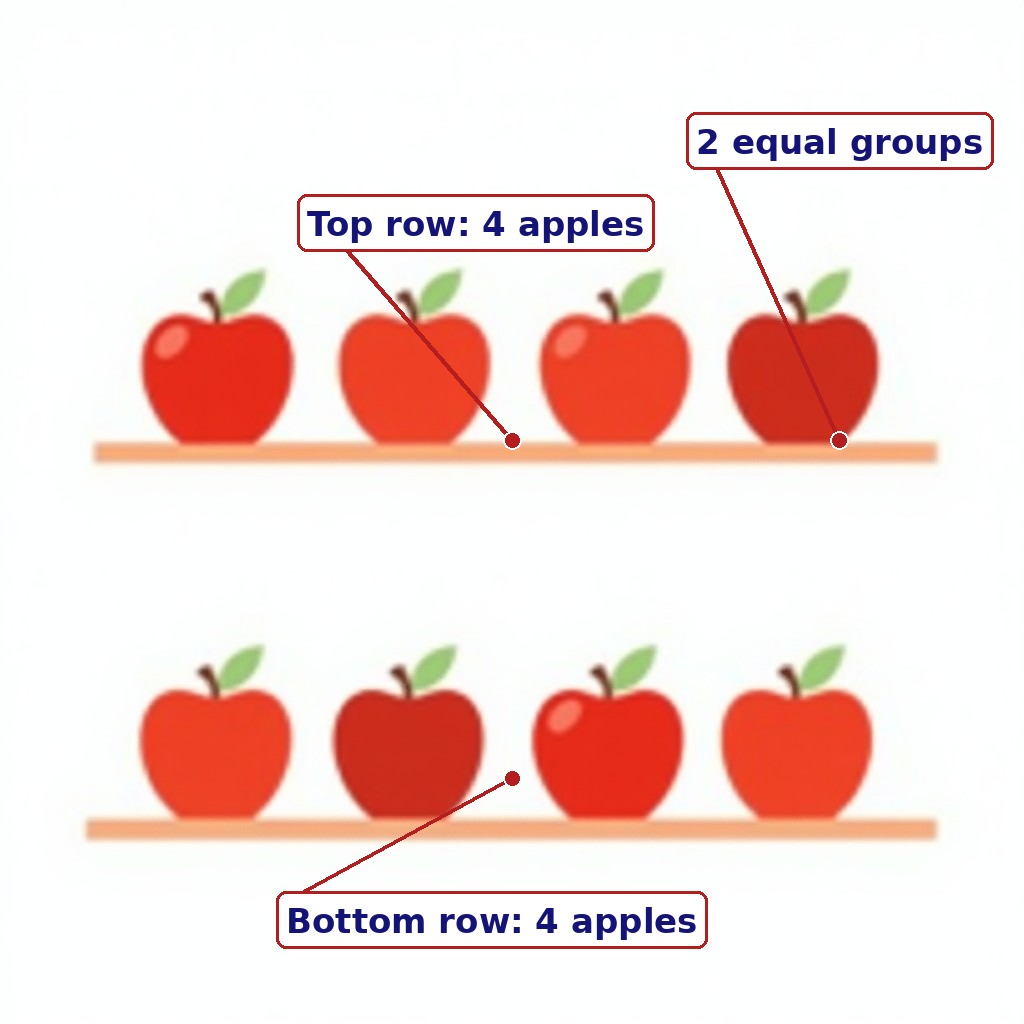
Diagram (labels are printed on the image): Eight red apples on two shelves: four apples in the top row and four in the bottom row. 'Top row: 4 apples' points to the top row, 'Bottom row: 4 apples' to the bottom row, and '2 equal groups' to the two rows together. The two rows match exactly, so this is a true equal-groups picture: 2 groups of 4 = 8 apples.
1. What is an equal group?
An equal group is a group with the same number of things as every other group. If 4 plates each have 6 laddoos, the plates are equal groups. Equal groups are the secret behind multiplication: 4 groups of 6 = 4 × 6 = 24 laddoos in all.
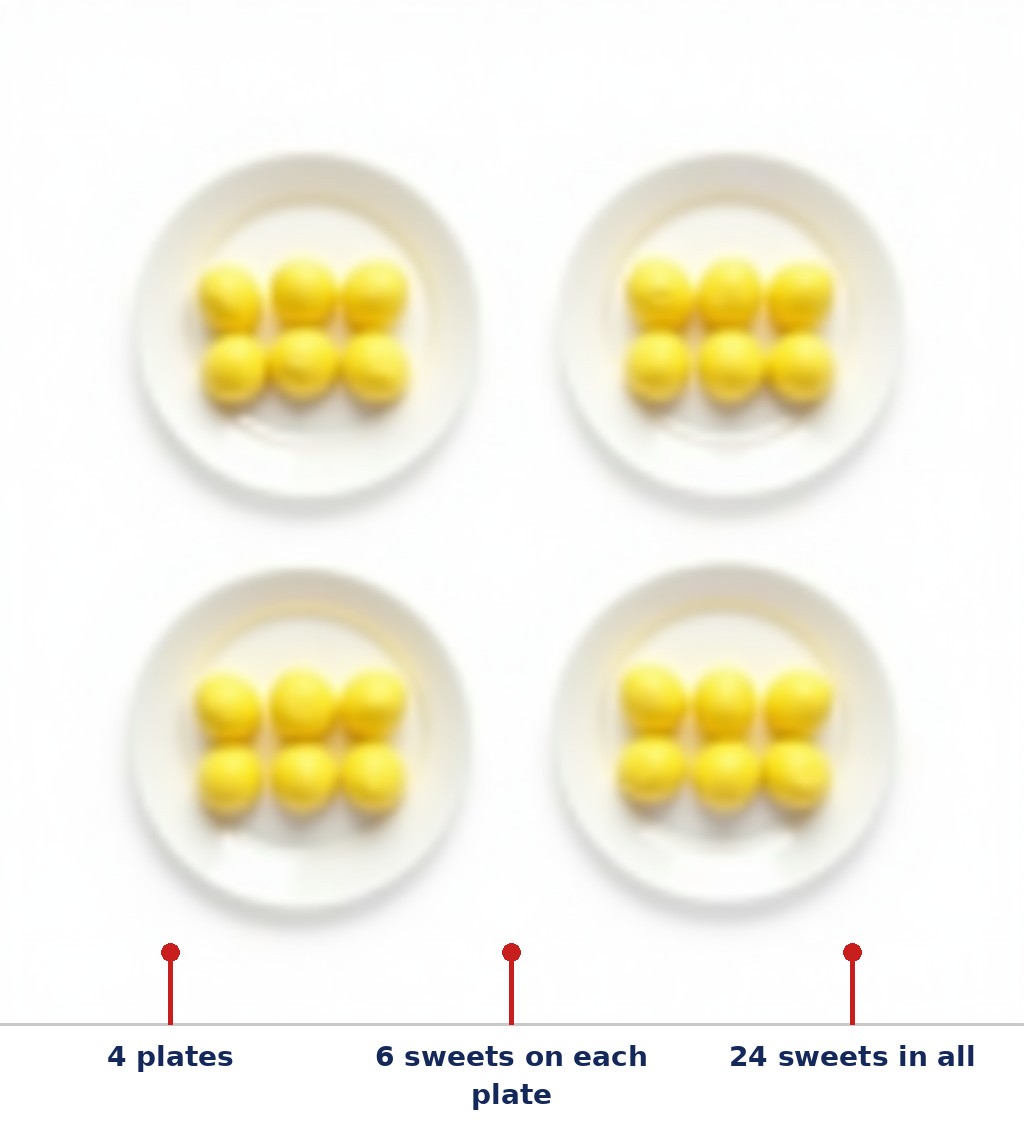
New diagram: Equal groups: 4 plates with 6 sweets on each plate make 24 sweets in all — count them in the picture: two rows of three on every plate. This matches the 4 groups of 6 = 24 example in the text.
2. Making equal groups
Take 18 marbles. Can you make equal groups of 3? Yes: 18 ÷ 3 = 6 groups. Groups of 6? Yes: 18 ÷ 6 = 3 groups. Groups of 5? No: 18 ÷ 5 = 3 remainder 3 — the groups would not be equal. A number that divides equally is a factor of that number. So 3 and 6 are factors of 18, but 5 is not.
| Total things | Group size | Number of groups | Equal? |
|---|---|---|---|
| 20 | 4 | 5 | Yes |
| 20 | 6 | 3, remainder 2 | No |
| 24 | 8 | 3 | Yes |
3. Arrays — groups in rows
When equal groups are lined up in rows, we get an array. An array with 3 rows and 5 columns has 3 × 5 = 15 things. Arrays are everywhere: chairs in a classroom, eggs in a tray, windows on a building. Counting an array is easy — multiply rows by columns instead of counting one by one.
4. Sharing into equal groups
Sharing 30 toffees among 6 children gives equal groups of 5, because 30 ÷ 6 = 5. If one child got 7 and another got 3, the groups would not be equal, and that would not be fair sharing. Equal groups keep sharing fair — and they make multiplication and division much simpler.
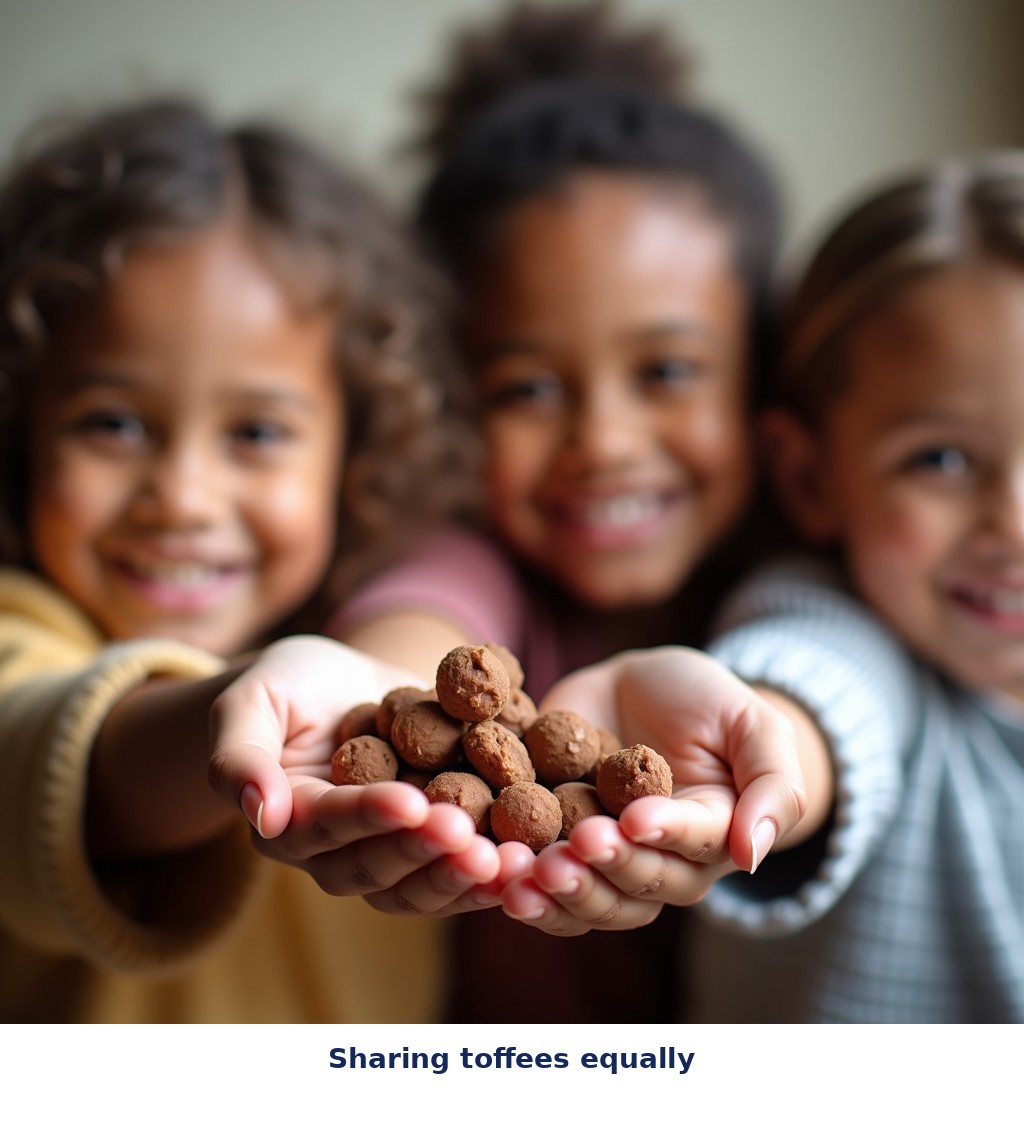
New picture: Children holding out a shared handful of toffees. Friendly picture; it shows sharing together, not separate equal piles, and not the 30 toffees shared by 6 children in the text.
Key Terms
- Equal groups — Groups that all have the same number of things.
- Factor — A number that divides another number exactly, with no remainder.
- Array — Things arranged in equal rows and columns.
- Multiplication — Adding equal groups again and again; 4 groups of 6 = 4 × 6.
Remember
- Equal groups make multiplication easy: groups × group size = total.
- A factor divides exactly, with no remainder.
- An array's total = rows × columns.
Exam Tip / Common Mistake
Common mistake: making groups that only look equal. Count each group. If one group has 5 and another has 7, they are not equal groups, and the division has a remainder.
Practice set — try it yourself
- Make equal groups of 4 from 32 buttons. How many groups do you get?
Hint: Hint: 32 ÷ 4 = ? - Is 7 a factor of 28? Show how you know.
Hint: Hint: Does 28 ÷ 7 leave a remainder? - An array has 6 rows and 4 columns of chairs. How many chairs in all?
Hint: Hint: Rows × columns. - Can 25 marbles be split into equal groups of 6? Why or why not?
Hint: Hint: Try 25 ÷ 6 and look at the remainder. - Share 54 stickers equally among 9 children. Check with multiplication.
Hint: Hint: 9 × ? = 54.