
Chapter 7: The Cleanest Village
Original notes — ready CBSE (NCERT, English Medium) • Class 4 • Mathematics • Book: Math Mela
The Cleanest Village — EG's own notes, in simple words
Book: Math Mela (CBSE, Class 4) | Chapter 7 | Medium: English
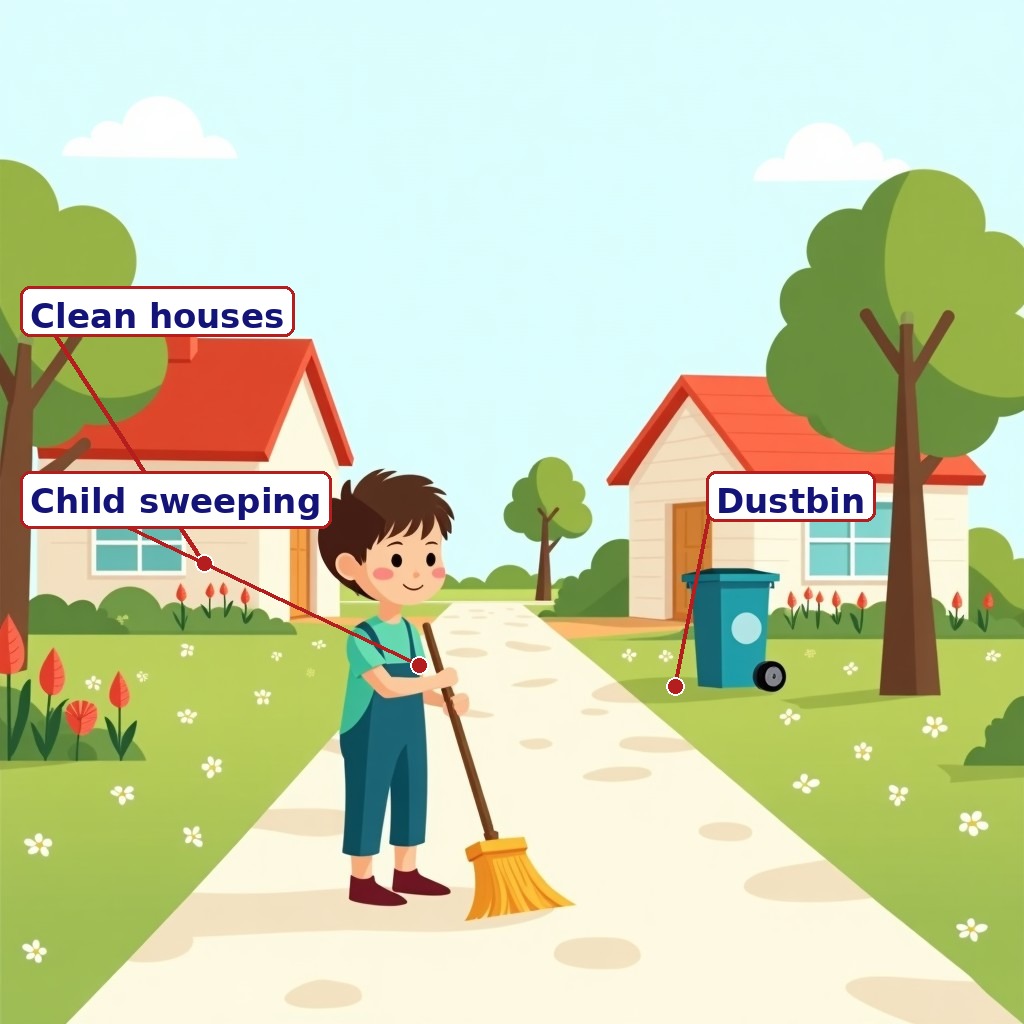
Diagram (labels are printed on the image): A clean village path with houses, green grass and flowers. 'Clean houses' points to a house on the left, 'Dustbin' to the blue bin on the right, and 'Child sweeping' to the boy with a broom on the path. Honest note: the picture shows one dustbin and one child sweeping — it does not show sorted wet and dry waste bins, which are explained in the text.
1. What makes a village clean?
A clean village has clean streets, clean water, and no garbage lying around. Every home uses a dustbin. Waste is sorted: wet waste like vegetable peels goes in one bin, dry waste like paper and plastic in another. Clean villages are healthy villages — fewer flies, fewer mosquitoes, fewer diseases.
2. Counting and comparing cleanliness
Maths helps us check cleanliness. Suppose a village has 120 houses. If 96 houses use dustbins, how many do not? 120 − 96 = 24 houses. That is, most houses are clean, but 24 still need help. When we count, we can see where to work harder.
| Street | Houses | Houses using dustbins | Houses not yet |
|---|---|---|---|
| Main Street | 40 | 36 | 4 |
| School Road | 35 | 30 | 5 |
| Garden Lane | 45 | 30 | 15 |
3. Sorting waste — a maths job
Sorting is grouping things by a rule — just like sorting numbers into odd and even, or shapes into triangles and squares. Wet waste can become compost for plants. Dry waste like paper can be recycled. Plastic should never be thrown in a river or field. Every sorted bag is a small win.
New diagram: Sorting waste: wet waste in the green bin, dry waste in the blue bin. Simplified picture; only a few example items are shown, not every kind of waste.
4. What can one child do?
One child can do a lot: use a dustbin every time, never litter, keep drinking water covered, and tell one friend to do the same. If each of 30 children in a class tells 2 friends, 60 more children learn the habit. Good habits multiply — that is maths and cleanliness working together.
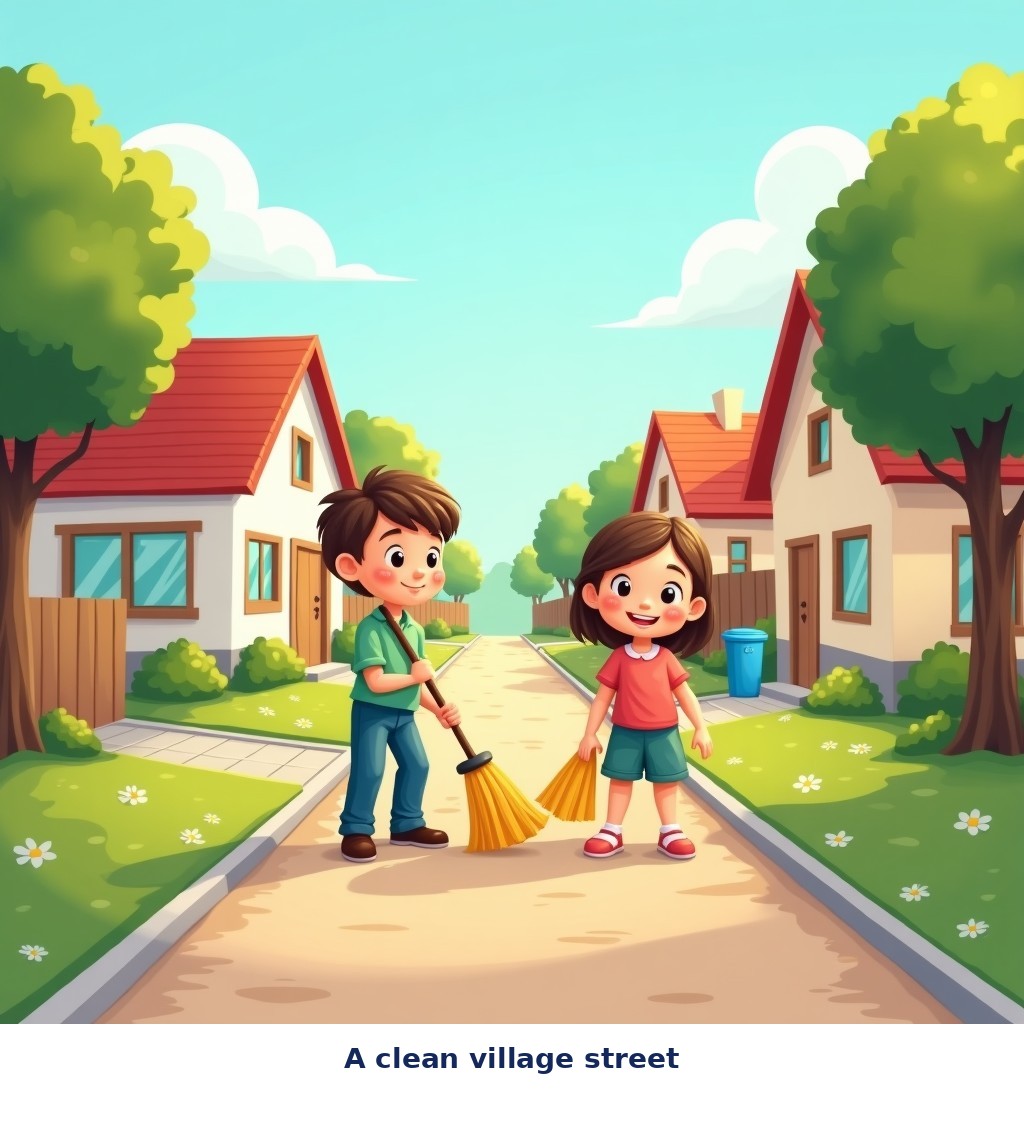
New picture: Children sweeping a clean village street with dustbins placed neatly. Cheerful picture; it shows a clean street, not the house counts in the table.
Key Terms
- Wet waste — Waste like food peels that is wet and can become compost.
- Dry waste — Waste like paper and plastic that is dry.
- Recycle — To turn old things into new useful things.
- Compost — Decayed plant waste used to help plants grow.
Remember
- Wet waste and dry waste go in different bins.
- Clean streets mean fewer diseases.
- One good habit, told to friends, multiplies.
Exam Tip / Common Mistake
Common mistake: putting all waste in one bin. Mixed waste cannot be recycled or composted well. Sorting first is what makes a village truly clean.
Practice set — try it yourself
- A village has 150 houses. 128 use dustbins. How many do not yet?
Hint: Hint: Subtract 128 from 150. - Street A has 24 houses not using dustbins, Street B has 17. How many in all?
Hint: Hint: Add the two streets. - Sort these into wet and dry waste: banana peel, newspaper, plastic bottle, vegetable stalk.
Hint: Hint: Wet waste comes from food and plants. - If each of 40 children tells 3 friends about using dustbins, how many friends learn?
Hint: Hint: 40 × 3 = ? - A street had 30 houses not using dustbins. After a clean-up drive, only 8 do not. How many houses improved?
Hint: Hint: 30 − 8 = ?