
Chapter 6: Measuring Length
Original notes — ready CBSE (NCERT, English Medium) • Class 4 • Mathematics • Book: Math Mela
Measuring Length — EG's own notes, in simple words
Book: Math Mela (CBSE, Class 4) | Chapter 6 | Medium: English
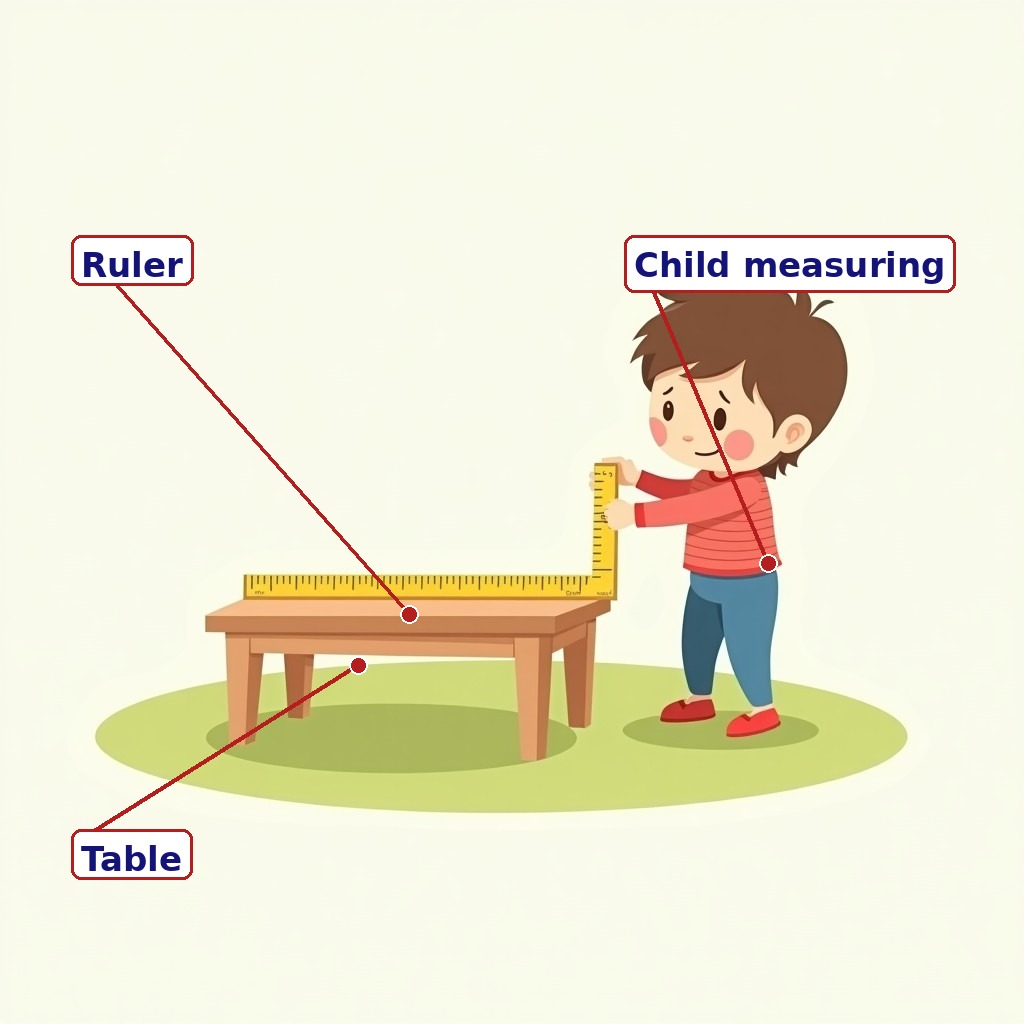
Diagram (labels are printed on the image): A child holding a long yellow ruler along the top of a wooden table. 'Ruler' points to the ruler, 'Table' to the table, and 'Child measuring' to the child. Honest note: the marks on the ruler are too small to read, so no measurement can be read off this picture — the numbers in the text examples are worked out, not taken from the image.
1. How do we measure length?
Length tells us how long something is. We measure length with a ruler, a measuring tape or a metre scale. Long ago, people used their hands and feet — a handspan, a footstep, a finger width. But my handspan is not the same as yours, so we need standard units that are the same for everyone.
2. Centimetre, metre and kilometre
Small lengths are measured in centimetres (cm). Bigger lengths are measured in metres (m). Very long distances are measured in kilometres (km). Remember: 1 metre = 100 centimetres, and 1 kilometre = 1,000 metres.
| Unit | Equals | Good for measuring |
|---|---|---|
| 1 cm | About the width of a finger | A pencil, an eraser |
| 1 m | 100 cm | A door, a classroom wall |
| 1 km | 1,000 m | Distance to school, to a town |
3. Measuring step by step
To measure with a ruler: put the 0 mark exactly at one end of the object. Keep the ruler straight along the object. Read the number at the other end. Worked example: a pencil starts at 0 and ends at the 14 mark — it is 14 cm long. Common mistake: starting at 1 instead of 0. If you start at 1, your answer will be 1 cm too long!

New diagram: How to measure with a ruler: start at the 0 mark, and read where the pencil ends — 14 cm in the worked example. The ruler marks in this picture are small, so do not read an exact length off the image; the text gives the 14 cm example.
4. Changing units
To change metres to centimetres, multiply by 100. Example: 3 m = 3 × 100 = 300 cm. To change centimetres to metres, divide by 100. Example: 250 cm = 250 ÷ 100 = 2 m 50 cm. A ribbon 2 m long and a ribbon 150 cm long — which is longer? 2 m = 200 cm, so the 2 m ribbon is longer.

New picture: A child measuring a classroom door with a measuring tape. Everyday picture; it shows measuring in action, not the 14 cm pencil example.
Key Terms
- Length — How long something is.
- Centimetre (cm) — A small unit of length; 100 cm = 1 m.
- Metre (m) — A unit of length; 1 m = 100 cm.
- Kilometre (km) — A unit for long distances; 1 km = 1,000 m.
- Standard unit — A unit that is the same for everyone, everywhere.
Remember
- 1 m = 100 cm. 1 km = 1,000 m.
- Always start measuring from the 0 mark, not from 1.
- Use cm for small things, m for rooms, km for long distances.
Exam Tip / Common Mistake
Common mistake: starting a ruler at 1 instead of 0. Your answer will be 1 cm too long. Always line up the 0 mark with the end of the object.
Practice set — try it yourself
- A ribbon is 2 m 30 cm long. Write its length in centimetres only.
Hint: Hint: 2 m = 200 cm. - A pencil measures 16 cm. A crayon measures 9 cm. How much longer is the pencil?
Hint: Hint: Subtract the shorter from the longer. - Rahul's school is 3 km away. How many metres is that?
Hint: Hint: 1 km = 1,000 m. - A table is 120 cm long. Is it longer or shorter than 1 metre? By how much?
Hint: Hint: 1 metre = 100 cm. - Meena measures a book starting her ruler at 1 instead of 0 and reads 21 cm. What is the real length?
Hint: Hint: Starting at 1 adds 1 cm extra.