
Chapter 5: Sharing and Measuring
Original notes — ready CBSE (NCERT, English Medium) • Class 4 • Mathematics • Book: Math Mela
Sharing and Measuring — EG's own notes, in simple words
Book: Math Mela (CBSE, Class 4) | Chapter 5 | Medium: English
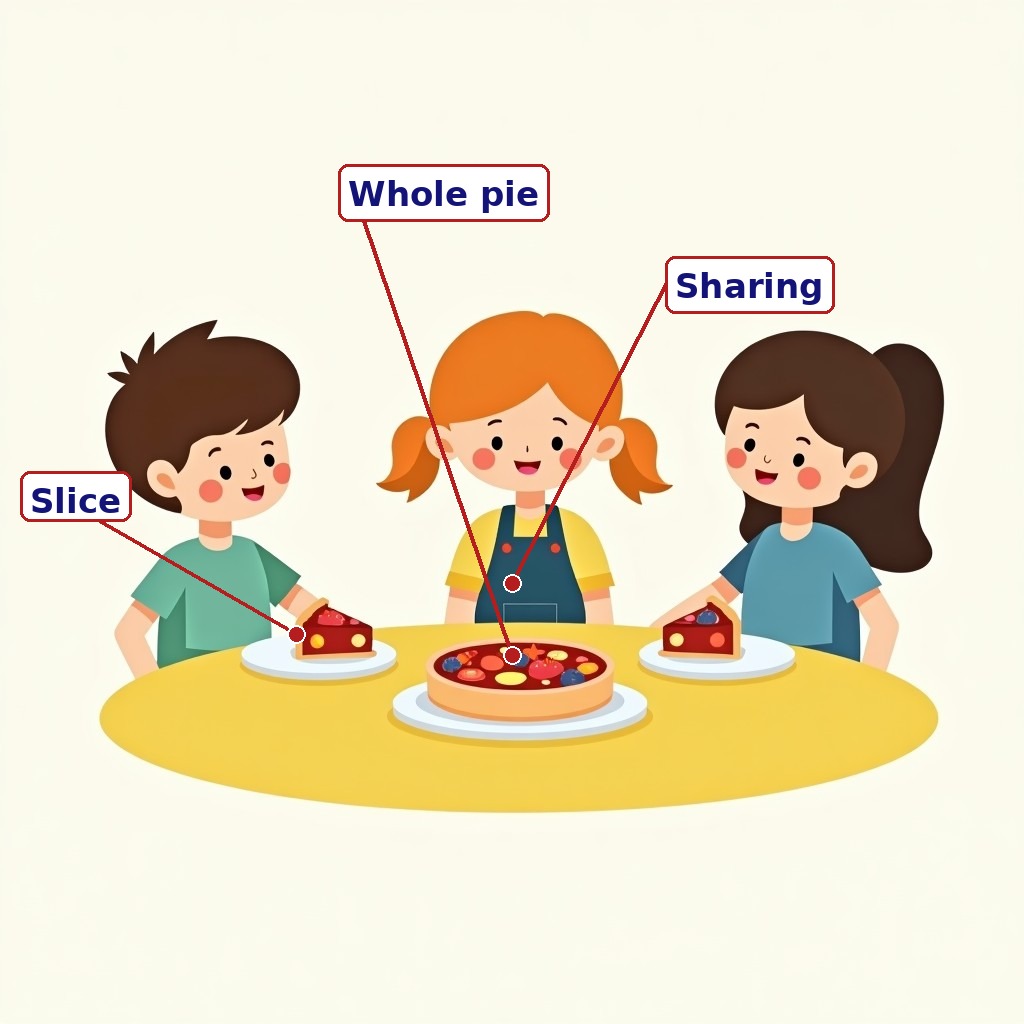
Diagram (labels are printed on the image): Three children at a round yellow table with a whole round pie in the middle and a slice on a plate at the left and right. 'Whole pie' points to the pie in the middle, 'Slice' to the slice on the left plate, and 'Sharing' to the children at the table. Honest note: only two slices are served in the picture, so it does not show three equal shares — equal sharing with numbers is worked out in the text.
1. Sharing equally
Sharing means dividing something into equal parts. If 4 friends share 12 laddoos equally, each friend gets 12 ÷ 4 = 3 laddoos. The sign ÷ means "divide" or "share equally". Division is the opposite of multiplication: 4 × 3 = 12, so 12 ÷ 4 = 3.
2. Sharing with a remainder
Sometimes things do not share exactly. Share 13 pencils among 4 children: each gets 3 pencils (4 × 3 = 12), and 1 pencil is left over. That leftover is the remainder. So 13 ÷ 4 = 3 remainder 1. The remainder must always be smaller than the number you divide by.
| Share | Division | Each gets | Left over |
|---|---|---|---|
| 20 toffees, 5 children | 20 ÷ 5 | 4 | 0 |
| 23 toffees, 5 children | 23 ÷ 5 | 4 | 3 |
| 17 pencils, 3 children | 17 ÷ 3 | 5 | 2 |
3. Measuring with litres and millilitres
Liquids are measured in litres (L) and millilitres (mL). 1 litre = 1,000 millilitres. A small medicine spoon holds about 5 mL. A water bottle holds about 1 litre. Worked example: a jug holds 2 litres of juice. How many 500 mL glasses can it fill? 2 litres = 2,000 mL, and 2,000 ÷ 500 = 4 glasses.

New diagram: Measuring juice: in the worked example, a 2-litre jug fills four 500 mL glasses. Only three glasses are shown in this picture, not four, and they are not drawn to exact scale, so do not read exact millilitres off the picture — the text gives the numbers.
4. Measuring with kilograms and grams
Heavy things are measured in kilograms (kg) and grams (g). 1 kg = 1,000 g. A packet of biscuits may weigh 200 g; a school bag may weigh about 4 kg. When you share 2 kg of rice equally between 4 people, each gets 2,000 ÷ 4 = 500 g.
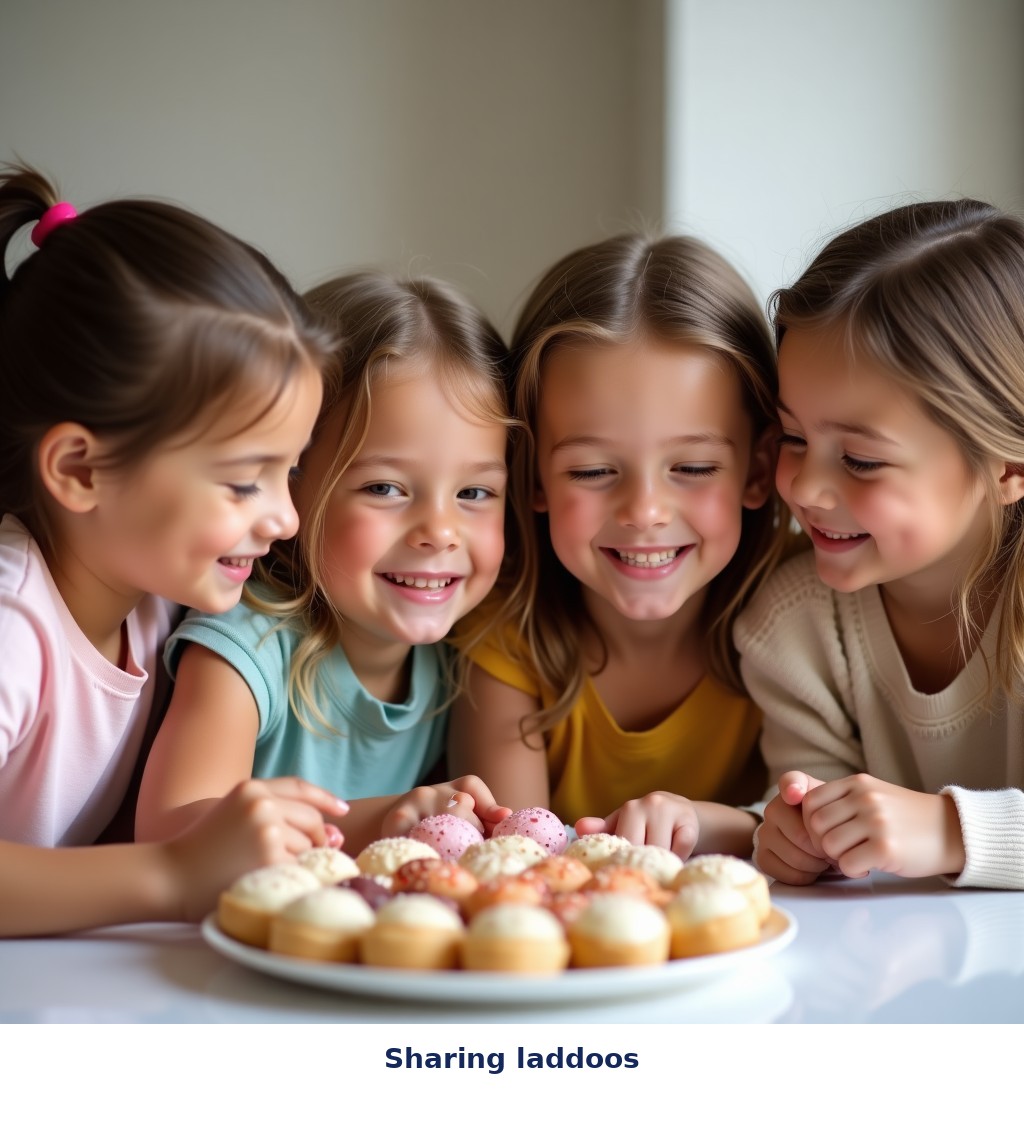
New picture: Four children sharing round sweets together. Friendly picture; it shows sharing, not the 12 laddoos shared by 4 friends in the text.
Key Terms
- Divide (÷) — To share something equally, or to split it into equal parts.
- Remainder — What is left over after sharing equally.
- Litre (L) — A unit for measuring liquids; 1 L = 1,000 mL.
- Millilitre (mL) — A small unit for measuring liquids.
- Kilogram (kg) — A unit for weighing heavy things; 1 kg = 1,000 g.
- Gram (g) — A small unit for weighing light things.
Remember
- Division is sharing equally. 12 ÷ 4 = 3 means 4 groups of 3.
- The remainder is always smaller than the number you divide by.
- 1 litre = 1,000 mL. 1 kg = 1,000 g.
Exam Tip / Common Mistake
Common mistake: forgetting the remainder. 13 ÷ 4 is not 3 — it is 3 remainder 1. Always check: divisor × answer + remainder must equal the original number (4 × 3 + 1 = 13).
Practice set — try it yourself
- Share 28 pencils equally among 7 children. How many does each child get?
Hint: Hint: 28 ÷ 7 = ? - Share 19 toffees among 4 children. How many each, and what is left over?
Hint: Hint: 4 × 4 = 16. What is left from 19? - A jug holds 3 litres of milk. How many 500 mL glasses can it fill?
Hint: Hint: First change 3 litres to millilitres. - A packet weighs 2 kg 500 g. Write its weight in grams only.
Hint: Hint: 2 kg = 2,000 g. - 6 friends share 42 marbles equally. Check your answer with multiplication.
Hint: Hint: If each gets 7, does 6 × 7 = 42?