
Chapter 4: Thousands Around Us
Original notes — ready CBSE (NCERT, English Medium) • Class 4 • Mathematics • Book: Math Mela
Thousands Around Us — EG's own notes, in simple words
Book: Math Mela (CBSE, Class 4) | Chapter 4 | Medium: English
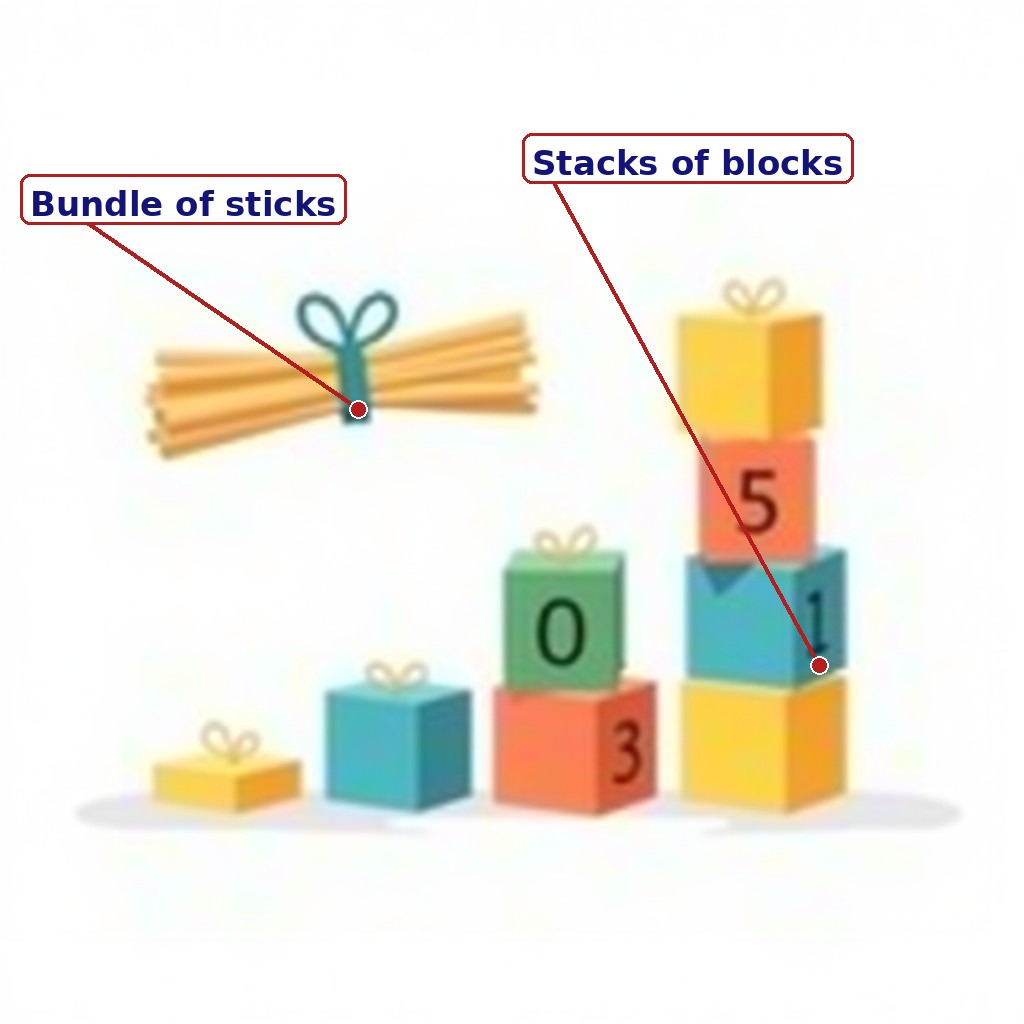
Diagram (labels are printed on the image): A tied bundle of sticks on the left and stacks of coloured blocks on the right, some blocks carrying the digits 5, 0, 3 and 1. Honest note: the picture does NOT show 1,000 sticks or 1,000 blocks — counting that many is impossible in one picture. It shows the idea of bundling and stacking that place value is built on, and the digits on the blocks are decoration, not a number to read.
1. How big is a thousand?
One thousand is written as 1,000. It is 10 hundreds, or 100 tens, or 1,000 ones. Imagine 10 boxes, each holding 100 marbles — that is 1,000 marbles! Big numbers feel less scary when you break them into hundreds, tens and ones.
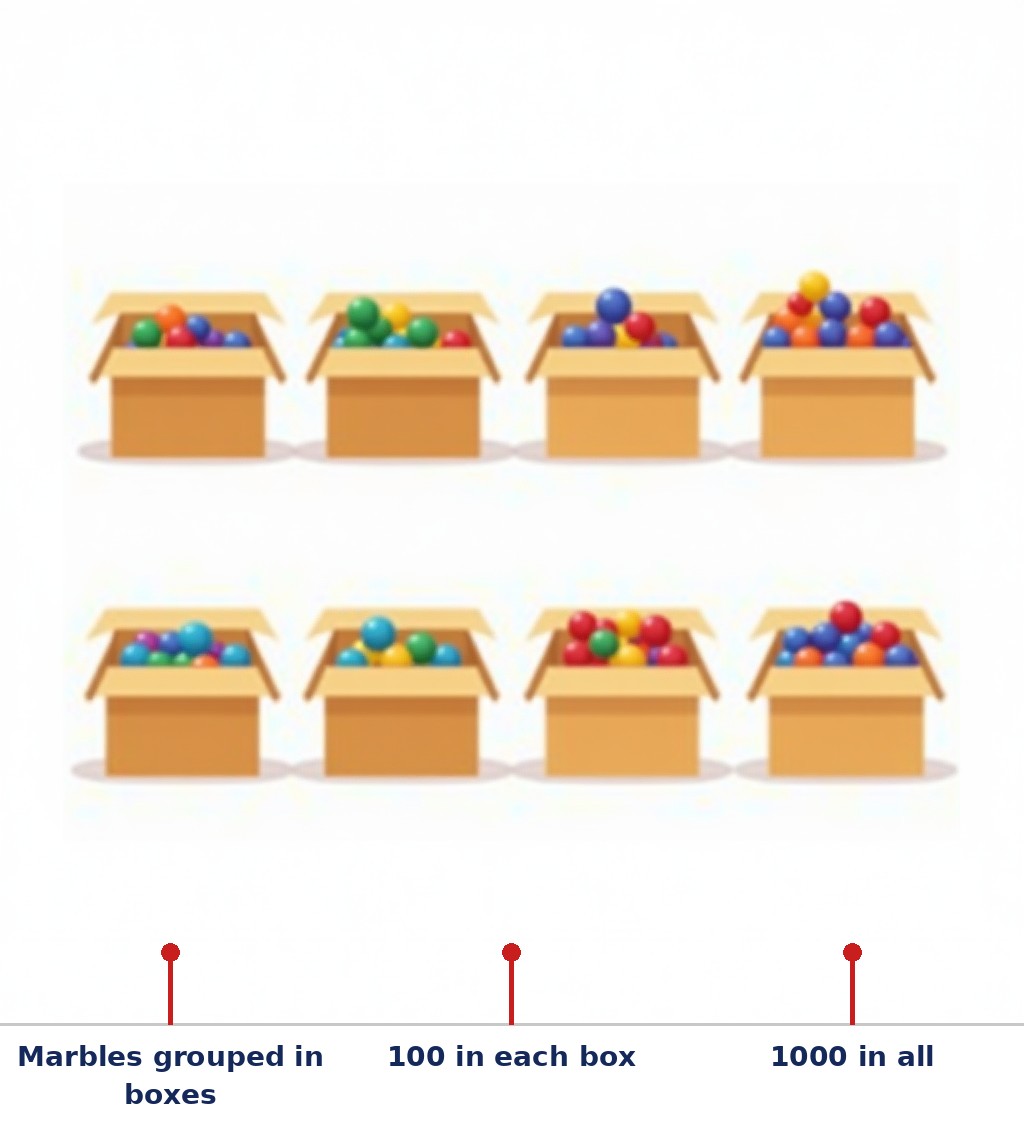
New diagram: How big is a thousand? In the text example, ten boxes with 100 marbles in each box make 1,000 marbles in all. The picture shows only eight boxes, and the boxes do not each show exactly 100 marbles, so do not try to count 1,000 marbles off this picture — the maths is in the text.
2. Place value — every digit has a place
In the number 3,452, each digit means something different because of its place. The 2 is in the ones place, so it means 2. The 5 is in the tens place, so it means 50. The 4 is in the hundreds place, so it means 400. The 3 is in the thousands place, so it means 3,000. So 3,452 = 3,000 + 400 + 50 + 2.
| Thousands | Hundreds | Tens | Ones | Number |
|---|---|---|---|---|
| 3 | 4 | 5 | 2 | 3,452 |
| 7 | 0 | 8 | 1 | 7,081 |
| 1 | 2 | 0 | 6 | 1,206 |
3. Reading and writing big numbers
Read 7,081 as "seven thousand eighty-one". Note: there is a zero in the hundreds place, so we do not say "hundred" at all. Worked example: write "nine thousand three hundred seven" in digits. Nine thousand = 9,000; three hundred = 300; seven = 7. Together: 9,307. The tens place is empty, so we put 0 there.
4. Comparing thousands
To compare two numbers, first look at the thousands digit. 5,214 is bigger than 4,986 because 5 thousand is more than 4 thousand — you do not even need to look at the rest. If the thousands are equal, compare the hundreds, then the tens, then the ones. Example: 6,350 and 6,402 — thousands equal (6), but 4 hundred is more than 3 hundred, so 6,402 is bigger.
New picture: A child stacking colourful counting blocks into towers. Playful picture; it shows counting blocks, not a thousand of anything.
Key Terms
- Thousand — 1,000 — equal to 10 hundreds or 100 tens.
- Place value — What a digit is worth, decided by its place in the number.
- Digit — One of the symbols 0 to 9 used to write numbers.
- Compare — To say which of two numbers is bigger or smaller.
Remember
- 1 thousand = 10 hundreds = 100 tens = 1,000 ones.
- In 3,452: 3 means 3,000, 4 means 400, 5 means 50, 2 means 2.
- Compare thousands first, then hundreds, then tens, then ones.
- A zero in a place means nothing there — do not skip it when writing digits.
Exam Tip / Common Mistake
Common mistake: reading 7,081 as 'seven thousand eight hundred one'. The zero in the hundreds place means no hundreds — it is 'seven thousand eighty-one'. Write a 0 in every empty place.
Practice set — try it yourself
- Write 5,209 in words. Why do we say no 'hundred'?
Hint: Hint: Look at the hundreds digit. - Write 'eight thousand four hundred six' in digits.
Hint: Hint: Which place is empty? Put 0 there. - Which is bigger: 4,785 or 4,812? Explain using place value.
Hint: Hint: Compare thousands, then hundreds. - Break 6,340 into thousands + hundreds + tens + ones.
Hint: Hint: 6,340 = 6,000 + ___ + ___ + ___. - How many hundreds are there in 2,000?
Hint: Hint: 1 thousand = 10 hundreds.