
Chapter 2: Hide and Seek
Original notes — ready CBSE (NCERT, English Medium) • Class 4 • Mathematics • Book: Math Mela
Hide and Seek — EG's own notes, in simple words
Book: Math Mela (CBSE, Class 4) | Chapter 2 | Medium: English

Diagram (labels are printed on the image): Two children playing in a garden beside a big tree. 'Counting child' points to the girl on the left with her hands near her face, 'Tree' points to the tree trunk, and 'Seeker' points to the boy on the right touching the trunk. Honest note: no child is actually hidden in this picture — the hiding part of the game is in the text, not shown here.
1. Hide and seek is a counting game
In hide and seek, one child counts — 1, 2, 3, 4... — while the others hide. Counting in order matters. If you skip a number, you finish too fast or too slow! This chapter is about counting carefully, finding hidden things, and guessing where something can hide.
2. Counting in groups
When there are many things to count, count them in groups. Counting in 2s goes 2, 4, 6, 8, 10. Counting in 5s goes 5, 10, 15, 20, 25. Counting in 10s goes 10, 20, 30, 40. Worked example: there are 24 marbles in a box. Count them in 2s: 2, 4, 6, 8, 10, 12, 14, 16, 18, 20, 22, 24 — that is 12 counts of 2. Counting in groups is faster and you are less likely to make a mistake.
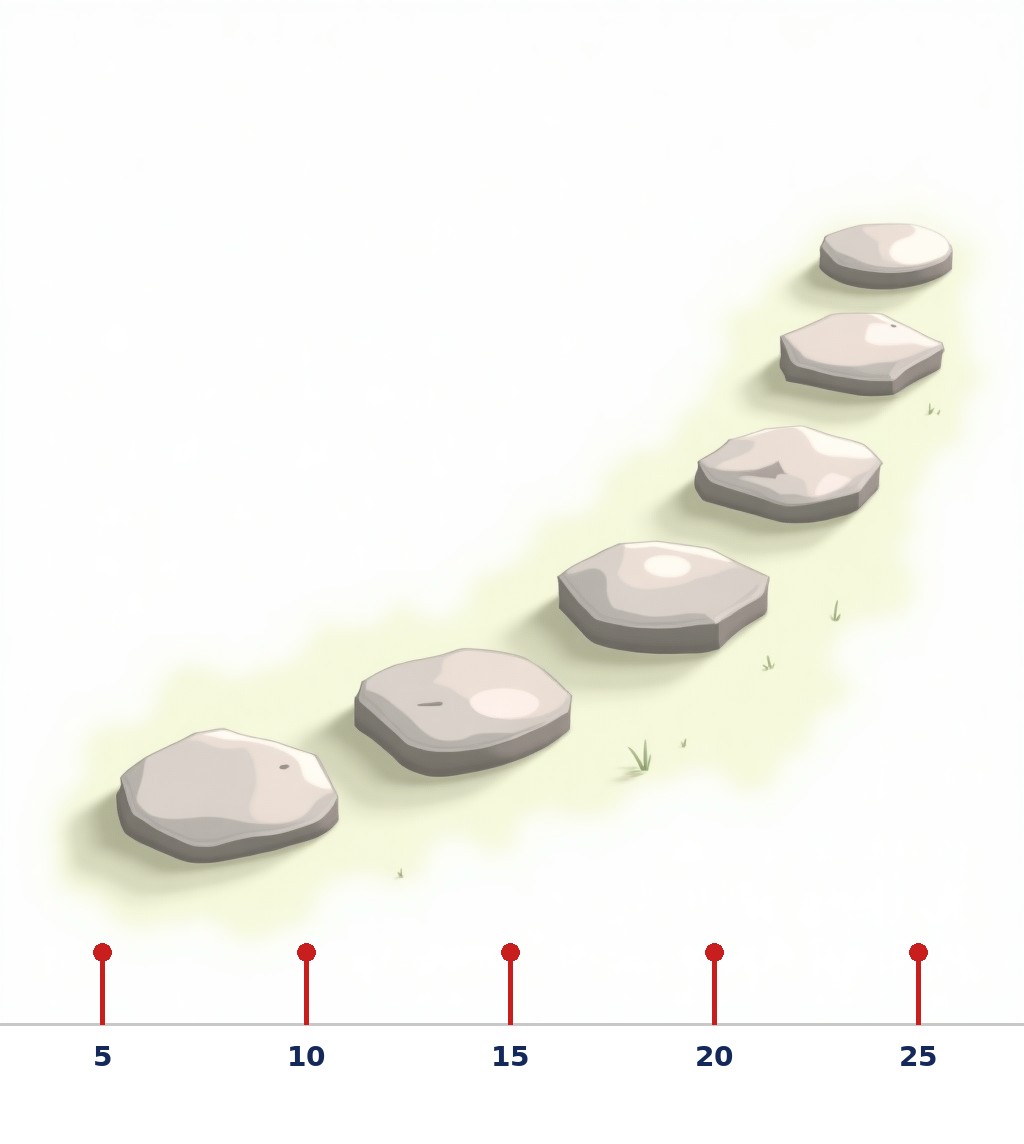
New diagram: Stepping stones labelled for counting in 5s: 5, 10, 15, 20, 25. Six stones are actually shown, arranged diagonally, so follow the labels in order rather than counting stones; the full counting sequences are in the text.
3. Finding the hidden number
Sometimes a number hides in a pattern. Look at 3, 6, 9, 12, ___. Each step adds 3, so the next number is 15. Look at 20, 18, 16, 14, ___. Each step takes away 2, so the next number is 12. The rule of the pattern is the clue — find the rule, and the hidden number is found.
| Pattern | Rule | Next number |
|---|---|---|
| 4, 8, 12, 16 | Add 4 | 20 |
| 50, 45, 40, 35 | Take away 5 | 30 |
| 7, 14, 21, 28 | Add 7 | 35 |
4. Guessing and checking
In hide and seek you guess a hiding place, then check it. Maths works the same way. Guess an answer, then check it. Example: "I think 9 + 8 = 17." Check: 9 + 1 = 10, and 8 is 1 more than 7... simpler: 10 + 7 = 17. Yes, the guess was right! A good guess plus a check is better than a wild guess.
New picture: Children playing hide and seek in a garden around a tree. Simplified picture; no child is shown counting with eyes covered — the counting game is described in the text, not a counting sequence.
Key Terms
- Counting in groups — Counting by 2s, 5s or 10s instead of one by one.
- Pattern — Something that repeats, or grows by a rule.
- Rule — The instruction that tells you how a pattern continues.
- Guess and check — Guessing an answer, then checking if it is right.
Remember
- Counting in groups (2s, 5s, 10s) is faster and safer than counting one by one.
- Every pattern has a rule. Find the rule to find the next number.
- Guess, then check — never leave a guess unchecked.
Exam Tip / Common Mistake
Common mistake: skipping a number while counting fast. Count in groups and say each group number aloud. If your count ends at a strange number, count again slowly.
Practice set — try it yourself
- Count 36 marbles in 2s. How many counts of 2 do you make?
Hint: Hint: 36 ÷ 2 = ? - Find the next number: 9, 18, 27, 36, ___. What is the rule?
Hint: Hint: How much is added each step? - Find the next number: 60, 55, 50, 45, ___. What is the rule?
Hint: Hint: Is the pattern going up or down? - Seema counts 5, 10, 15, 20, 25, 30. She stops at 30. How many counts did she make?
Hint: Hint: Count the numbers she said. - Guess: 7 + 9 = 16. Check your guess in a different way.
Hint: Hint: Try 10 + 6, or count up from 9.