
Chapter 13: The Transport Museum
Original notes — ready CBSE (NCERT, English Medium) • Class 4 • Mathematics • Book: Math Mela
The Transport Museum — EG's own notes, in simple words
Book: Math Mela (CBSE, Class 4) | Chapter 13 | Medium: English

Diagram (labels are printed on the image): A green steam train giving off smoke, a red and cream bus, and a yellow old car. 'Steam train' points to the train, 'Bus' to the bus, and 'Old car' to the yellow car. Honest note: the letters on the bus's destination board are garbled AI marks, not a real place name — ignore them. The picture also shows the vehicles side by side, not inside a museum hall.
1. What is a transport museum?
A transport museum is a place where old vehicles are kept and shown: old trains, buses, cars, carts and even aeroplanes. Each vehicle tells a story about how people travelled long ago — before cars and aeroplanes, people walked, rode bullock carts, or travelled by steam train.
2. Old and new transport
Transport has changed a lot. A bullock cart moves at about 5 km per hour — walking speed. A steam train could travel at about 60 km per hour. A modern train can go faster than 130 km per hour, and an aeroplane flies at about 900 km per hour. Worked example: a journey of 120 km by bullock cart at 5 km per hour would take 120 ÷ 5 = 24 hours — a whole day! The same journey by a train at 60 km per hour takes 120 ÷ 60 = 2 hours.
| Vehicle | About how fast? | Good for |
|---|---|---|
| Bullock cart | About 5 km per hour | Short village trips, carrying goods |
| Bicycle | About 15 km per hour | Going to school, nearby places |
| Steam train | About 60 km per hour | Long journeys long ago |
| Aeroplane | About 900 km per hour | Very long journeys, across countries |
3. Timelines — putting things in order
A timeline puts events in order, from earliest to latest, like numbers on a number line. Example timeline: bullock cart (very old) → bicycle (about 200 years ago) → steam train (about 200 years ago) → motor car (about 130 years ago) → aeroplane (about 120 years ago). Timelines help us see how inventions follow one another.
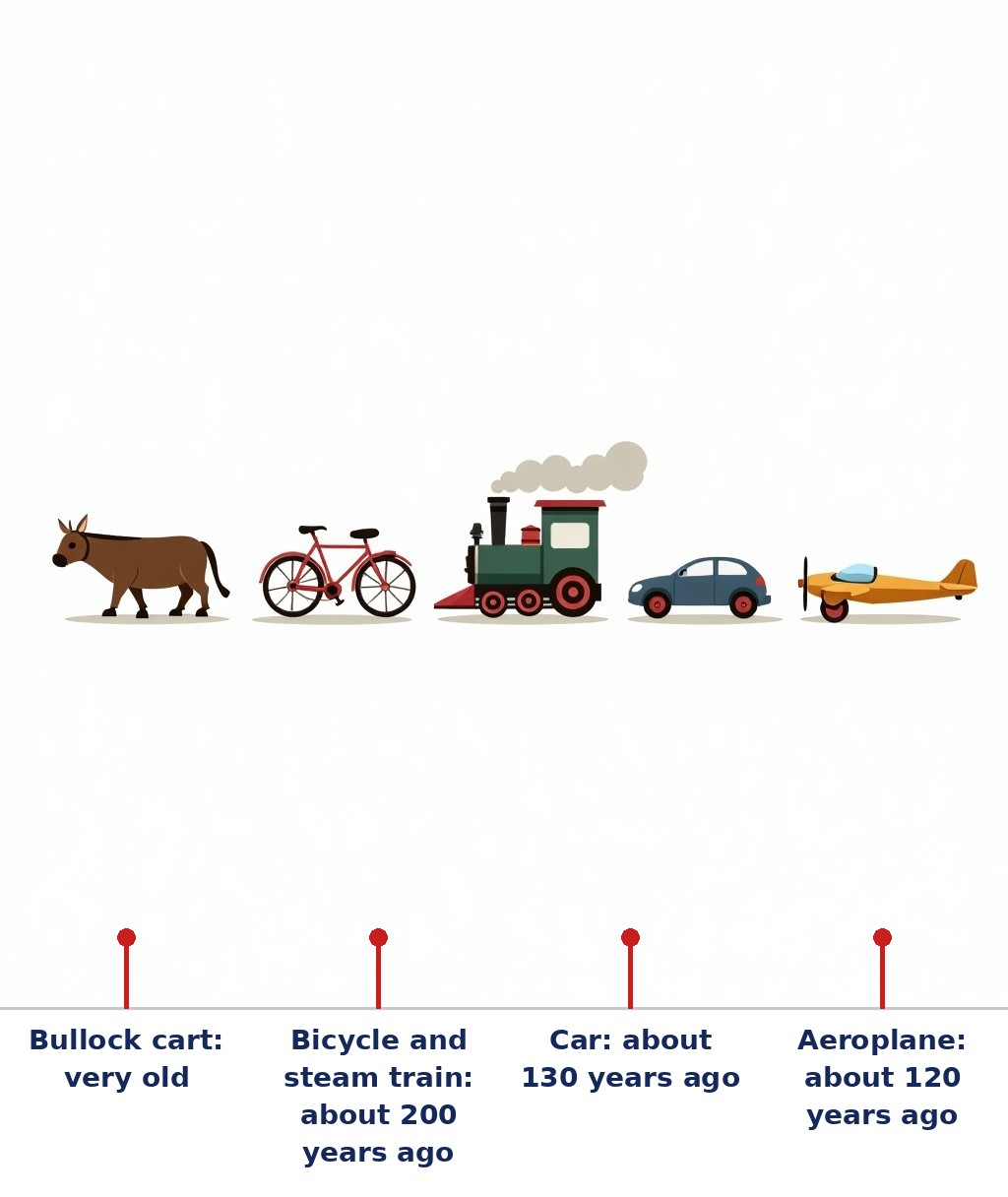
New diagram: Transport through time, oldest to newest: bullock cart, bicycle and steam train (about 200 years ago), motor car (about 130 years ago), aeroplane (about 120 years ago). Simplified timeline picture; the first picture shows the bullock animal only — no cart is shown — and the vehicles are not drawn to real size and the years are approximate, as in the text.
4. At the museum — counting visitors
Museums count their visitors. Suppose 240 people visit on Saturday and 180 on Sunday. How many visited over the weekend? 240 + 180 = 420 people. If tickets cost ₹20 for a child, how much do 5 children pay? 5 × 20 = ₹100. Museums use maths every day — for tickets, timings and counting visitors.

New picture: Children looking at old vehicles in a museum hall. Inviting picture; it shows a museum visit, not the visitor counts or ticket maths in the text.
Key Terms
- Transport — Ways of moving people and goods from one place to another.
- Timeline — Events put in order from earliest to latest.
- Steam train — An old train that ran on steam power.
- Museum — A place where old and interesting things are kept and shown.
Remember
- Older transport was slower: bullock cart about 5 km per hour, steam train about 60.
- A timeline puts events in order, earliest first.
- Speed × time = distance; distance ÷ speed = time.
Exam Tip / Common Mistake
Common mistake: mixing up speed and time. Faster does not mean more time — faster means LESS time for the same journey. Double the speed, half the time.
Practice set — try it yourself
- A train travels at 60 km per hour. How far does it go in 3 hours?
Hint: Hint: Speed × time = distance. - A bullock cart covers 15 km at 5 km per hour. How many hours does it take?
Hint: Hint: Distance ÷ speed = time. - Put these in timeline order: aeroplane, bicycle, bullock cart, steam train.
Hint: Hint: Which is oldest? Which is newest? - A museum gets 150 visitors on Monday and 230 on Tuesday. How many in two days?
Hint: Hint: Add. - A child ticket costs ₹25. How much do 4 children pay?
Hint: Hint: 4 × 25 = ?