
Chapter 12: Ticking Clocks and Turning Calendar
Original notes — ready CBSE (NCERT, English Medium) • Class 4 • Mathematics • Book: Math Mela
Ticking Clocks and Turning Calendar — EG's own notes, in simple words
Book: Math Mela (CBSE, Class 4) | Chapter 12 | Medium: English
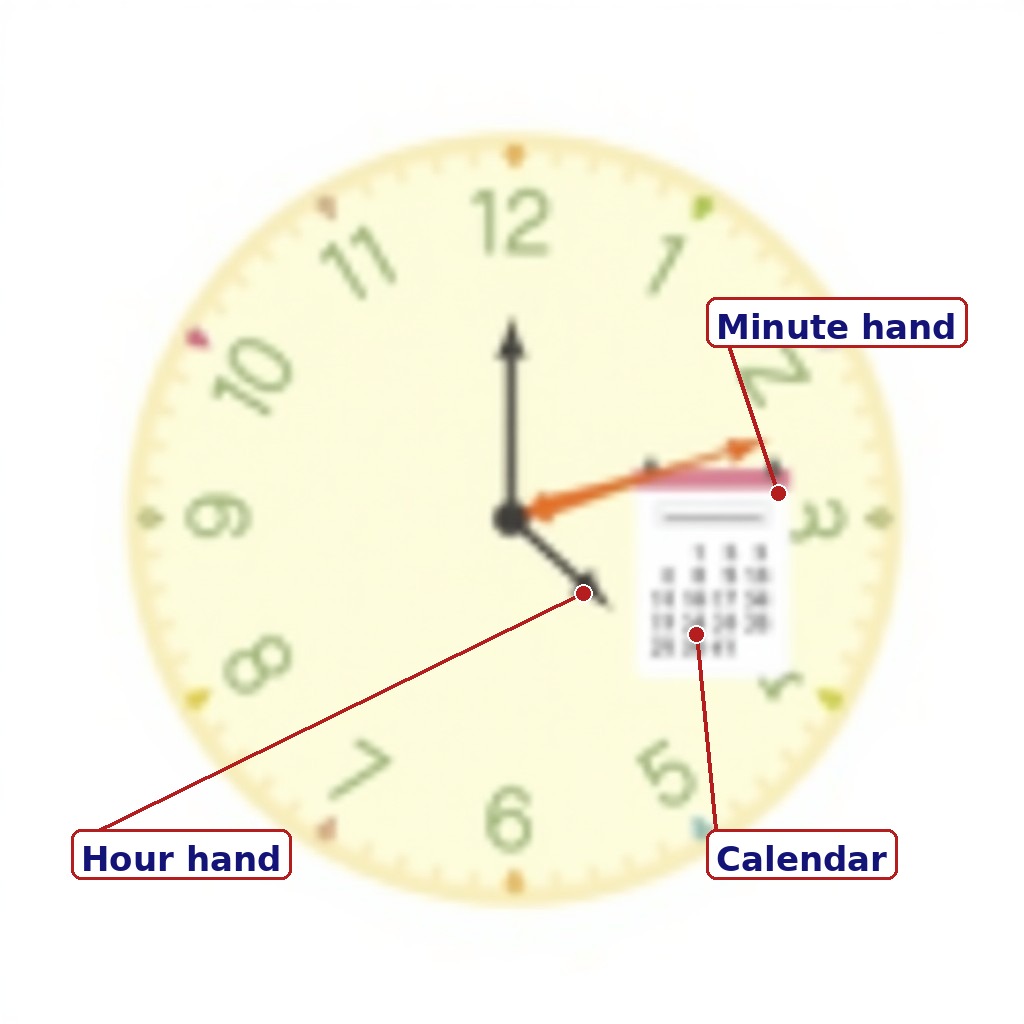
Diagram (labels are printed on the image): A round clock face with numbers and three hands, plus a small calendar page overlapping the right side of the face. 'Minute hand' points to the long orange hand, 'Hour hand' to the short black hand, and 'Calendar' to the small calendar page. Honest note: the calendar overlaps the clock face and its dates are too tiny to read, and the hands overlap each other, so do NOT try to read a time off this picture — the times in the text are worked examples, not this clock's time.
1. Reading a clock
A clock has two main hands. The short hour hand points to the hour. The long minute hand points to the minutes. When the minute hand points to 12, it is "o'clock". When it points to 6, it is "half past" — 30 minutes past the hour. When it points to 3, it is "quarter past" — 15 minutes past.
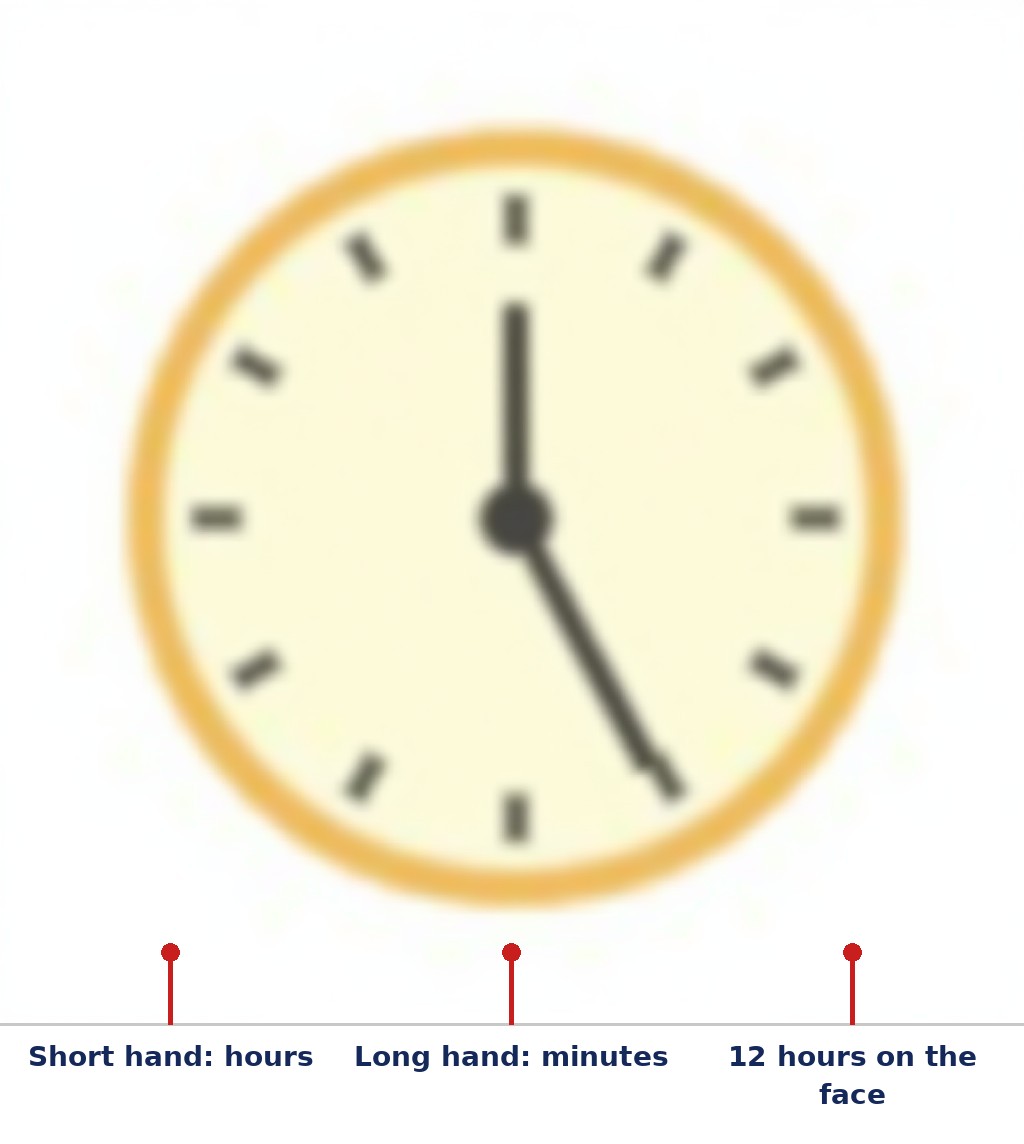
New diagram: Reading a clock: the short hand shows hours, the long hand shows minutes, and the face has 12 hours. The hands in this picture are illustrative; practise reading exact times from the examples in the text, not from this picture. The clock picture is also soft and blurry.
2. Minutes and hours
1 hour = 60 minutes. 1 minute = 60 seconds. The clock face is divided into 12 hours. From one number to the next is 5 minutes: from 12 to 1 is 5 minutes, from 1 to 2 is another 5, and so on. Worked example: the minute hand points to 4. How many minutes past the hour? 4 × 5 = 20 minutes past. If the hour hand is between 3 and 4, the time is 3:20.
| Minute hand at | Minutes past the hour | We say |
|---|---|---|
| 12 | 0 | o'clock |
| 3 | 15 | quarter past |
| 6 | 30 | half past |
| 9 | 45 | quarter to the next hour |
3. The calendar
A calendar shows days, weeks and months. 1 week = 7 days. 1 year = 12 months = 365 days (366 in a leap year). The months are January, February, March, April, May, June, July, August, September, October, November, December. February usually has 28 days, but 29 in a leap year.
4. Finding days and dates
Worked example: if 1st May is a Monday, what day is 8th May? Dates 7 days apart fall on the same weekday, so 8th May is also a Monday. And 15th May is a Monday too (8 + 7 = 15). This "add 7" trick works for any date on a calendar. Try it: if your birthday is on a Friday this year, next year it will usually be one day later — because 365 days is 52 weeks plus 1 extra day.

New picture: A child looking up at a big classroom wall clock with a calendar beside it. Everyday picture; it shows a clock and calendar, and the time on its face is not one of the worked examples in the text.
Key Terms
- Hour hand — The short hand of a clock; it points to the hour.
- Minute hand — The long hand of a clock; it points to the minutes.
- Quarter past — 15 minutes past the hour.
- Half past — 30 minutes past the hour.
- Leap year — A year with 366 days, when February has 29 days.
Remember
- 1 hour = 60 minutes. 1 minute = 60 seconds.
- Minute hand at 3 = quarter past, at 6 = half past, at 9 = quarter to.
- Each clock number is 5 minutes: minute hand at 4 = 20 minutes past.
- 1 week = 7 days. 1 year = 12 months. Add 7 days to land on the same weekday.
Exam Tip / Common Mistake
Common mistake: reading the hour hand wrongly. When the minute hand is past 6, the hour hand has moved towards the next hour. At 3:40 the hour hand is closer to 4 than to 3, but the hour is still 3.
Practice set — try it yourself
- The minute hand points to 6 and the hour hand is between 7 and 8. What is the time?
Hint: Hint: Minute hand at 6 = half past. - The minute hand points to 3 and the hour hand is just past 5. What is the time?
Hint: Hint: Minute hand at 3 = quarter past. - A film starts at 4:00 and lasts 1 hour 30 minutes. When does it end?
Hint: Hint: Add 1 hour, then 30 minutes. - If 3rd June is a Tuesday, what day is 10th June?
Hint: Hint: Add 7 days to land on the same weekday. - How many days are there in March, April and May together?
Hint: Hint: March 31, April 30, May 31.