Chapter 11: Fun with Symmetry
Original notes — ready CBSE (NCERT, English Medium) • Class 4 • Mathematics • Book: Math Mela
Fun with Symmetry — EG's own notes, in simple words
Book: Math Mela (CBSE, Class 4) | Chapter 11 | Medium: English

Diagram (labels are printed on the image): An orange butterfly with matching wings. 'Left wing' points to the left wing, 'Right wing' to the right wing, and 'Line of symmetry' to the dark body down the middle, which is the fold line. The left and right wings mirror each other. Honest note: the small spots on the lower wings are not perfectly identical, but the overall wing shapes match, which is what makes the butterfly symmetrical.
1. What is symmetry?
A shape has symmetry when you can fold it in half and the two halves match exactly. The fold line is called the line of symmetry. A butterfly's wings match each other — fold a butterfly picture down the middle and the left wing covers the right wing perfectly.
2. Lines of symmetry
Different shapes have different numbers of lines of symmetry. A square has 4 lines of symmetry. A rectangle has 2. An equilateral triangle (all sides equal) has 3. A circle has many — in fact, countless lines of symmetry, because any line through its centre folds it into matching halves.

New diagram: A sheet folded down its middle: the left and right halves match exactly, and the dashed line is the line of symmetry. Simplified picture; it shows one line of symmetry, while the text table gives the counts for other shapes too.
| Shape | Lines of symmetry | How to check |
|---|---|---|
| Square | 4 | Fold across, down, and both diagonals |
| Rectangle | 2 | Fold across and down (not diagonals) |
| Equilateral triangle | 3 | Fold from each corner to the middle of the opposite side |
| Circle | Countless | Any fold through the centre works |
3. Symmetry around us
Faces are nearly symmetrical. Leaves, kites, the Taj Mahal's front, and rangoli designs all show symmetry. But not everything is symmetrical: your handwriting, a mango, and most clouds are not. To test a shape, imagine folding it — if both halves match exactly, it is symmetrical.
4. Making symmetrical art
Paint one half of a paper, fold it, and press — when you open it, you get a symmetrical picture! This is called a mirror print. Worked example: draw half a heart on the fold line of a paper. Cut it out and open it — you get a full, symmetrical heart, because the fold line was its line of symmetry.
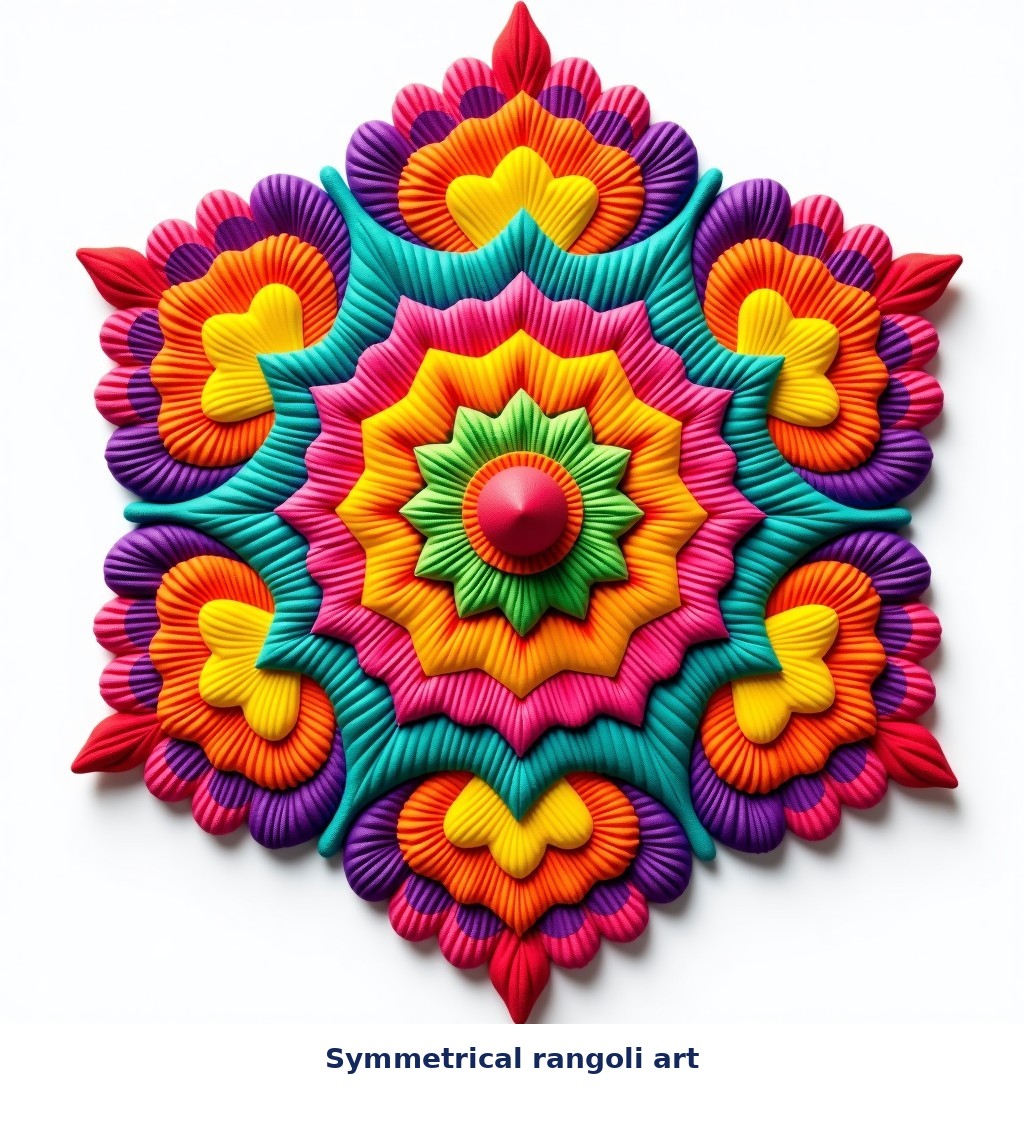
New picture: A symmetrical rangoli with matching patterns on both sides. Decorative picture; it shows symmetry in art, not a named shape from the table.
Key Terms
- Symmetry — When folding a shape in half makes the two halves match exactly.
- Line of symmetry — The fold line that divides a shape into two matching halves.
- Mirror image — What you see in a mirror — the left and right swap places.
Remember
- A shape is symmetrical if folding it makes both halves match exactly.
- Square: 4 lines of symmetry. Rectangle: 2. Equilateral triangle: 3. Circle: countless.
- A rectangle's diagonals are NOT lines of symmetry — check by folding.
Exam Tip / Common Mistake
Common mistake: saying a rectangle has 4 lines of symmetry like a square. It has only 2. Fold a paper rectangle along a diagonal — the corners do not match, so the diagonal is not a line of symmetry.
Practice set — try it yourself
- How many lines of symmetry does a square have? Draw or describe them.
Hint: Hint: Across, down, and both diagonals. - Does a rectangle have 2 or 4 lines of symmetry? Explain with folding.
Hint: Hint: Try folding along a diagonal — do the corners match? - Draw half a butterfly and explain how to complete its mirror half.
Hint: Hint: The other wing must match exactly, like a mirror. - Which of these is symmetrical: a leaf, a kite, a shoe? Give a reason for each.
Hint: Hint: Imagine folding each one in half. - A circle is folded through its centre. Does it always give matching halves? Why?
Hint: Hint: Any line through the centre works for a circle.