
Chapter 10: Elephants, Tigers, and Leopards
Original notes — ready CBSE (NCERT, English Medium) • Class 4 • Mathematics • Book: Math Mela
Elephants, Tigers, and Leopards — EG's own notes, in simple words
Book: Math Mela (CBSE, Class 4) | Chapter 10 | Medium: English

Diagram (labels are printed on the image): Three animals standing in a forest clearing. 'Elephant' points to the grey elephant on the left, 'Tiger (stripes)' to the orange tiger with black stripes in the middle, and 'Leopard (spots)' to the yellow leopard with dark spots on the right. Honest note: the animals are drawn small and cartoon-style, so their sizes are not to scale — a real elephant is far bigger than a tiger or leopard, as the numbers in the text show.
1. Three big animals
Elephants, tigers and leopards are three of India's most famous wild animals. An elephant is the largest land animal — it can weigh about 4,000 kg, as much as a small truck! A tiger is the largest cat, with orange fur and black stripes. A leopard is smaller than a tiger, with beautiful spots called rosettes.
2. Numbers about the animals
Maths helps us understand these animals. An elephant eats about 150 kg of food in a day. A tiger may sleep for about 16 hours a day. A leopard can run fast — about 58 km in one hour at top speed. Worked example: if an elephant eats 150 kg a day, how much does it eat in 4 days? 150 × 4 = 600 kg. That is more than half a tonne!
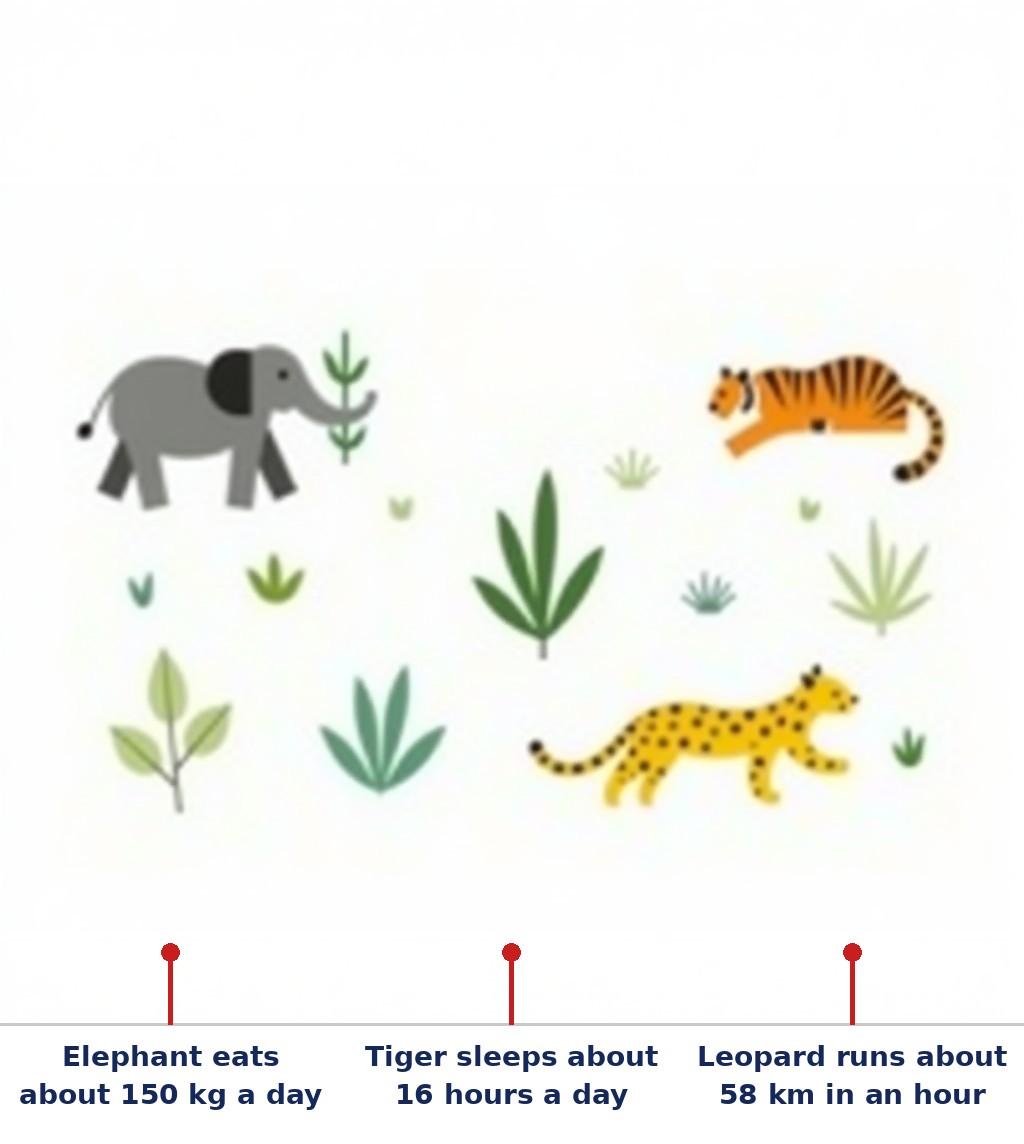
New diagram: Three animal facts from the notes: an elephant eats about 150 kg of food a day, a tiger sleeps about 16 hours a day, and a leopard can run about 58 km in an hour. The tiger in the picture is shown running, not sleeping; the facts are in the labels and text. The animals are not drawn to real size — a real elephant is far bigger than a tiger or leopard, as the text says.
| Animal | About how heavy? | Special mark | Where it lives |
|---|---|---|---|
| Elephant | About 4,000 kg | Trunk and tusks | Forests and grasslands |
| Tiger | About 220 kg | Black stripes | Forests |
| Leopard | About 60 kg | Spots (rosettes) | Forests, hills, near villages |
3. Counting animals — why it matters
Forest officers count tigers and leopards to know if their numbers are going up or down. Suppose a forest had 28 tigers last year and 34 this year. The number went up by 34 − 28 = 6. Counting protects animals: if numbers fall, people know they must act.
4. Staying safe and kind
Wild animals are not pets. We admire them from far away, in books, films and safaris with trained guides. We protect their forests, we do not feed them, and we never go near them alone. Loving animals means giving them space to live wild and free.
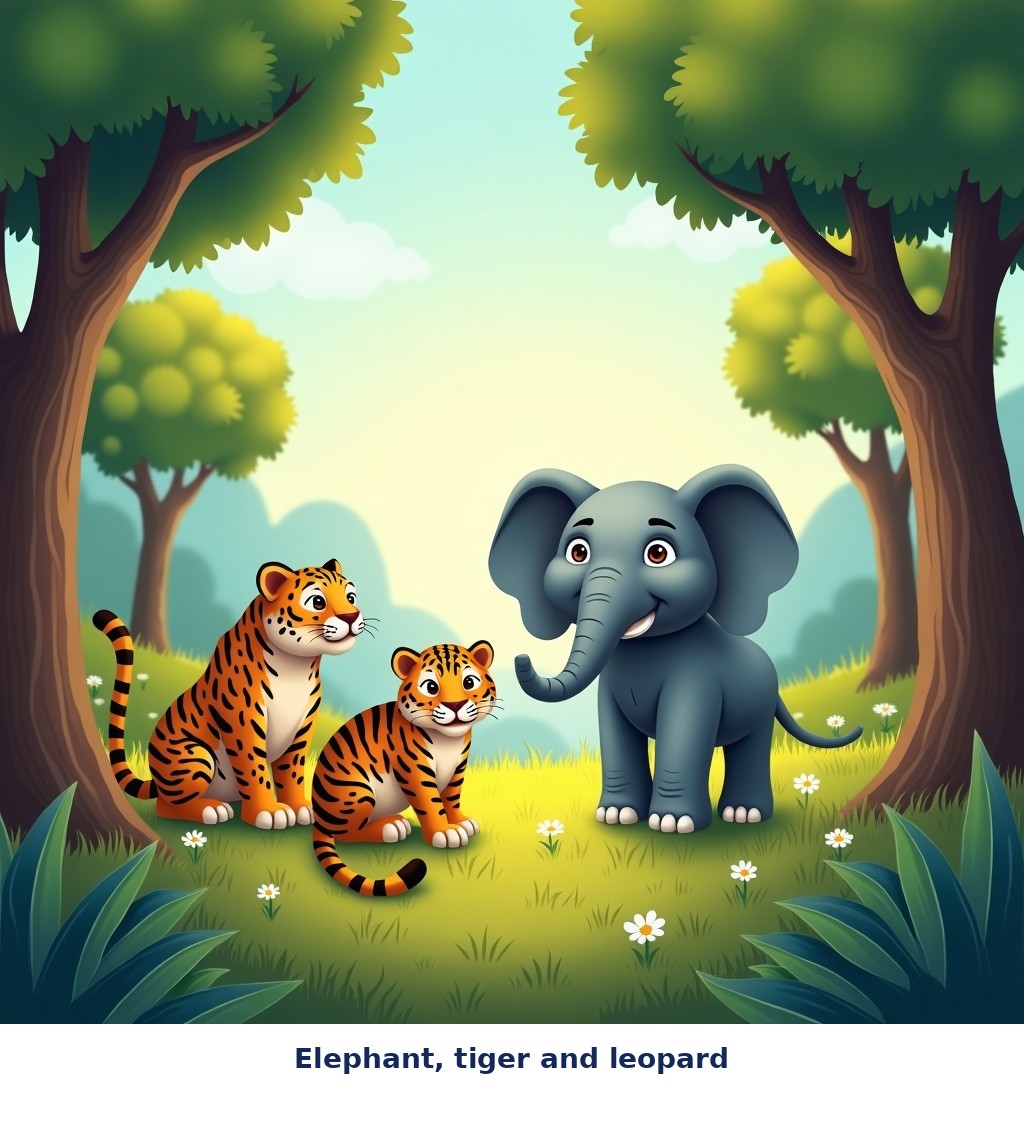
New picture: An elephant and two tigers together in a forest. Storybook picture; no leopard is shown — the leopard is described in the text only. The animals are not to scale and it shows no numbers.
Key Terms
- Rosettes — The spot patterns on a leopard's coat.
- Tonne — 1,000 kilograms.
- Wild animal — An animal that lives free in nature, not as a pet.
- Census — Counting animals or people to know how many there are.
Remember
- Elephant: biggest land animal, trunk and tusks. Tiger: stripes. Leopard: spots (rosettes).
- Counting animals helps protect them.
- Wild animals are admired from far away, never approached.
Exam Tip / Common Mistake
Common mistake: mixing up tiger stripes and leopard spots. Tigers have stripes (long lines). Leopards have rosettes (spots shaped like little roses). Look at the pattern, not just the colour.
Practice set — try it yourself
- An elephant eats 150 kg of food a day. How much does it eat in 7 days?
Hint: Hint: 150 × 7 = ? - A forest had 45 leopards. 9 more arrived from another forest. How many now?
Hint: Hint: Add. - A tiger sleeps 16 hours a day. How many hours is it awake?
Hint: Hint: A day has 24 hours. - Which is heavier: a tiger at 220 kg or 4 leopards at 60 kg each? Show your working.
Hint: Hint: 4 × 60 = ? - A forest counted 30 tigers last year and 24 this year. By how many did the number fall?
Hint: Hint: Subtract this year from last year.