Chapter 1: Shapes Around Us
Original notes — ready CBSE (NCERT, English Medium) • Class 4 • Mathematics • Book: Math Mela
Shapes Around Us — EG's own notes, in simple words
Book: Math Mela (CBSE, Class 4) | Chapter 1 | Medium: English

Diagram (labels are printed on the image): Four flat shapes on a white background. 'Circle' points to the red circle on the left, 'Square' to the blue square in the middle, 'Triangle' to the yellow triangle at the top right, and 'Rectangle' to the green rectangle at the bottom right. Two extra triangles at the bottom left are not labelled. Honest note: this is a picture of flat shapes only — it does not show 3-D shapes, which are described in the text.
1. Shapes are everywhere
Look around your room. A plate looks like a circle. A book looks like a rectangle. A slice of pizza looks like a triangle. Shapes are not only in your maths book — they are in your home, your school and the street.
2-D shapes are flat shapes. You can draw them on paper. They have sides and corners. A corner is the point where two sides meet. A side is a straight line that makes the shape.
| Shape | Sides | Corners | Example at home |
|---|---|---|---|
| Triangle | 3 | 3 | A sandwich cut in half |
| Square | 4, all equal | 4 | A handkerchief |
| Rectangle | 4, opposite sides equal | 4 | A door, a book |
| Circle | 0 (one curved line) | 0 | A bangle, a wheel |
2. Square or rectangle? How to tell
Both have 4 sides and 4 corners. The difference is in the sides. In a square, all 4 sides are the same length. In a rectangle, only the opposite sides are equal — one pair is longer and one pair is shorter. Worked example: Ria draws a shape with sides 5 cm, 5 cm, 5 cm and 5 cm. All sides are equal, so it is a square. Arjun draws sides 6 cm, 3 cm, 6 cm, 3 cm. Opposite sides match but all four are not equal, so it is a rectangle.
3. 3-D shapes — shapes you can hold
Some shapes are not flat. A ball is a sphere. A box is a cuboid. A dice is a cube. A birthday cap is a cone and a tin of biscuits can be a cylinder. You can hold them, turn them and see many faces. A cube has 6 square faces. A cuboid has 6 rectangular faces.
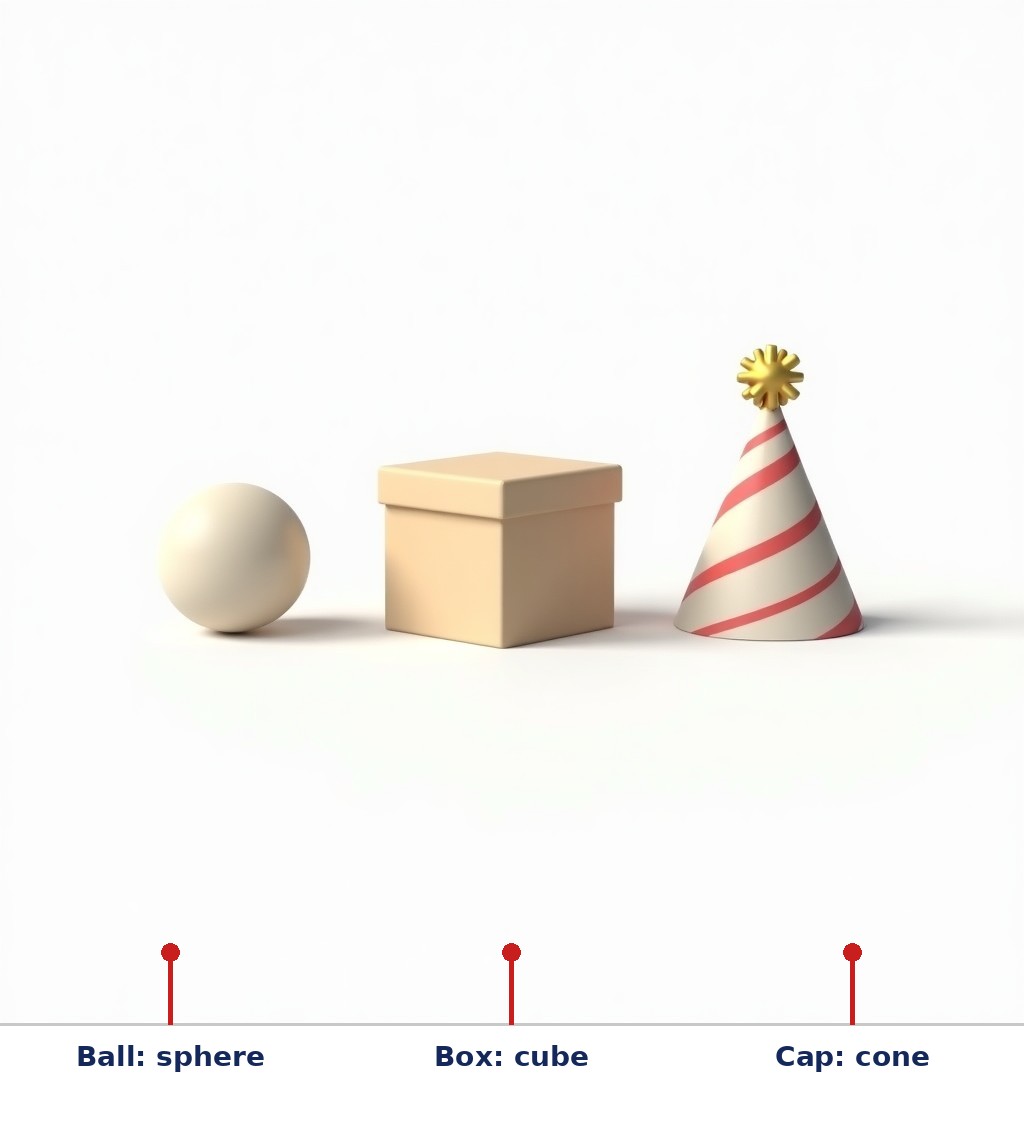
New diagram: Three 3-D shapes you can hold: a ball (sphere), a box (cube) and a party cap (cone). Simplified drawing; the shapes are not shown in real sizes, and flat 2-D shapes are in the first diagram on this page.
4. Making shapes
You can make shapes with sticks, string or paper folds. Try this: take 4 sticks of equal length and join them end to end — you get a square. Now push one corner gently sideways — the shape leans, but it still has 4 equal sides. That leaning shape is called a rhombus. Shapes can bend and stretch, but counting their sides and corners always tells you their name.
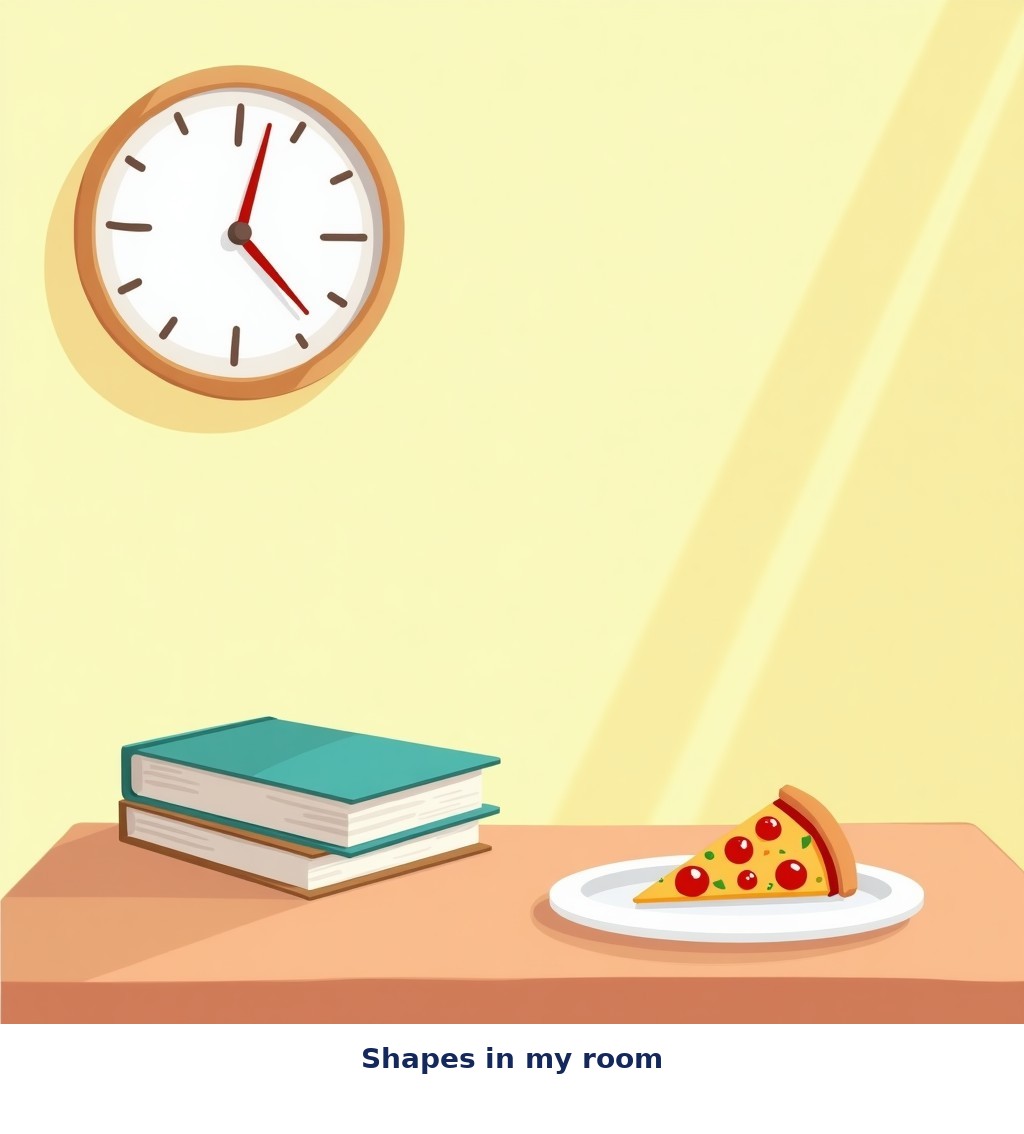
New picture: A room full of shapes to spot: a round clock, a rectangular book and a triangular pizza slice. Simplified picture; it shows examples only, not every shape in the notes.
Key Terms
- 2-D shape — A flat shape you can draw on paper, like a triangle or a circle.
- Side — A straight line that makes part of a shape.
- Corner — The point where two sides of a shape meet.
- Square — A shape with 4 equal sides and 4 corners.
- Rectangle — A shape with 4 sides where opposite sides are equal.
- Cube — A 3-D shape with 6 square faces, like a dice.
- Cuboid — A 3-D shape with 6 rectangular faces, like a box.
- Sphere — A round 3-D shape like a ball.
Remember
- Triangle: 3 sides, 3 corners. Square: 4 equal sides. Rectangle: opposite sides equal. Circle: no sides, no corners.
- 3-D shapes can be held: cube, cuboid, sphere, cone, cylinder.
- Count sides and corners to name a flat shape.
Exam Tip / Common Mistake
Common mistake: calling every 4-sided shape a square. A square needs all 4 sides equal. If only opposite sides are equal, it is a rectangle. Count the sides before you name the shape.
Practice set — try it yourself
- Draw a shape with 4 sides where all sides are 5 cm. What is it called, and why?
Hint: Hint: Are all four sides equal? - A shape has 3 sides and 3 corners. Name it and give one example from your kitchen.
Hint: Hint: Think of a sandwich cut in half. - A box has 6 rectangular faces. Is it a cube or a cuboid? Why?
Hint: Hint: A cube's faces are squares, not rectangles. - How many sides and corners does a circle have?
Hint: Hint: A circle is made of one curved line. - Ria makes a shape with sides 8 cm, 4 cm, 8 cm, 4 cm. Square or rectangle? Why?
Hint: Hint: Are all sides equal, or only opposite sides?