

Story of English 3: Global English
Original notes — ready Bihar Board — BSEB • Class 11 • English • Book: Rainbow Bhag-1 (Purani pustak — 2025 se pehle wali)
Global English — EG's own notes, in simple English
Book: Rainbow Bhag-1 (Purani pustak — 2025 se pehle wali) (BSEB, Class 11) | Story of English 3 | Type: Story of English
This page carries Educational Galaxy's own original notes — a theme-level summary in simple English, not a copy of the textbook. No official textbook PDF is given here.
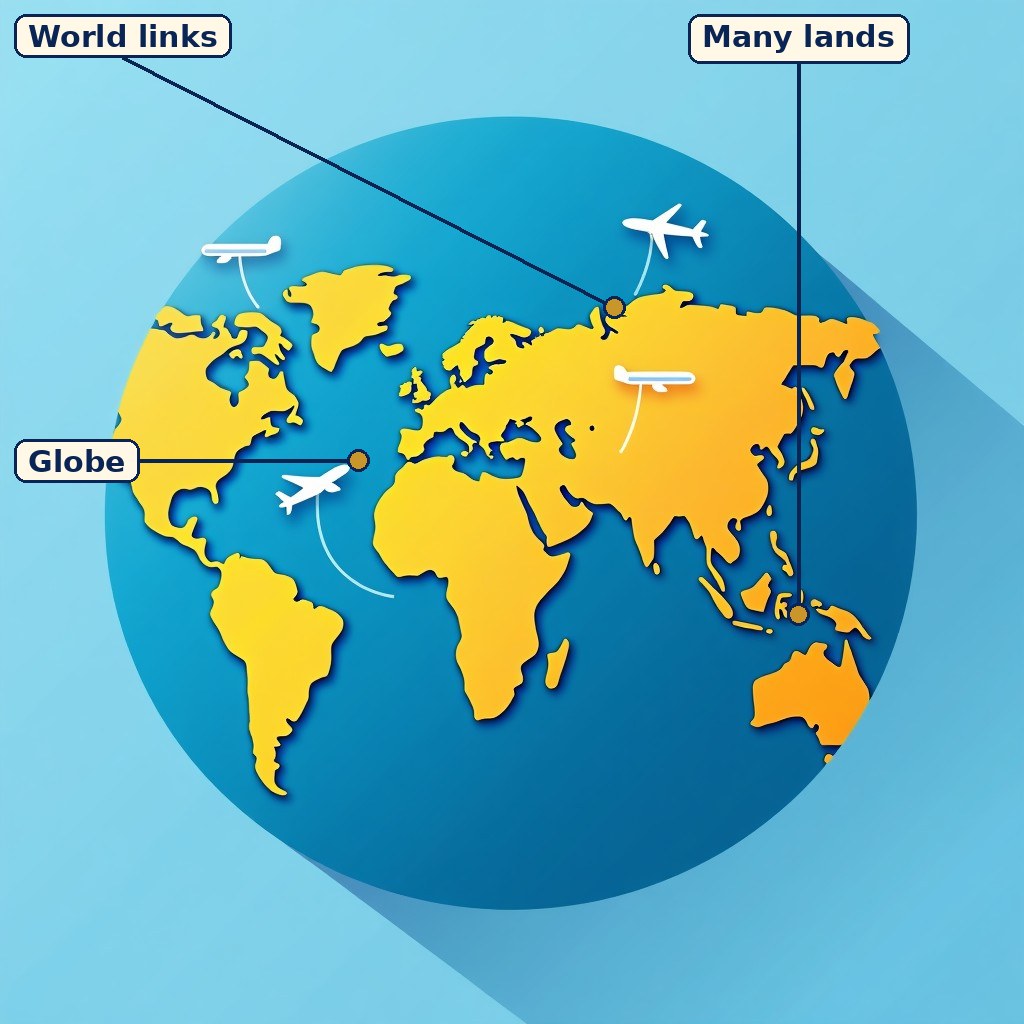
Diagram (labels are printed on the image): A globe with world links — a general picture of English going global, not a book scene.

People of many countries talking in a market — a general picture of a world language in use.
What the chapter is about
English spread across the world with trade, empire, science and now the internet. Today it is a mother tongue in Britain, America, Canada, Australia and elsewhere, a second language in India, Nigeria and Singapore, and a foreign language studied in China, Japan and beyond.
The spread created many Englishes: British and American English differ, and new varieties like Indian English have their own words and patterns. English became, in the chapter's phrase, a gloriously impure language — rich precisely because it borrows everywhere.
What you should learn
English went global by spreading and borrowing — many Englishes, one world language.
Key Terms
- Mother tongue — The first language learnt at home.
- Second language — A language used officially but not first at home.
- Variety — A distinct form of a language.
- Indian English — English as used in India, with its own words.
- Global language — A language used across the world.
Remember
- English spread by trade, empire, science, internet.
- Mother tongue: UK, USA, Canada, Australia, etc.
- Second language: India, Nigeria, Singapore.
- Foreign language: studied in China, Japan, etc.
- Many Englishes exist: British, American, Indian, etc.
Exam Tip / Common Mistake
Common mistake: saying there is one correct English. Global English means MANY varieties, all real.
Chart / Table
| Point | Detail |
|---|---|
| Mother tongue | UK, USA, Canada, Australia |
| Second language | India, Nigeria, Singapore |
| Foreign language | China, Japan, many others |
| Result | Many Englishes, one world tongue |
Practice set (try on your own)
- How did English spread worldwide?
Hint: Think about trade, empire and internet. - Name countries where English is a mother tongue.
Hint: Think about UK, USA, Canada, Australia. - Name countries where it is a second language.
Hint: Think about India, Nigeria, Singapore. - How do British and American English differ?
Hint: Think about words and spelling. - What is Indian English?
Hint: Think about English with Indian words and patterns.
Questions with Answers
- How did English become global?
Through trade, the British Empire, science, technology and now the internet, which carried it to every continent. - Where is English a mother tongue, a second language, and a foreign language?
Mother tongue in the UK, USA, Canada, Australia and others; second language in India, Nigeria, Singapore; foreign language studied in China, Japan and many other countries. - What are 'many Englishes'?
Distinct national varieties — British, American, Canadian, Australian, Indian, Nigerian — each with its own words, sounds and patterns. - Why is English called 'gloriously impure'?
Because it borrows words from Latin, French, Spanish, Italian and many other languages. Its impurity is its richness. - What does Global English mean for Indian students?
That their Indian English is a real, living variety. They should learn standard forms while valuing their own English identity.
How to use this page: First read the summary, say the key terms in your own words, then try the practice set without looking. Finally check yourself with the questions and answers. Get your answers checked by your teacher or parents.