

Prose 12: Exceptional Role of Newspapers in Development
Original notes — ready Bihar Board — BSEB • Class 11 • English • Book: Rainbow Bhag-1 (Purani pustak — 2025 se pehle wali)
Exceptional Role of Newspapers in Development — EG's own notes, in simple English
Book: Rainbow Bhag-1 (Purani pustak — 2025 se pehle wali) (BSEB, Class 11) | Prose 12 | Type: Prose | Author: K. R. Narayanan
This page carries Educational Galaxy's own original notes — a theme-level summary in simple English, not a copy of the textbook. No official textbook PDF is given here.

Diagram (labels are printed on the image): People reading newspapers at a stall — a general picture of the press reaching citizens, not a book scene.
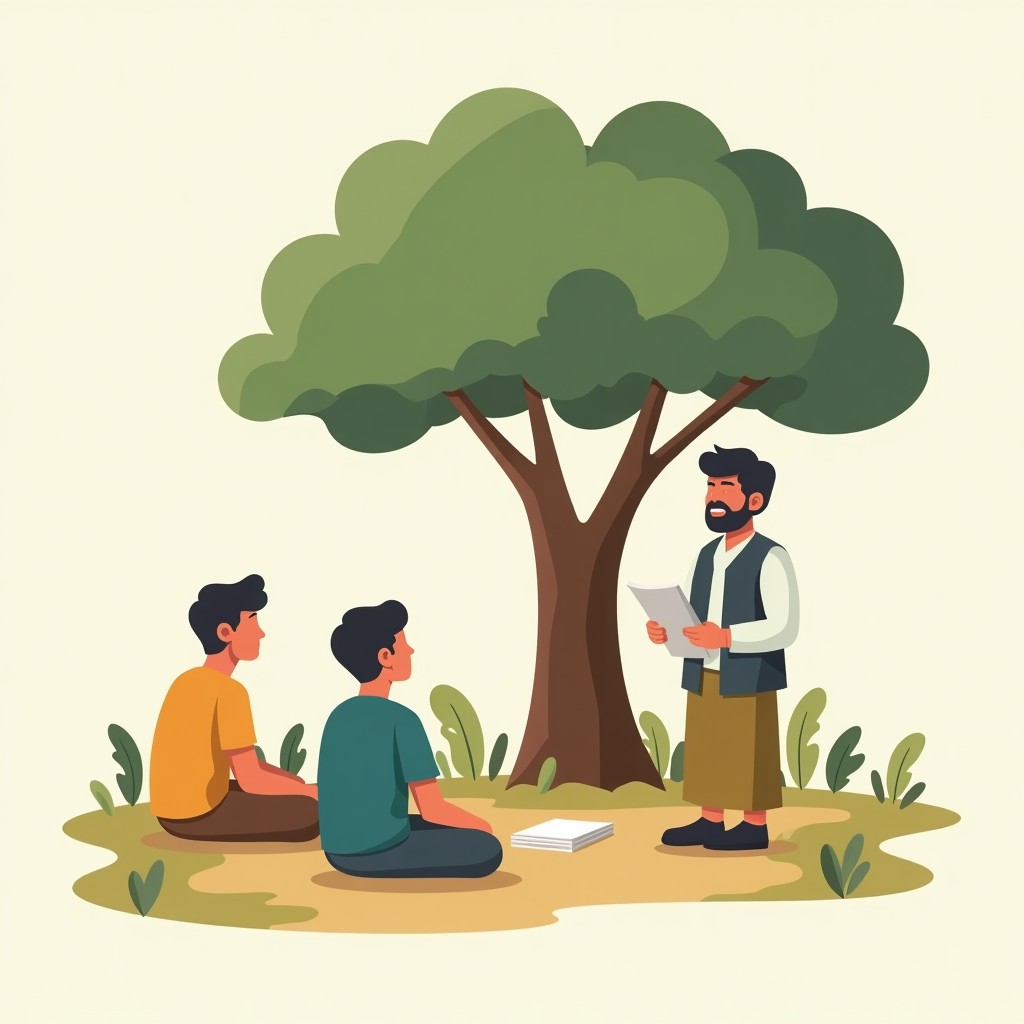
A man reading aloud under a tree — a general picture of news reaching a village.
What the chapter is about
Narayanan explains that newspapers do far more than carry news. They inform citizens, spread new ideas about health, farming and education, and give a voice to the poor and the remote. In a developing country, that information is power.
A free and responsible press also checks power: it questions rulers, exposes wrongs and keeps democracy honest. But freedom needs responsibility — truth, fairness and care for the public good. Newspapers develop a nation by developing its people's minds.
What you should learn
A free, truthful press develops a nation by informing citizens and keeping power honest.
Key Terms
- Press — Newspapers and journalism as a whole.
- Development — Growth towards a better life for all.
- Democracy — Rule by the people through free choice.
- Accountability — Being answerable for one's actions.
- Public opinion — The shared views of the people.
Remember
- Newspapers inform citizens about health, farming and education.
- They give a voice to the poor and remote.
- They spread new ideas needed for development.
- A free press questions rulers and exposes wrongs.
- Freedom of the press needs truth and responsibility.
Exam Tip / Common Mistake
Common mistake: saying newspapers only give news. Narayanan's point is DEVELOPMENT — information that changes lives.
Chart / Table
| Point | Detail |
|---|---|
| Inform | News, health, farming, education |
| Voice | Poor and remote people heard |
| Check | Power questioned, wrongs exposed |
| Duty | Truth, fairness, public good |
Practice set (try on your own)
- How do newspapers help development?
Hint: Think about information reaching villages. - How do newspapers give voice to the poor?
Hint: Think about problems reaching rulers. - How does a free press keep democracy honest?
Hint: Think about questioning power. - Why must press freedom come with responsibility?
Hint: Think about truth versus rumour. - How can a student use newspapers well?
Hint: Think about reading and checking facts.
Questions with Answers
- What is the exceptional role of newspapers, according to Narayanan?
They do more than report news: they spread useful knowledge, give voice to the voiceless, and guide a developing nation. - How do newspapers help villages and the poor?
By carrying ideas about health, farming and education to remote places, and by bringing villagers' problems to the attention of rulers. - How does the press protect democracy?
By questioning those in power, exposing wrongs and informing public opinion, so rulers stay answerable to the people. - What responsibility comes with press freedom?
Truth, fairness and care for the public good. A press that spreads rumour or hatred harms the very people it should serve. - What is the message for young readers?
Read newspapers critically, value truth, and use information to improve your own life and your community.
How to use this page: First read the summary, say the key terms in your own words, then try the practice set without looking. Finally check yourself with the questions and answers. Get your answers checked by your teacher or parents.